

In the realm of footwear fitting and foot health assessment, the method of measuring feet has evolved significantly over the years. Traditional manual measurement has long been the norm, but the advent of 3D foot measurement technology has brought about a new era in this field. As a supplier of 3D foot measurement solutions, I am well - versed in the numerous advantages that this technology offers over manual measurement.
Precision and Accuracy
One of the most prominent advantages of 3D foot measurement is its unparalleled precision and accuracy. Manual measurement typically relies on a measuring tape or a Brannock device. While these tools can provide a basic understanding of foot length and width, they are limited in capturing the complex three - dimensional shape of the foot.
The human foot is a highly intricate structure, with arches, curves, and unique contours that vary from person to person. Manual measurement often fails to account for these irregularities accurately. For example, when measuring the arch height manually, it is difficult to get an exact reading due to the subjective nature of determining the starting and ending points.
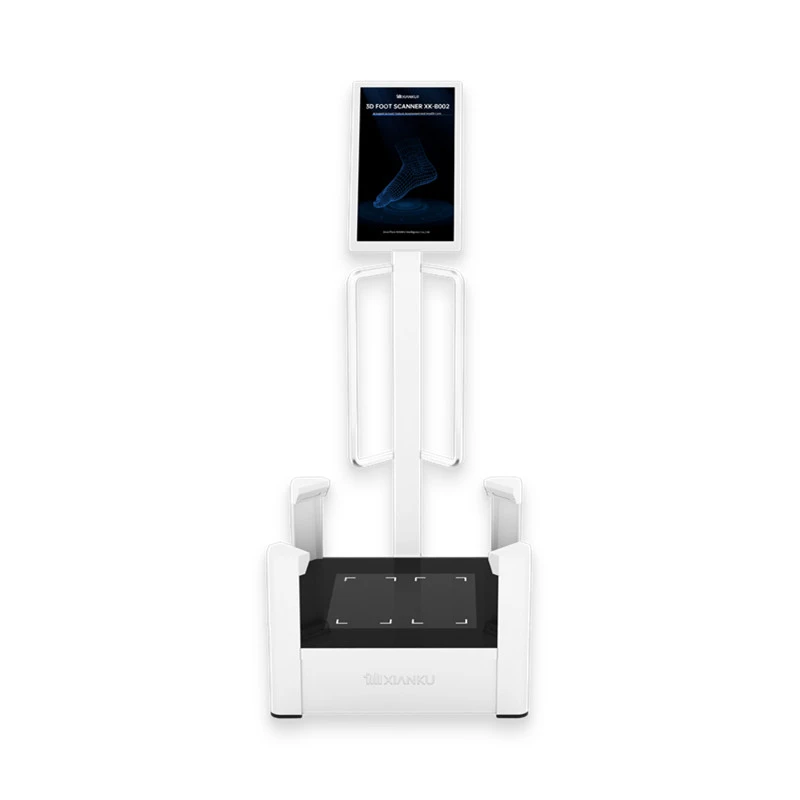
In contrast, 3D foot scanners, such as the Xianku 3D Foot Scanner, use advanced sensors and imaging technology to capture a detailed 3D model of the foot. These scanners can measure multiple parameters simultaneously, including foot length, width, arch height, instep circumference, and even the volume of the foot. The data obtained is highly accurate, with a margin of error that is significantly lower than that of manual measurement. This precision is crucial in industries such as footwear manufacturing, where a perfect fit is essential for customer satisfaction and foot health.
Efficiency and Speed
Time is of the essence in today's fast - paced world, and 3D foot measurement offers a distinct advantage in terms of efficiency and speed. Manual measurement can be a time - consuming process, especially when dealing with a large number of customers or complex foot shapes. The process often involves multiple steps, such as positioning the foot correctly, taking measurements, and recording the data. Any mistakes during this process may require repeating the entire measurement.
On the other hand, 3D foot scanners can complete the measurement in a matter of seconds. The user simply stands on the scanner platform, and the scanner quickly captures all the necessary data. The results are then available immediately, which can significantly reduce the waiting time for customers. This efficiency is not only beneficial for customers but also for businesses, as it allows them to serve more customers in a shorter period, increasing productivity and revenue.

Comprehensive Data Analysis
3D foot measurement provides a wealth of data that goes beyond what can be obtained through manual measurement. In addition to basic dimensions, 3D scanners can analyze the pressure distribution on the foot, which is an important factor in understanding foot function and potential problems. By measuring the pressure points on the foot during standing and walking, podiatrists and footwear designers can gain valuable insights into a person's gait and foot mechanics.
For example, excessive pressure on certain areas of the foot may indicate issues such as flat feet, high arches, or improper foot alignment. This information can be used to design customized orthotics or footwear that can help alleviate pain and prevent further foot problems. Manual measurement, on the other hand, does not provide this level of detailed analysis, as it is mainly focused on external dimensions.
Customization and Personalization
In the era of personalized products, 3D foot measurement plays a crucial role in enabling customization. With the detailed data obtained from a 3D foot scan, footwear manufacturers can create custom - made shoes that fit the individual's foot perfectly. This is a significant improvement over the one - size - fits - all approach that is often associated with mass - produced footwear.
Custom - made shoes not only provide a better fit but also offer enhanced comfort and support. They can be designed to accommodate specific foot conditions, such as bunions, hammertoes, or diabetic foot problems. Manual measurement is limited in its ability to support such customization, as it does not provide the detailed data required to create a truly personalized product.
Consistency and Reproducibility
Another advantage of 3D foot measurement is its consistency and reproducibility. Manual measurement is highly dependent on the skill and experience of the person taking the measurements. Different operators may obtain slightly different results, even when measuring the same foot. This lack of consistency can lead to errors in fitting and product selection.
In contrast, 3D foot scanners follow a standardized measurement process, ensuring that the results are consistent every time. This reproducibility is essential in industries where accurate and consistent data is required, such as medical research and footwear manufacturing. Whether the scan is performed today or a year from now, the results will be comparable, allowing for better tracking of foot changes over time.
Integration with Technology
3D foot measurement technology can be easily integrated with other digital systems, such as computer - aided design (CAD) software and manufacturing equipment. The 3D models obtained from the foot scanner can be directly imported into CAD software, where designers can use the data to create virtual prototypes of shoes or orthotics. This seamless integration streamlines the design and manufacturing process, reducing the time and cost involved in product development.
Furthermore, 3D foot scanners can be connected to databases, allowing for easy storage and retrieval of customer data. This is particularly useful for businesses that offer repeat services or products. For example, a shoe store can store the foot data of its customers, making it easier to recommend the right shoes in future visits. Manual measurement, on the other hand, is more difficult to integrate with digital systems, as the data is often recorded on paper and may require manual entry into a computer.
Improved Customer Experience
Finally, 3D foot measurement offers an improved customer experience. Customers are increasingly looking for personalized and high - quality products, and 3D foot scanning provides a modern and innovative way to meet these expectations. The quick and accurate measurement process, along with the ability to offer customized products, can enhance customer satisfaction and loyalty.
In a retail setting, the use of 3D foot scanners can also create a more engaging and interactive shopping experience. Customers are often fascinated by the technology and are more likely to make a purchase when they feel that the product is tailored to their needs. Manual measurement, on the other hand, may seem outdated and less appealing to modern consumers.
Conclusion
In conclusion, 3D foot measurement offers numerous advantages over manual measurement in terms of precision, efficiency, data analysis, customization, consistency, technology integration, and customer experience. As a supplier of 3D foot measurement solutions, we are committed to providing high - quality products that can help businesses and individuals in the footwear and foot health industries.
If you are interested in exploring the benefits of 3D foot measurement for your business, whether it's a footwear store, a podiatry clinic, or a footwear manufacturing company, we invite you to contact us for a detailed discussion. Our team of experts can provide you with more information about our Xianku 3D Foot Scanner and how it can be integrated into your existing operations. We also offer Xianku 3D Body Scanner and Xianku 3D Body Scanning Room for more comprehensive body measurement needs. Let's work together to take your business to the next level with the latest 3D measurement technology.
References
- "Footwear Biomechanics: Design, Function, and Performance" by Michael Nigg and Ian B. Hamill.
- "Clinical Biomechanics of the Foot and Ankle" by David S. F. Chan and Peter C. Amis.
- Industry reports on the latest trends in foot measurement technology.