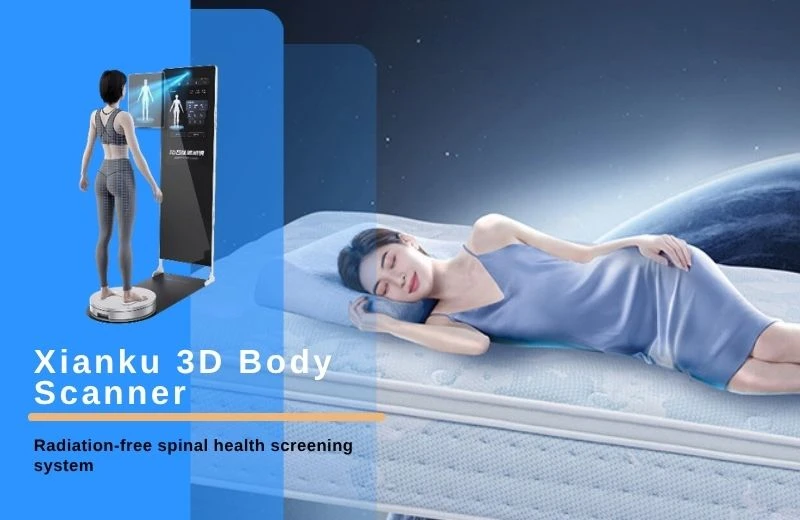
In the premium bedding industry, selling a mattress is no longer just about materials, firmness, or thickness.
Consumers are increasingly asking a more important question:
Is this mattress actually right for my body and my sleep habits?
This shift has created a new opportunity for bedding brands to move beyond traditional product sales and build personalized sleep solutions.
DeRUCCI, one of the well-known Chinese sleep and bedding brands, provides an interesting example of this transformation. Instead of positioning itself simply as a mattress manufacturer, the brand has increasingly connected its products with sleep health, ergonomics, personalization, and technology.
So, what can other bedding brands learn from DeRUCCI's strategy?

1. From Selling Mattresses to Providing Sleep Solutions
Traditional mattress marketing often focuses on product specifications:
- Mattress firmness
- Foam materials
- Spring systems
- Thickness
- Breathability
- Durability
These features are important, but they don't necessarily answer the customer's biggest concern:
"Will this mattress work for me?"
DeRUCCI's broader sleep-focused positioning reflects a different approach.
Instead of treating the mattress as an isolated product, the brand connects mattresses with pillows, beds, sleep environments, and personalized sleep needs.
This changes the customer journey from:
Product → Purchase
to:
Sleep Problem → Assessment → Recommendation → Sleep Product
That is a much more valuable position for a premium bedding brand.
2. Why Personalization Matters in the Bedding Industry
There is no universal "perfect mattress."
People have different:
- Heights
- Body weights
- Shoulder widths
- Body shapes
- Sleeping positions
- Spinal alignment
- Comfort preferences
A mattress that feels supportive to one person may feel too firm or too soft to someone else.
The same principle applies to pillows.
For example, side sleepers may require different pillow support from back sleepers because the distance between the head, neck, shoulder, and mattress changes according to body structure and sleeping position.
This is why personalization is becoming increasingly important in premium bedding.
Instead of simply asking:
"Which mattress do you want?"
brands can begin asking:
"What kind of support does your body need?"
That is a much more powerful sales conversation.
3. DeRUCCI's Bigger Opportunity: Turning Sleep Into a Measurable Experience
One of the most interesting directions for modern bedding brands is the shift from subjective product selection toward measurable sleep experiences.
Traditionally, customers choose bedding through trial and personal preference:
"This one feels comfortable."
But comfort is subjective and can be difficult to explain.
Technology provides another possibility.
By collecting information about body shape, posture, and physical characteristics, a bedding business can make its recommendations more data-driven.
The customer experience could become:
Measure → Analyze → Recommend → Customize
Instead of simply telling a customer that a mattress or pillow is ergonomic, the business can demonstrate why a particular configuration may be more suitable for that individual.
This creates a stronger sense of personalization and expertise.
4. The Role of 3D Body Scanning in Personalized Bedding
This is where 3D body scanning becomes particularly interesting.
A 3D body scanner can capture the external geometry of a person's body without physical contact. The resulting data can be used to analyze characteristics such as body proportions, posture, and alignment.
For bedding businesses, this creates several potential applications.
Personalized Pillow Recommendations
Body measurements can help determine a more suitable pillow height and support configuration.
Mattress Matching
Body shape and weight distribution can provide additional information when recommending different mattress support levels.
Posture Analysis
A 3D scan can help visualize body alignment and provide customers with a more intuitive understanding of their posture.
Customized Sleep Products
The scan data can potentially become the starting point for personalized pillows, cushions, mattresses, or other sleep-support products.
This creates a new relationship between technology and bedding:
3D Body Data → Sleep Analysis → Product Recommendation → Personalization
5. Why This Can Be More Powerful Than Traditional Product Marketing
Imagine two different mattress stores.
Store A
A salesperson tells the customer:
"This mattress uses high-density memory foam and has seven comfort zones."
Useful information, but the customer still has to decide whether it is suitable for them.
Store B
The customer receives a quick body scan.
The salesperson then explains:
"Based on your body shape and posture, here are the areas where you may need different levels of support."
Suddenly, the product recommendation becomes much more meaningful.
The store is no longer simply selling a mattress.
It is providing a personalized sleep consultation.
This distinction can be particularly valuable in premium retail, where customers are willing to pay more for expertise, customization, and service.
6. Personalization Can Also Create a Stronger Brand Barrier
Materials can be copied.
Product specifications can be compared.
Even product designs can eventually be replicated.
But a complete personalized service system is much harder to copy.
Consider the difference between these two business models:
Traditional Bedding Brand
Product + Marketing + Retail
versus
Personalized Sleep Brand
Data + Analysis + Consultation + Recommendation + Customization + Product
The second model creates more touchpoints with the customer.
It also gives the brand more opportunities to collect useful insights about consumer needs and improve its products and services.
For premium bedding companies, this can become an important competitive advantage.
7. What Other Bedding Brands Can Learn From DeRUCCI
DeRUCCI's development offers several lessons for the broader bedding industry.
Lesson 1: Stop Competing Only on Materials
"Better foam" and "better fabric" are becoming increasingly difficult to differentiate.
Brands should also explain:
Why is this product better for this particular customer?
Lesson 2: Make Personalization Visible
Personalization should not remain a vague marketing claim.
A brand can make the process visible through:
- Body scanning
- Posture analysis
- Sleep assessments
- Personalized reports
- Product recommendations
- Customized manufacturing
The more tangible the personalization process becomes, the easier it is for customers to understand its value.
Lesson 3: Turn Technology Into a Retail Experience
Technology should not exist only behind the scenes.
A 3D body scan can become part of the customer journey itself.
A customer walks into a bedding store, completes a short scan, receives a visual analysis, and then gets personalized recommendations.
That creates a completely different retail experience from simply lying on several mattresses and choosing the one that "feels good."
Lesson 4: Sell the Solution, Not Just the Product
The future of premium bedding may not be about selling:
"A better mattress."
It may be about selling:
"A better sleep solution for you."
That shift creates room for higher-value services, customized products, and long-term customer relationships.
8. Where Is Personalized Bedding Going Next?
The evolution of bedding can be viewed as a gradual shift:
Standard Bedding
↓
Ergonomic Bedding
↓
Personalized Bedding
↓
Data-Driven Sleep Solutions
The next generation of bedding businesses may combine multiple technologies into a single workflow:
3D Body Scanning
↓
Body Shape & Posture Analysis
↓
AI-Powered Recommendation
↓
Personalized Pillow or Mattress Specifications
↓
Customized Manufacturing
This approach could make personalized bedding more standardized and scalable.
Instead of relying entirely on the experience of individual salespeople, businesses could use digital measurement and analysis to create a more consistent personalization process across multiple stores.

9. Why This Matters for Bedding Retailers
For bedding retailers, the biggest opportunity may not be selling more products.
It may be increasing the value of every customer interaction.
A customer who simply buys a standard pillow may become a one-time purchaser.
A customer who receives:
Body Scan → Sleep Assessment → Personalized Recommendation → Customized Product
has a reason to engage with the brand on a much deeper level.
The store becomes more than a place to buy bedding.
It becomes a personalized sleep experience center.
That can help brands differentiate themselves in an increasingly competitive market.
Conclusion: The Future of Bedding Is Becoming Personal
DeRUCCI's strategy reflects a broader transformation taking place across the bedding industry.
The traditional question was:
"What kind of mattress do you sell?"
The new question is:
"What kind of sleep solution can you provide for each customer?"
That difference may define the next stage of competition in premium bedding.
As body measurement, 3D scanning, AI analysis, and personalized manufacturing become more accessible, bedding brands will have more opportunities to move from standardized products toward individualized sleep solutions.
The ultimate goal is not simply to sell a mattress or pillow.
It is to understand the person sleeping on it.
Because the future of bedding may not be one-size-fits-all.
It may be one-person, one solution.