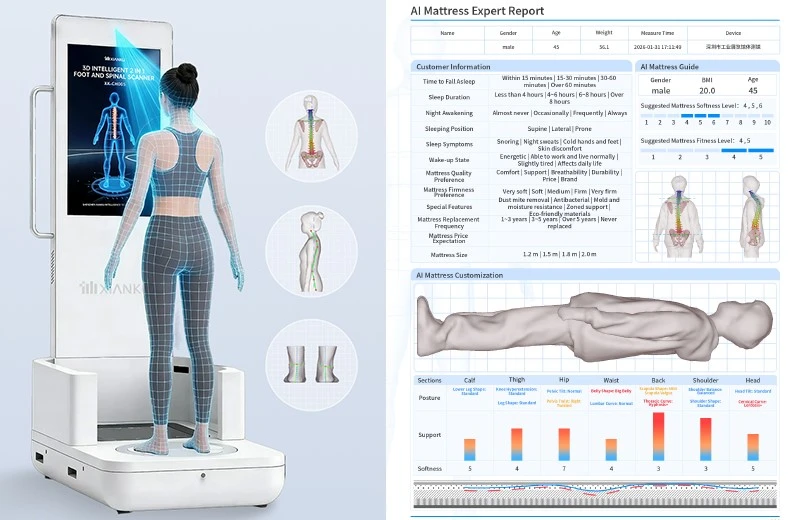
In the time it takes to tie your shoes-roughly 20 seconds-the Xianku 3D Body Scanner captures more data about your body than a personal trainer, a chiropractor, and a tailor could gather in an hour. But how does it work? What makes structured light scanning different from the depth cameras in your smartphone? And why does this technology matter for sleep health?
Let's dive into the engineering behind the world's first AI-powered mattress and pillow selection system.

The Limits of Traditional Measurement
Historically, selecting a mattress involved little more than a tape measure, a weight scale, and a subjective "comfort test." Even in clinical settings, posture assessment often relies on visual observation, goniometers, and manual palpation-methods that are inherently subjective and limited in precision.
Consider what traditional methods miss:
- 3D contour: A tape measure captures circumference but not shape. Two people with the same hip circumference can have completely different hip contours, affecting how they interact with a mattress surface.
- Spinal curvature: Visual assessment cannot quantify the subtle lateral curves (scoliosis) or sagittal imbalances (kyphosis/lordosis) that dramatically impact sleep alignment.
- Asymmetry: High shoulders, pelvic tilt, and rotational imbalances are difficult to measure accurately with manual tools.
- Dynamic relationships: The relationship between shoulder width, hip breadth, and spinal curvature determines ideal sleep support-a calculation too complex for manual methods.
Structured light scanning solves all these limitations.
What Is Structured Light Scanning?
Structured light scanning is a 3D imaging technology that projects a known pattern of light (typically infrared) onto a surface and captures how that pattern deforms. The deformation of the pattern reveals the three-dimensional shape of the object.
The Xianku system uses proprietary structured light modules engineered specifically for human body scanning. Here's how the process works:
Step 1: Pattern Projection
The scanner projects a precise grid of infrared dots onto the user's body. Unlike laser scanners that move a single point across the surface, structured light captures thousands of points simultaneously.
Step 2: Image Capture
High-resolution cameras capture the projected pattern from multiple angles. The system uses two cameras to achieve stereo vision-similar to human binocular vision but with far greater precision.
Step 3: Triangulation
By analyzing how the projected pattern deforms across the body's surface, the system calculates the 3D coordinates of each point. The denser the pattern, the more detailed the reconstruction.
Step 4: Point Cloud Generation
The result is a "point cloud"-a collection of millions of individual 3D coordinates that map the body's surface with millimeter accuracy. Xianku's system generates approximately 2 million point clouds per scan, with a density of 28 points per square centimeter.
Step 5: 3D Reconstruction
Advanced algorithms convert the point cloud into a continuous 3D mesh, creating a 1:1 realistic model of the user's body that can be viewed from any angle.
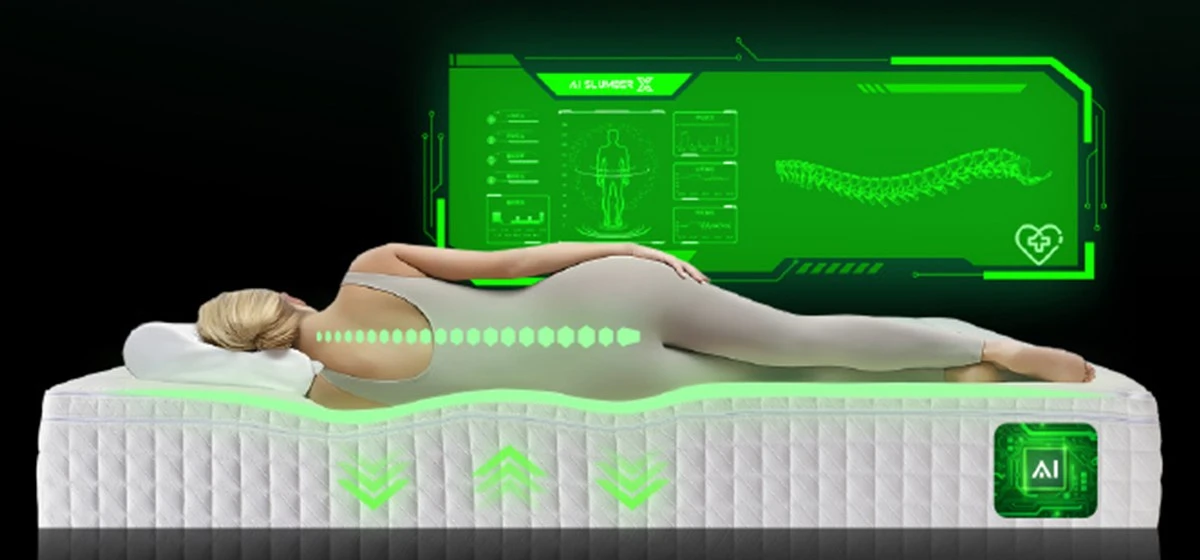
Why 2 Million Points Matter
The density of the point cloud determines the level of detail captured. A low-density scan might capture overall body shape but miss subtle contours that matter for sleep health:
| Feature | Why It Matters for Sleep |
|---|---|
| Shoulder contour | Determines how much a side sleeper's shoulder sinks into the mattress |
| Lumbar curve depth | Dictates required lower back support |
| Hip-to-waist ratio | Affects pelvic alignment in all sleep positions |
| Spinal lateral deviation | Requires asymmetric support for scoliosis patients |
| Cervical curve | Determines optimal pillow height and loft |
With 28 points per square centimeter, Xianku captures these features with sufficient resolution to make clinically meaningful assessments.
The Role of the Turntable
Unlike fixed scanners that require the user to stand in a specific position and rotate, Xianku uses an integrated turntable. This design offers several advantages:
Consistent rotation speed: The turntable rotates at a precisely controlled speed, ensuring uniform coverage and eliminating motion blur.
Optimal measurement distance: The user stands at a fixed distance from the scanner (0.6-0.75m), maintaining ideal focal length throughout the scan.
Full 360° coverage: Combined with the scanner's wide field of view, the turntable ensures complete coverage of all body surfaces, including the back-critical for spinal assessment.
Minimal user movement: The user simply stands still while the turntable rotates. This reduces motion artifacts and ensures scan consistency across different users.
From Raw Data to Biomechanical Insights
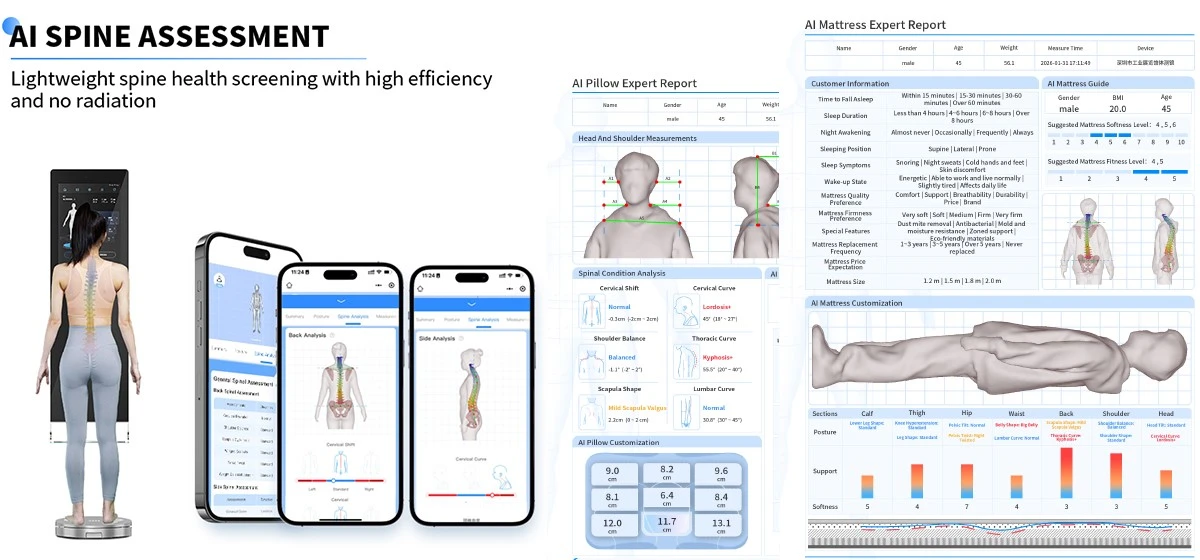
Capturing 2 million points is impressive, but raw point clouds are meaningless without intelligent analysis. This is where Xianku's AI algorithms come into play.
Automatic Landmark Detection
The system automatically identifies anatomical landmarks:
- Acromion (shoulder peak)
- Iliac crest (pelvis)
- C7 vertebra (base of neck)
- PSIS (posterior pelvic landmarks)
- Femoral heads (hip joints)
- Patellae (kneecaps)
Skeletal Reconstruction
Using these landmarks, the AI reconstructs a skeletal model aligned with the body's surface. This is not a generic skeleton scaled to height-it's a personalized skeletal model based on the actual surface contours.
Spinal Curve Analysis
The system extracts the spinal midline from the back surface and calculates:
- Cobb angle for scoliosis detection
- Thoracic kyphosis angle
- Lumbar lordosis angle
- Vertebral rotation indicators
Posture Deviation Quantification
The AI measures deviations from ideal alignment:
- Forward head posture (in degrees)
- Rounded shoulders (in degrees)
- Pelvic tilt (anterior/posterior)
- Shoulder height asymmetry (in millimeters)
- Knee alignment (O/X leg angles)
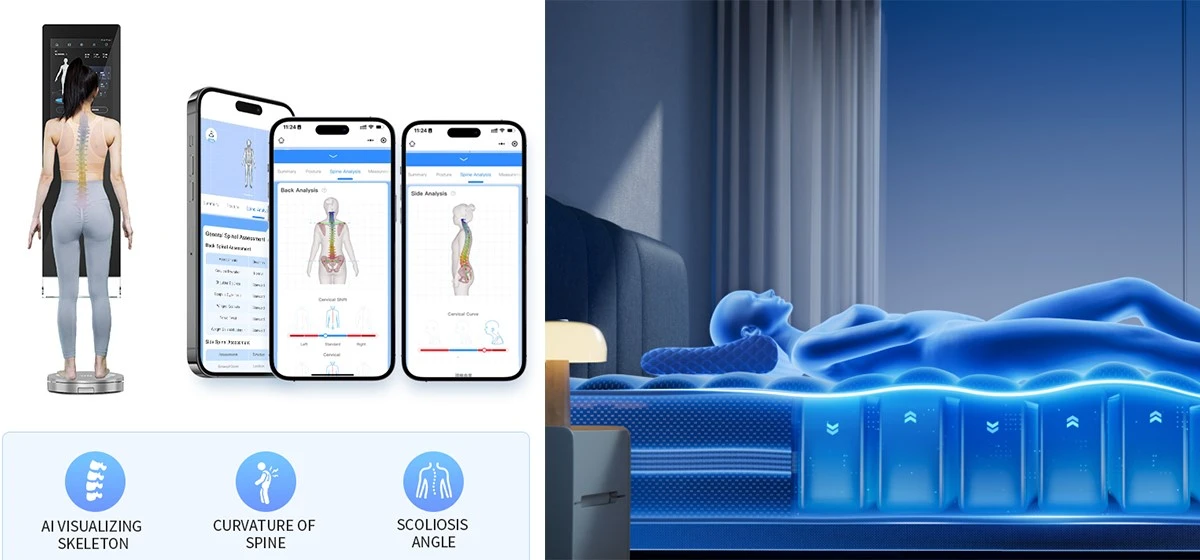
Calibration and Accuracy
For medical and retail applications, accuracy is non-negotiable. Xianku's system undergoes rigorous calibration protocols:
Factory Calibration
Each unit is individually calibrated at the factory using precision targets. Calibration data is stored in the device and referenced during every scan.
Environmental Compensation
The system compensates for ambient lighting conditions, ensuring consistent results in showroom, clinical, or hotel environments.
Self-Verification
During each scan, the system performs real-time quality checks, alerting the operator if positioning or environmental factors could affect accuracy.
The Speed Advantage
Why does speed matter? Consider the real-world application:
In a bedding showroom, customers have limited time and patience. A scanning process that takes several minutes creates friction. A 20-second scan feels effortless-customers are more likely to participate, and staff can process more customers per hour.
In clinical settings, time is money. A 20-second scan replaces 15-20 minutes of manual assessment, allowing practitioners to focus on interpretation and treatment rather than measurement.
In hotel environments, guests expect convenience. A quick, non-intrusive scan at check-in allows for personalized pillow selection without disrupting the guest experience.
Data Privacy and Security
With any body scanning technology, privacy concerns are paramount. Xianku prioritizes data security:
On-Device Processing
All scanning and initial analysis occurs on the device's local hardware. The system does not stream raw scan data to external servers without explicit permission.
Encrypted Storage
Customer data is encrypted at rest and in transit. Access is controlled through the CRM system with role-based permissions.
Compliance
The system is designed to comply with GDPR, CCPA, and other regional privacy regulations. Users receive clear information about how their data will be used and can request deletion at any time.
The Bottom Line
Structured light scanning is not new-it has been used in industrial inspection, automotive design, and medical imaging for years. But applying this technology to sleep health, with the specific requirements of speed, accuracy, and affordability, required years of R&D.
Xianku's achievement is making clinical-grade 3D body scanning practical for everyday use in retail, hospitality, and wellness settings. The result is a system that captures more data in 20 seconds than traditional methods could gather in an hour-and translates that data into actionable sleep solutions.
In our next article, we'll explore how this raw data becomes a complete spinal health assessment, and why understanding your spine is the key to better sleep.