Why Fall Prevention Is Becoming a Strategic Priority in the 2026 Silver Economy
In 2026, the global silver economy is no longer a future concept. It is becoming one of the most urgent health, service, and infrastructure markets in the world.
As the UN Decade of Healthy Ageing 2021–2030 enters its second half, governments, healthcare systems, senior living operators, rehabilitation centers, and community health providers are under increasing pressure to answer one question:
How can we help older adults stay mobile, independent, and safe before a fall happens?
Falls are not minor accidents for older adults. A single fall may lead to hip fracture, hospitalization, loss of independence, long-term fear of walking, and higher care costs. Traditional fall-prevention programs often focus on handrails, home environment modification, vision checks, medication review, and balance training. These are important, but one major factor is still frequently overlooked:
the foot base.
The feet are the body's first point of contact with the ground. When aging changes the shape, stability, and load distribution of the foot, the whole balance system can be affected.

The Missing Link: Aging Feet and Balance Decline
With age, older adults commonly experience changes such as:
- Muscle loss and reduced lower-limb strength
- Ligament laxity and reduced soft-tissue elasticity
- Flattening of the medial longitudinal arch
- Heel valgus or calcaneal valgus
- Reduced toe grip strength
- Slower gait response
- Poorer plantar sensory feedback
- Increased foot pain and fatigue
These changes may appear small at first, but they can gradually reduce postural stability.
For senior care providers, the problem is that traditional physical examinations rarely quantify foot geometry in a fast, standardized, visual, and repeatable way. Many older adults are assessed only after they already show obvious gait instability or after a fall has occurred.
This creates a gap between general elderly health checkups and true biomechanical fall-risk screening.
Why Arch Collapse Matters in Older Adults
Age-related arch collapse is not simply a "flat foot" issue. It can change how the body receives ground reaction force.
When the arch lowers and the heel tilts outward or inward, several biomechanical changes may follow:
- The foot base becomes less stable.
- The ankle may compensate during standing and walking.
- The knee may rotate inward or outward.
- The hip and pelvis may adjust to maintain balance.
- Step width and gait rhythm may become less consistent.
- The risk of stumbling may increase when turning, climbing stairs, or walking on uneven ground.
In senior living communities, rehabilitation centers, physical examination centers, and geriatric clinics, early arch collapse screening can become a practical first step in fall-prevention management.
The goal is not to label every older adult as high-risk. The goal is to identify which residents need:
- Supportive footwear
- Anti-slip walking shoes
- Shock-absorbing insoles
- Medial arch support
- Heel stabilization
- Custom orthotics
- Balance training
- Rehabilitation referral
- Longitudinal follow-up
From Traditional Foot Checks to 3D Foot Geometry Screening
Traditional Model: Observation-Based Screening
Conventional foot checks often rely on:
- Visual inspection
- Manual arch observation
- Basic shoe-size measurement
- Simple gait observation
- Pressure-only testing
- Self-reported pain or instability
These methods are useful but limited. They may not provide a complete 3D understanding of arch height, heel inclination, foot asymmetry, toe shape, or structural changes over time.
New Model: Data-Driven Foot Base Screening
A 3D foot scanning workflow can digitize the elderly foot base in seconds. Instead of asking only "Does the patient feel unstable?", care providers can measure and visualize the structural foundation of balance.
This is where Age-related arch collapse screening and fall prevention via 3D foot scanning becomes highly relevant for the 2026 silver economy.
How XIANKU 3D Foot Scanner Fits the New Fall-Prevention Workflow
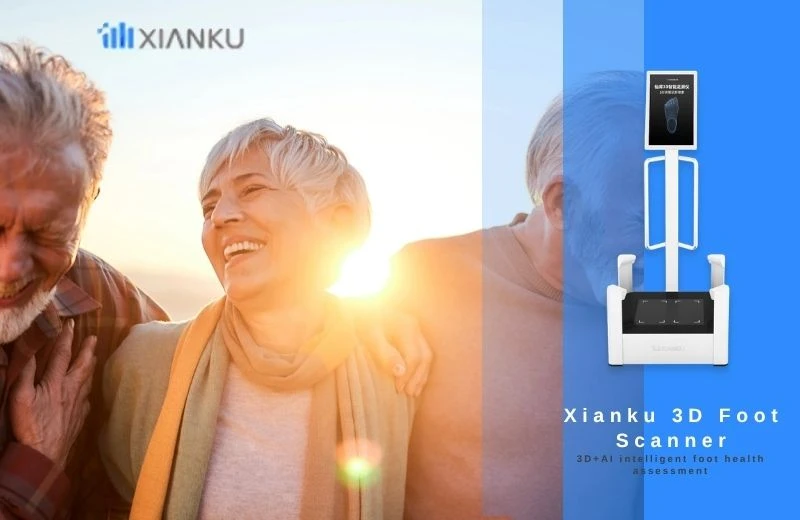
XIANKU 3D Foot Scanner is designed as a 3D+AI intelligent foot health assessment system for clinical, rehabilitation, senior care, and retail health scenarios.
Its value is especially clear in elderly fall-prevention screening because it combines safety, speed, visualization, and AI-based recommendation.
Key Technical Advantages
- 1-second fast scan for both feet
- 5-second report generation
- 30+ / 32+ foot data dimensions
- Millimeter-level accuracy
- 1:1 Realistic 3D human foot models
- non-radiation 3D structured light scan
- Foot arch assessment
- Heel inclination assessment
- Foot width and toe shape assessment
- Hallux valgus assessment
- Pronation and supination evaluation
- Online report and printable PDF report
- AI-powered foot health solutions
- Merchant / institution management backend
For older adults, speed and comfort matter. A slow, complex, or unstable test may reduce willingness to participate. A one-second, non-contact scan is more suitable for community-scale screening.
Why Pure Infrared Structured Light Matters for Elderly Users
Safety is a critical factor in senior care technology adoption.
Older adults may have weaker balance, sensitive eyes, reduced mobility, or anxiety toward unfamiliar medical devices. Compared with traditional laser or photography-based methods, XIANKU uses infrared structured light scanning to create a safe, stable, non-contact measurement experience.
This matters because elderly screening environments require:
- Low physical burden
- No radiation exposure
- Minimal contact
- Fast completion
- Clear visual output
- Easy-to-understand reports
- Staff-friendly operation
- Repeatable data collection
The device structure also includes side support handles, making the scanning process more elderly-friendly for users who may need additional standing stability.

ACA & AHI: Turning Foot Shape into Fall-Risk Intelligence
Aging-related fall prevention cannot depend only on a single shoe size or pressure image. It needs a structured data model.
XIANKU's ACA & AHI logic can support a more precise interpretation of elderly foot degeneration.
AHI: Arch Height Index
AHI helps quantify arch structure and arch collapse tendency. For older adults, this can support:
- Low arch identification
- Severe arch collapse classification
- Left-right arch asymmetry comparison
- Longitudinal monitoring of arch degeneration
- Matching of arch-support products
ACA: Arch Collapse Assessment
ACA can be positioned as a practical screening logic for measuring how much the foot base has structurally changed with age. It can help senior care operators and clinics classify users into different risk-management pathways.
For example:
- Mild arch decline: footwear guidance and preventive insole support
- Moderate arch collapse: arch-support insole and balance training
- Severe collapse with heel valgus: professional orthotic evaluation
- Asymmetrical degeneration: follow-up screening and rehabilitation referral
Heel Inclination Angle
Heel inclination is essential for identifying calcaneal valgus or rearfoot instability. When combined with AHI and ACA, it can help providers understand whether the older adult's foot base is still stable enough for daily walking.
Recommended Screening Workflow for Senior Care and Rehab Centers
Step 1: Community Intake Scan
Older adults complete a 1-second scan during check-in, annual health assessment, rehabilitation intake, or community wellness events.
Step 2: Digital Foot Base Report
The system generates a visual report including:
- 1:1 realistic 3D foot model
- Foot length and width
- Arch assessment
- Heel inclination assessment
- Foot type classification
- Left-right comparison
- Foot health indicators
Step 3: Fall-Risk Support Mapping
The care provider uses the report to identify potential foot-base risks:
- Arch collapse
- Heel valgus
- Severe pronation
- Forefoot deformity
- Asymmetry
- Foot pain-related support needs
Step 4: AI-Powered Solution Recommendation
Based on the data, the system can recommend:
- Supportive walking shoes
- Anti-slip elderly footwear
- Shock-absorbing insoles
- Arch-support insoles
- Heel-cup stabilization
- 3D printed custom orthotics
- Rehabilitation or podiatry referral
Step 5: Longitudinal Monitoring
Older adults can be rescanned every 3–6 months to track structural changes and evaluate whether footwear, insoles, or rehabilitation support is improving stability.

Business Value for the 2026 Silver Economy
For senior care communities, rehabilitation centers, and elderly health screening providers, 3D foot scanning creates both clinical and commercial value.
For Smart Senior Living Communities
- Build digital foot health archives for residents
- Identify high-risk users earlier
- Improve fall-prevention service quality
- Create visible health-management reports
- Support family communication with clear data
For Rehabilitation Centers
- Add foot-base screening to balance assessment
- Improve orthotic recommendation accuracy
- Track rehabilitation progress
- Support post-fall recovery programs
- Build a repeatable assessment SOP
For Footwear and Orthotic Providers
- Match elderly users with better-fitting shoes and insoles
- Reduce trial-and-error product selection
- Offer personalized orthotic pathways
- Improve trust through visual 3D evidence
- Build long-term customer data assets
The Strategic Shift: From Fall Response to Fall Prediction
The future of elderly care is not only about reacting after a fall. It is about identifying hidden risk before instability becomes injury.
In this transition, foot-base screening deserves a more important role.
Age-related arch collapse, heel valgus, and foot asymmetry are measurable. Once they are measurable, they can become manageable.
XIANKU 3D Foot Scanner helps turn the elderly foot from an ignored body part into a digital indicator of mobility, balance, and fall-prevention risk.
For the 2026 silver economy, this is not just a foot measurement device. It is a practical infrastructure tool for safer aging.
Q&A: Age-related Arch Collapse Screening and Fall Prevention via 3D Foot Scanning
Q1: Why is foot scanning important for elderly fall prevention?
Because the feet are the foundation of standing and walking balance. Arch collapse, heel valgus, foot pain, and foot asymmetry can reduce stability and increase fall risk.
Q2: What is AHI in elderly foot screening?
AHI stands for Arch Height Index. It helps quantify the height and structure of the foot arch, making it useful for identifying age-related arch collapse.
Q3: What is calcaneal valgus?
Calcaneal valgus refers to abnormal heel alignment, often seen when the heel tilts outward. It may affect ankle stability, gait balance, and lower-limb alignment.
Q4: Is 3D structured light scanning safe for older adults?
Yes. XIANKU uses non-radiation 3D structured light scanning. It is non-contact, fast, stable, and suitable for elderly users who need a low-burden assessment experience.
Q5: Can 3D foot scanning replace medical diagnosis?
No. It should be used as a screening and decision-support tool. For severe pain, deformity, instability, neuropathy, or post-fall conditions, professional medical evaluation is still necessary.
Q6: What organizations can use this solution?
It is suitable for senior living communities, rehabilitation centers, foot and spinal clinics, physical examination centers, orthopedic service providers, elderly footwear brands, and smart health screening programs.
Q7: What makes XIANKU different from ordinary foot scanners?
XIANKU combines 1-second scanning, 5-second report generation, millimeter-level accuracy, 1:1 realistic 3D foot models, foot arch assessment, heel inclination assessment, AI-powered recommendations, and digital management backend.