

Frequent ankle sprains are often treated as a simple sports injury or a "weak ankle" problem. But for many people, chronic ankle instability starts much lower-from the structure of the foot itself. A high arch, excessive lateral loading, narrow heel base, poor forefoot support, or shoe last mismatch can all increase the risk of the ankle rolling outward during walking, running, or sudden direction changes.
This is why ankle instability correction and shoe last contour scanning is becoming a critical topic for orthopedic footwear brands, sports shoe manufacturers, custom insole providers, rehabilitation product companies, and foot health service centers.
The foot is the body's foundation. When the foot base is unstable, the ankle must compensate. Over time, this can lead to repeated ankle sprains, lateral foot pain, unstable gait, knee compensation, pelvic imbalance, and reduced confidence during movement.

For B2B providers, the opportunity is clear: by using 3D foot scanning to capture accurate foot base data, businesses can improve ankle instability assessment, redesign shoe last contours, enhance lateral outsole stability, and create more personalized footwear and orthotic solutions.
Xianku's 3D Foot Scanner makes this possible through Infrared structured light technology, 1-second scanning, ±1mm precision, 30+ biomechanical datasets, the proprietary ACA & AHI algorithm, and exportable STL/OBJ 3D models.
Why Habitual Ankle Sprains Are Often Linked to Foot Base Structure
People who frequently sprain their ankles often share certain structural or biomechanical characteristics. While ligament weakness and poor balance control may contribute, the foot base itself is often overlooked.
Common foot-related factors include:
- High arch foot structure
- Excessive lateral weight-bearing
- Narrow heel support area
- Heel varus tendency
- Supination tendency during walking or running
- Poor midfoot contact with the ground
- Unstable forefoot loading
- Poor shoe last matching
- Insufficient lateral support in the outsole or insole
A high arch foot, for example, may have reduced ground contact area and weaker natural shock absorption. The foot may load more heavily on the outer edge, making the ankle more likely to roll outward. In sports, hiking, daily commuting, or unstable surfaces, this lateral instability can increase the chance of repeated sprains.
For footwear and orthotic businesses, solving ankle instability requires more than adding a generic ankle brace. It requires understanding the foot base in three dimensions.
From Ankle Correction to Shoe Last Design: Why Foot Data Matters
The shoe last is the three-dimensional form that defines the internal shape and contour of a shoe. If the last does not match the user's real foot structure, the shoe may fail to stabilize the foot properly.
For people with ankle instability, shoe last contour design should consider:
- Heel width and heel cup geometry
- Forefoot width and toe box shape
- Lateral outsole extension
- Medial-lateral balance of the shoe base
- Instep height and midfoot volume
- Arch height and arch contact area
- Left-right foot asymmetry
- High arch or supinated foot tendency
- The need for lateral stability structures
A shoe that looks supportive from the outside may still fail if the internal last is not compatible with the user's foot morphology. For example, a high arch user with excessive lateral loading may need a shoe last and insole system that improves midfoot contact, stabilizes the heel, and increases lateral base support.
This is where shoe last contour scanning becomes a powerful B2B capability. Instead of designing around average foot shapes, brands can use real 3D foot data to optimize footwear for different biomechanical profiles.
The Limitations of Traditional 2D Foot Scanning and Pressure Mats
Traditional foot assessment methods often rely on 2D footprints, manual measurement, visual inspection, or pressure mats. These methods may be useful for basic screening, but they do not fully capture the complete structure of the foot.
A pressure mat shows where the foot applies pressure. A 2D footprint shows the plantar contact area. But ankle instability correction and shoe last design require more than contact information.
Traditional methods may miss:
- True arch height and arch curvature
- Heel width and heel alignment
- Instep height and midfoot volume
- Forefoot width and toe morphology
- Lateral loading tendency
- Foot circumference and girth
- Left-right structural asymmetry
- 3D foot base contour required for shoe last design
- Exportable files for CAD and 3D printing workflows
For ankle instability, this limitation is significant. The key question is not only "Where does the foot apply pressure?" but also "What foot structure is causing the ankle to become unstable?"
Xianku's 3D full-foot structured light modeling provides the missing answer.
Xianku 3D Foot Scanner: Turning Foot Base Assessment into Digital Product Intelligence
Xianku is a global leader in 3D precise body-sign data operation services, helping footwear, orthotic, rehabilitation, and health service partners transform human foot structure into actionable digital data.
Xianku's 3D Foot Scanner uses advanced Infrared structured light technology to capture the complete external structure of both feet. Compared with traditional laser scanning or pressure mat systems, infrared structured light provides a faster, more comfortable, and more accurate scanning experience.
The system can complete dual-foot 1-second scanning and generate a professional digital report in about 5 seconds. With ±1mm precision, it supports accurate structural measurement for ankle instability assessment, shoe last contour optimization, custom insole design, and 3D printed orthotic production.
Core technical advantages include:
- 1-second scanning for both feet
- Non-contact infrared structured light capture
- ±1mm precision for millimeter-level foot measurement
- 5-second digital report generation
- 1:1 real 3D full-foot model reconstruction
- 30+ biomechanical datasets covering length, width, height, girth, arch, and morphology
- Exportable STL/OBJ 3D models
- Seamless connection with CAD, shoe last design, and 3D printing systems
For B2B partners, this means the scanner is not just a measurement device. It becomes a digital infrastructure for personalized footwear and orthotic product development.
ACA & AHI Algorithm: Better Arch Data for Ankle Stability Analysis
Arch structure plays a major role in ankle stability. High arches often reduce plantar contact area and may increase lateral loading. Low arches may increase pronation and alter knee alignment. In both cases, arch classification must be accurate.
However, traditional arch assessment often relies on plantar contact area. This can be misleading, especially when the foot has severe pronation, supination, high arch geometry, or abnormal heel alignment.
Xianku's proprietary ACA & AHI algorithm provides a more intelligent approach.
ACA stands for Arch Conduction Angle.
AHI stands for Arch Height Index.
The ACA & AHI algorithm combines:
- 3D full-foot model data
- Arch height index
- Arch morphology
- Medial longitudinal arch structure
- Heel-to-midfoot spatial relationship
- Foot posture tendency beyond simple contact area
For ankle instability correction, this is highly valuable. A person with a high arch and lateral loading may need different footwear and insole design than someone with a normal arch but narrow heel support. By combining arch morphology with complete 3D foot structure, the system helps B2B providers make more precise design and recommendation decisions.
30+ Biomechanical Datasets for Shoe Last Contour Optimization
A professional shoe last or custom orthotic design workflow requires more than length and width. It needs a multi-dimensional understanding of foot shape.
Xianku's 3D Foot Scanner outputs 30+ biomechanical datasets, including:
- Foot length
- Foot width
- Forefoot width
- Heel width
- Ball girth
- Foot circumference
- Instep height
- Arch height
- Arch type
- Toe structure
- Heel alignment reference
- Left-right asymmetry
- Foot morphology classification
- Shoe fitting reference
- Custom insole design reference
- Shoe last contour reference
- 3D printing production data
These datasets can help footwear brands and orthotic providers optimize key design elements:
- Wider lateral base for unstable ankles
- More accurate heel cup contour
- Better midfoot support geometry
- Improved forefoot fit
- Higher shoe-last compatibility across foot types
- Custom orthotic matching based on real anatomy
For brands developing shoes for people with ankle instability, hiking shoes, recovery shoes, sports shoes, or orthopedic footwear, this data can improve both product fit and functional performance.
STL/OBJ 3D Models: Connecting Foot Scanning with Shoe Last and Orthotic Design
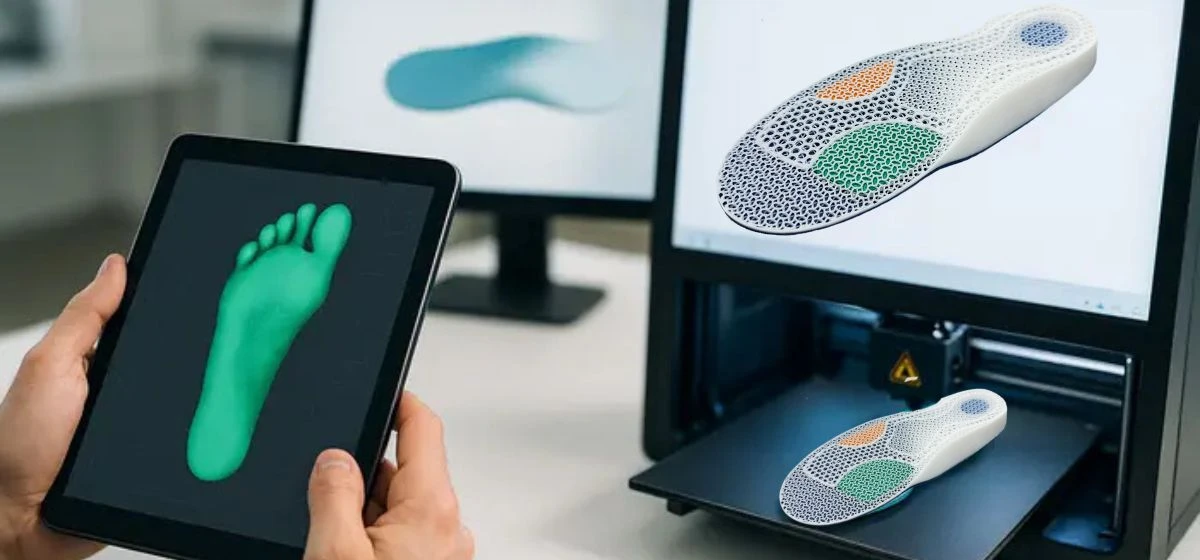
Xianku's scanner outputs true 1:1 full-foot STL/OBJ 3D models, enabling direct connection with CAD design, 3D printing, and digital footwear development systems.
STL/OBJ model export can support:
- Custom shoe last development
- Personalized insole design
- Heel cup and ankle stability product design
- High arch orthotic support
- Lateral support structure design
- Footwear prototype validation
- 3D printed orthotics production
- Digital fitting and customer visualization
This is especially useful for B2B customization providers. Instead of relying on manual measurement sheets or rough foot outlines, designers can work with accurate 3D geometry. This improves efficiency, reduces design uncertainty, and enables scalable personalization.
How 3D Foot Data Helps Correct Ankle Instability
A 3D foot scan does not replace medical diagnosis or rehabilitation treatment. However, it provides structural data that helps identify why the ankle may be unstable and how footwear or orthotic design can better support the foot.
3D assessment may help identify:
- High arch structure linked to reduced shock absorption
- Excessive lateral loading pattern
- Heel varus tendency
- Narrow heel base requiring better heel cup design
- Forefoot width mismatch affecting shoe stability
- Foot asymmetry affecting gait balance
- Poor shoe last compatibility
- Need for custom insole or lateral support design
For habitual ankle sprain users, the goal is not simply to make the shoe harder or add more padding. The better goal is to redesign support based on real foot base geometry.
3D Foot Scanning vs Traditional Foot Assessment for Ankle Instability
|
Assessment Area |
Traditional 2D / Pressure Mat |
Xianku 3D Structured Light Modeling |
|
Data Capture |
Contact area or pressure map |
Full 3D foot structure |
|
Scan Speed |
Varies by method |
1-second scanning |
|
Report Speed |
Manual or device-dependent |
About 5 seconds |
|
Accuracy |
Limited structural measurement |
±1mm precision |
|
Arch Evaluation |
Often contact-area based |
ACA & AHI algorithm |
|
Data Depth |
Basic size or pressure data |
30+ biomechanical datasets |
|
Model Export |
Limited |
STL/OBJ 3D models |
|
Design Application |
Basic reference |
Shoe last contour, custom insoles, 3D printing |
|
Best Use |
General screening |
Ankle instability correction and personalized footwear design |
The core difference is that Xianku's system creates design-ready digital foot assets, not just assessment visuals.

Business Value for Footwear, Orthotic, and Rehabilitation Service Providers
For B2B partners, adding 3D foot scanning is not only a technical upgrade. It is a service model upgrade.
Xianku's 3D Foot Scanner can help businesses:
- Build professional foot health assessment services
- Improve customer trust through visible 3D data
- Support personalized shoe and insole recommendations
- Develop custom shoe lasts based on real foot morphology
- Improve ankle instability product design
- Connect scanning data with CAD and 3D printing workflows
- Reduce reliance on manual measurement
- Create premium consultation and customization packages
- Differentiate from traditional footwear retailers or foot care providers
For brands and service providers targeting ankle instability correction, the ability to visualize and quantify the foot base is a major competitive advantage.
Q&A: Common Questions About Ankle Instability Correction and Shoe Last Contour Scanning
How does a 3D foot scan help ankle instability correction?
A 3D foot scan captures the complete structure of the foot, including arch height, heel width, forefoot width, instep height, and left-right asymmetry. This helps identify structural factors such as high arches, lateral loading, or poor heel support that may contribute to ankle instability.
Why do people with high arches often sprain their ankles?
High arches may reduce ground contact area and shift loading toward the outer edge of the foot. This can make the ankle more likely to roll outward, especially during sports, walking on uneven ground, or sudden direction changes.
How does shoe last contour scanning improve footwear design?
Shoe last contour scanning provides accurate 3D foot shape data that can guide heel cup design, forefoot width, midfoot volume, lateral support, and overall shoe base geometry. This helps footwear brands design shoes that better match real foot structures.
What is the ACA & AHI algorithm?
The ACA & AHI algorithm is Xianku's self-developed arch evaluation method. It combines Arch Conduction Angle, Arch Height Index, 3D full-foot modeling, and arch morphology to provide more reliable arch assessment than traditional contact-area-based methods.
Can STL/OBJ 3D models be used for shoe last development?
Yes. Xianku's scanner exports STL/OBJ 3D models, which can be used in CAD workflows for shoe last design, custom insole development, 3D printed orthotics, and personalized footwear production.
Is a pressure mat enough for ankle instability assessment?
A pressure mat can show plantar pressure distribution, but it cannot fully capture arch height, heel structure, foot volume, forefoot morphology, or complete 3D contour. For ankle instability correction and shoe last design, full 3D foot data is more useful.
How fast is the Xianku 3D Foot Scanner?
The scanner can complete dual-foot 1-second scanning and generate a professional report in about 5 seconds, making it suitable for retail, rehabilitation, orthotic, and footwear customization environments.
Final Takeaway: Ankle Stability Starts with the Foot Base
Habitual ankle sprains are not always caused by the ankle alone. In many cases, they are linked to foot base structure, high arch morphology, lateral loading, heel alignment, and shoe last mismatch.
Ankle instability correction and shoe last contour scanning gives B2B providers a more accurate way to understand these problems and design better solutions. With Xianku's Infrared structured light technology, 1-second scanning, ±1mm precision, proprietary ACA & AHI algorithm, 30+ biomechanical datasets, and exportable STL/OBJ 3D models, businesses can build a complete digital workflow from foot assessment to shoe last design, custom insole development, and 3D printed orthotic production.
For footwear brands, orthotic manufacturers, rehabilitation service providers, and foot health centers, the future of ankle instability correction is not generic support. It is precise, personalized, and powered by real 3D foot data.
Upgrade Your Footwear and Orthotic Services with Xianku 3D Foot Scanner
If your business serves customers with ankle instability, repeated ankle sprains, high arches, or poor shoe fit, Xianku 3D Foot Scanner can help you deliver more professional, personalized, and data-driven services.
Add 1-second 3D foot scanning, 30+ biomechanical datasets, ACA & AHI arch analysis, and STL/OBJ model export to your service workflow-and turn every foot assessment into a foundation for better footwear design, custom orthotics, and long-term customer value.
