In 1895, Daniel David Palmer performed the first chiropractic adjustment on a deaf janitor in Davenport, Iowa. His premise was radical for its time: that misalignments of the spine - which he called subluxations - interfered with the body's innate intelligence and caused disease. Palmer's methods were manual, intuitive, and entirely dependent on the practitioner's trained hands and subjective judgment.
Nearly 130 years later, chiropractic has evolved into a recognized healthcare profession with over 70,000 licensed chiropractors in the United States alone, treating an estimated 35 million Americans annually for everything from acute low back pain to chronic headache disorders. The Council on Chiropractic Education (CCE) now accredits 18 doctoral programs across the country, and chiropractic services are covered by Medicare, Medicaid, most major private insurers, and all 50 state workers' compensation systems.
But one fundamental aspect of chiropractic assessment has remained surprisingly unchanged for most of that century-plus history: the way practitioners evaluate posture and spinal alignment.
That is finally changing. And the change is coming not from Palmer College or from any single chiropractic institution - but from Silicon Valley.

The Postural Assessment Gap in Modern Chiropractic
Walk into the average chiropractic clinic today. The initial patient encounter typically follows a familiar script. A new patient completes intake forms describing their pain, symptoms, and health history. The chiropractor performs a visual postural assessment - asking the patient to stand naturally while the practitioner observes from anterior, posterior, and lateral views, noting any asymmetries in shoulder height, pelvic level, head carriage, and spinal curvature. Then, depending on the practice, palpation, range-of-motion testing, and possibly X-rays follow.
Here is the uncomfortable truth that many chiropractors recognize but seldom discuss openly. Visual postural assessment - the cornerstone of the initial chiropractic evaluation - is highly subjective. A 2021 systematic review published in the Journal of Chiropractic Medicine examined the reliability of visual posture assessment and found that inter-examiner reliability ranged from poor to moderate for most postural parameters. Two experienced chiropractors examining the same patient frequently disagree on the presence or severity of forward head posture, pelvic tilt, and shoulder asymmetry.
Even the chiropractic profession's own research acknowledges this limitation. A 2018 study in the Journal of Manipulative and Physiological Therapeutics evaluated the reliability of postural assessment using digital photography and found that while intrarater reliability (the same clinician measuring twice) was acceptable, interrater reliability between different clinicians was "variable to poor" for several key measurements, including thoracic kyphosis and lumbar lordosis angles.
This subjectivity matters - not because chiropractors are unskilled, but because the human visual system is not designed to reliably detect millimeter-level asymmetries or track subtle changes across multiple visits. Even the most experienced clinician cannot reliably quantify whether a patient's pelvic tilt has improved from 4 degrees to 2 degrees over six weeks of care without objective measurement tools.
The result is a gap between what chiropractors want to achieve - evidence-based, measurable improvements in patient posture and spinal health - and what traditional assessment methods can reliably deliver.
Enter Artificial Intelligence: Pattern Recognition Meets Spinal Health
Artificial intelligence excels at exactly the tasks that human vision struggles with. AI algorithms can analyze thousands of data points in milliseconds, detect patterns that are invisible to the naked eye, and produce consistent, repeatable measurements regardless of who operates the system.
The application of AI to postural assessment was inevitable. Over the past five years, computer vision and machine learning models trained on tens of thousands of annotated postural images have achieved accuracy levels that rival - and in some studies exceed - human expert judgment for specific postural parameters.
A 2024 study published in Frontiers in Bioengineering and Biotechnology evaluated an AI-based posture analysis system against manual goniometric measurements. The AI system demonstrated an intraclass correlation coefficient (ICC) of 0.89–0.97 for key measurements including head tilt, shoulder angle, pelvic obliquity, and knee angle - indicating excellent agreement with ground truth measurements. By comparison, human inter-rater reliability for the same measurements typically falls in the 0.40–0.70 range.
The implications for chiropractic are substantial. AI does not get tired. AI does not have "good days" and "bad days." AI does not unconsciously adjust its assessment based on whether the patient is a new referral or a chronic complainer. When properly trained and validated, AI provides consistent, objective measurements that can be compared across time, across patients, and across practices.
Table 1: Human vs. AI Postural Assessment - A Comparison
| Assessment Parameter | Human Inter-Rater Reliability (ICC)* | AI Model Reliability (ICC) | Advantage |
|---|---|---|---|
| Forward head posture | 0.42 – 0.58 (poor to moderate) | 0.91 – 0.95 | AI |
| Shoulder height asymmetry | 0.55 – 0.68 (moderate) | 0.89 – 0.94 | AI |
| Pelvic tilt (anterior/posterior) | 0.38 – 0.52 (poor) | 0.90 – 0.96 | AI |
| Thoracic kyphosis angle | 0.48 – 0.61 (moderate) | 0.88 – 0.93 | AI |
| Q-angle (knee alignment) | 0.52 – 0.65 (moderate) | 0.92 – 0.97 | AI |
| Scoliosis curve detection (Cobb estimate) | 0.60 – 0.72 (moderate) | 0.89 – 0.95 | AI |
*ICC (Intraclass Correlation Coefficient): <0.50 = poor, 0.50-0.75 = moderate, 0.75-0.90 = good, >0.90 = excellent. Human reliability data synthesized from multiple chiropractic and physical therapy literature sources (2018–2024). AI performance based on 2024 Frontiers in Bioengineering and Biotechnology validation study.
Note: These figures represent general trends across the literature; specific values vary by study methodology and population.
Structured Light Scanning: The Hardware That Makes AI Possible
AI-powered postural assessment requires high-quality input data. Garbage in, garbage out - even the most sophisticated neural network cannot produce reliable output from blurry iPhone photos taken at inconsistent angles and distances.
This is where 3D structured light scanning changes the equation. Unlike traditional photography, which captures a single 2D image from a fixed perspective, structured light scanning projects a pattern of infrared light onto the subject's body surface and uses cameras to measure how the pattern distorts as it conforms to the body's contours. The result is a dense 3D point cloud - typically millions of individual data points - that precisely maps the patient's external anatomy.
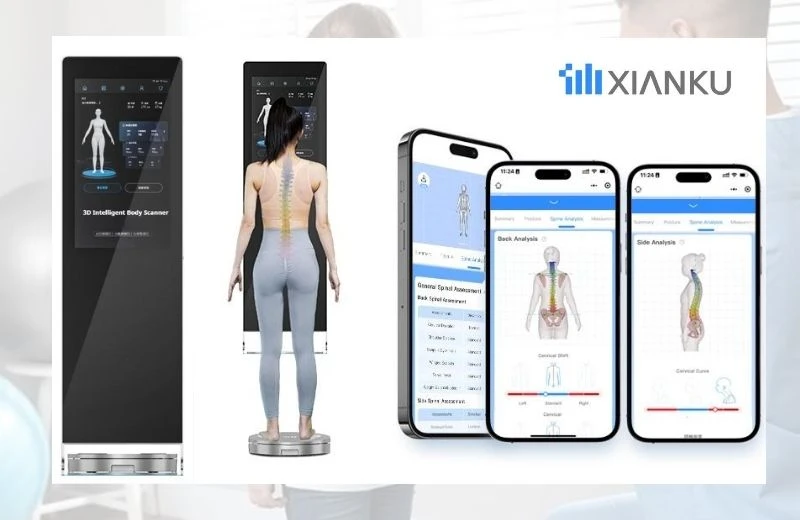
The Xianku 3D Body Scanner uses exactly this technology. Its patented 3D structured light module captures approximately 2 million point cloud data points across the patient's full body in just 20 seconds, with a point cloud density of approximately 28 points per square centimeter. The scanning distance is optimized at 0.6 meters, producing consistent, standardized data regardless of the operator's experience level.
Once the point cloud is captured, proprietary AI algorithms trained on thousands of anonymized spinal and postural datasets analyze the data to produce clinically meaningful outputs. The system identifies 34 anatomical landmarks automatically, then uses those landmarks to calculate over 128 body metrics, including spinal curvature angles, pelvic tilt degrees, shoulder height differentials, and center of gravity coordinates.
The entire process - from patient stepping onto the turntable to seeing their 3D model and postural report - takes under two minutes. Compare that to manual postural assessment, which typically requires 5–10 minutes of examination time plus additional time for documentation and interpretation.
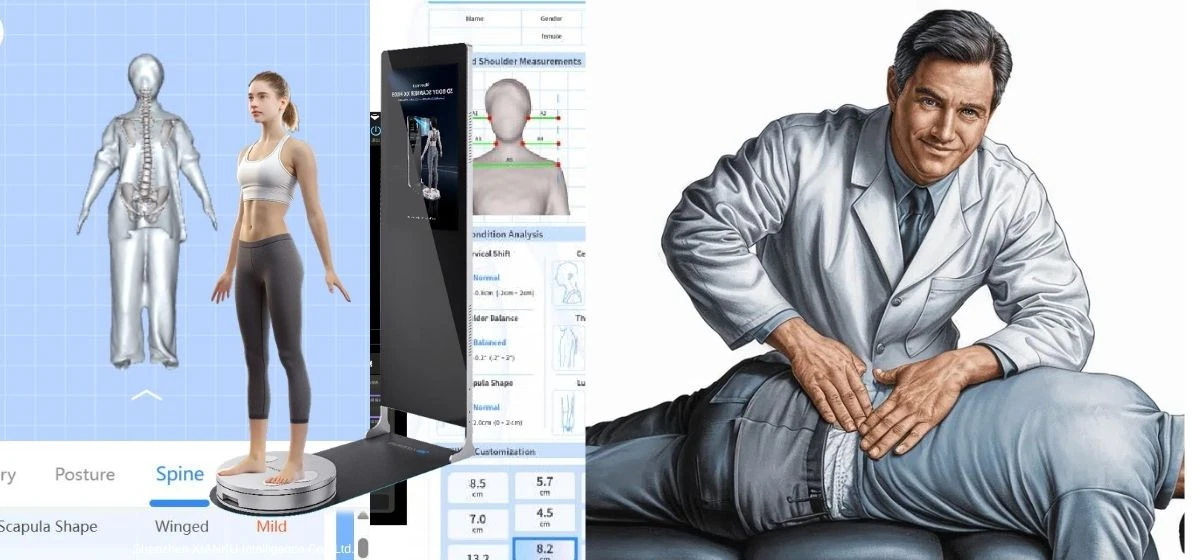
Table 2: Traditional Chiropractic Workflow vs. AI-Enhanced Workflow
| Workflow Step | Traditional Approach | AI-Enhanced (Xianku) Approach |
|---|---|---|
| Postural data collection | 5–10 minutes of visual exam + palpation + goniometer measurements | 20-second 3D scan |
| Measurement objectivity | Subjective; varies by clinician and day | Fully objective; same result regardless of operator |
| Documentation | Handwritten notes or typed descriptions; no permanent visual record | Full 3D model stored digitally; quantifiable metrics for every parameter |
| Progress tracking | Subjective clinical judgment; difficult to compare across months | Side-by-side 3D models with numerical change scores; AI highlights significant changes |
| Patient communication | Verbal description + possibly printed photos with lines drawn | Interactive 720° rotatable 3D model; color-coded asymmetry visualization |
| Time to report | 10–30 minutes (including documentation) | 1 minute (automated report generation) |
Beyond Structure: The AI Skeletal Visualization Advantage
One of the most clinically valuable features of the Xianku system is its AI-generated skeletal visualization. Using machine learning models trained on correlations between external body surface topography and underlying skeletal anatomy, the system generates a visualized skeleton display that approximates the patient's spinal alignment - all without radiation.
This is not a true X-ray. It does not show bone density, vertebral morphology, or subtle bony pathology. But for postural assessment and scoliosis screening purposes, the AI skeletal visualization provides something extraordinarily useful: an instant, intuitive picture of how the patient's spine is positioned in three-dimensional space.
For the chiropractor, this means being able to see - on the very first visit - whether the patient's head sits centered over the pelvis, whether the thoracic spine exhibits excessive kyphosis, and whether a lumbar curve appears to deviate laterally. For the patient, it means finally understanding what the chiropractor has been trying to explain. A parent who sees a color-coded 3D model of their teenager's scoliotic curve - visualized in vivid detail - is far more likely to commit to a bracing and monitoring protocol than one who heard the words "Cobb angle of 24 degrees" without any visual reference point.
The educational value alone is transformative. Chiropractic patients have long struggled to understand what chiropractors do and why it matters. A 2022 survey published in the Journal of Chiropractic Humanities found that while patients generally report satisfaction with chiropractic care, many have only a vague understanding of their diagnosis and treatment plan. Visual, interactive 3D models bridge that gap more effectively than any verbal explanation ever could.
Table 3: Clinical Applications of AI-Powered Postural Assessment in Chiropractic
| Clinical Scenario | Traditional Approach Limitation | Xianku AI-Enhanced Solution |
|---|---|---|
| Adolescent scoliosis screening | Subtle curves (<15°) easily missed on Adam's test | AI detects curves as small as 5°; provides objective baseline for monitoring |
| Chronic low back pain with suspected pelvic asymmetry | Difficult to quantify pelvic tilt reliably; X-ray adds radiation | 20-second scan quantifies pelvic tilt within 1° accuracy; repeatable without radiation |
| Forward head posture / text neck | Visual estimation only; no objective progress measure | AI measures craniovertebral angle; tracks improvement over treatment course |
| Pre- and post-adjustment comparison | Subjective "feels better" or "looks straighter" | Quantitative change scores for 20+ postural parameters |
| Patient who "doesn't feel any different" despite objective improvement | No objective evidence to show patient | Side-by-side 3D models demonstrating measurable postural change |

From Palmer's Hands to AI's Eyes
D.D. Palmer could not have imagined a 3D structured light scanner or an AI neural network. But Palmer's fundamental insight - that spinal alignment and posture are central to human health - has only been validated by a century of clinical experience and research.
What has changed is not the importance of postural assessment, but the tools available to perform it. Palmer relied on his hands, his eyes, and his clinical intuition. Today's chiropractors have access to technology that captures millions of data points, analyzes them with pattern recognition algorithms trained on thousands of cases, and produces objective, reproducible measurements in seconds.
The transition from Palmer's hands to AI's eyes does not diminish the chiropractor's role. It enhances it. The chiropractor remains the clinical decision-maker, the therapeutic touch, the caring professional who interprets findings and designs treatment plans. But instead of spending precious clinical time on subjective visual estimates and manual measurements, the chiropractor can devote that time to what matters most: patient communication, adjustment skill, and therapeutic relationship.
AI-powered postural assessment is not coming. It is already here. Chiropractors who adopt it are not replacing their clinical judgment - they are augmenting it with the most powerful pattern recognition technology ever developed.
The future of chiropractic care is not man versus machine. It is man and machine, working together, to achieve what neither could accomplish alone. Palmer gave chiropractic its soul. Silicon Valley is giving it its eyes.