

The Most Valuable Treatment Tool Isn't Always in Your Hands-Sometimes It's What Your Patients Can See
A patient walks into a spine clinic with one simple complaint:
"My back hurts."
They describe the discomfort.
They explain when it started.
They point to where it feels wrong.
The chiropractor, physiotherapist, or massage therapist performs an assessment, identifies possible causes, and begins a treatment plan.
But after the appointment, one question often remains in the patient's mind:
"How do I know this is actually working?"
This question is not a lack of trust in the practitioner.
It is a natural human response.
Patients want to understand their bodies.
They want to know what is changing.
They want evidence that the time, effort, and money they invest in treatment are leading them in the right direction.
For decades, healthcare has relied heavily on professional expertise.
Doctors observe.
Practitioners evaluate.
Patients trust.
But modern healthcare is entering a new era.
Patients no longer want only answers.
They want understanding.
They want participation.
Most importantly:
They want to see their progress.
The future of patient care is moving from:
"Trust me."
to:
"Let me show you."

The Hidden Challenge in Every Clinic: Building Patient Trust
Trust has always been the foundation of healthcare.
A patient must trust that their practitioner understands their condition.
They must trust the recommended treatment.
They must trust that improvement is possible.
But building trust can be challenging when the problem itself is invisible.
Many musculoskeletal conditions do not have obvious external signs.
A patient may experience:
- Neck discomfort
- Lower back pain
- Shoulder tension
- Uneven posture
- Limited mobility
However, what is happening inside the body's structure may not be immediately visible.
A patient cannot always see:
- Forward head posture
- Shoulder imbalance
- Pelvic asymmetry
- Spinal alignment changes
- Body compensation patterns
They only feel the symptoms.
The practitioner understands the underlying patterns.
This creates a communication gap.
The professional sees the problem.
The patient feels the problem.
But they may not always see the same thing.
And when people cannot see something, it becomes harder to fully understand it.
Why "Feeling Better" Is Sometimes Not Enough
Many rehabilitation and wellness treatments rely on gradual improvement.
Unlike medication that may create a noticeable short-term change, posture correction, chiropractic care, and physical therapy often require consistency over time.
Progress may happen slowly.
A patient's muscles become more balanced.
Their posture gradually improves.
Their movement patterns change.
Their body adapts.
But because these changes happen over weeks or months, patients may struggle to recognize them.
A patient might say:
"I feel better, but I'm not sure what's different."
Or:
"How do I know the treatment is really helping?"
This moment is critical.
Because perception influences commitment.
When patients understand their progress, they are more likely to:
- Continue treatment plans
- Follow professional recommendations
- Stay engaged in recovery
- Develop confidence in their practitioner
The challenge is finding a better way to communicate improvement.
The Power of Visual Evidence in Healthcare
Humans understand visual information quickly.
A patient may not fully understand a technical explanation about spinal alignment, posture compensation, or biomechanical changes.
But when they can see a clear comparison, everything changes.
A visual before-and-after assessment can transform an abstract concept into something meaningful.
Instead of saying:
"Your posture has improved."
A practitioner can demonstrate:
"Here is where your body started, and here is how it has changed."
This creates a completely different patient experience.
The conversation changes from:
"Do you believe me?"
to:
"Now you can see it yourself."

The Limitation of Traditional Posture Assessment
Traditional assessments remain valuable.
Experienced practitioners can identify many physical patterns through observation, movement tests, and hands-on evaluation.
However, traditional approaches often have limitations.
Human observation is subjective.
Manual measurements can vary.
Photographs only capture two-dimensional images.
Small changes over time can be difficult to track consistently.
For a clinic managing many patients, maintaining objective records of progress can become challenging.
Modern healthcare is increasingly moving toward measurable, data-driven approaches.
Not because professional expertise is becoming less important.
But because technology can help professionals communicate their expertise more effectively.
Turning the Human Body Into Understandable Data
This is where 3D Body Scanning creates a new opportunity.
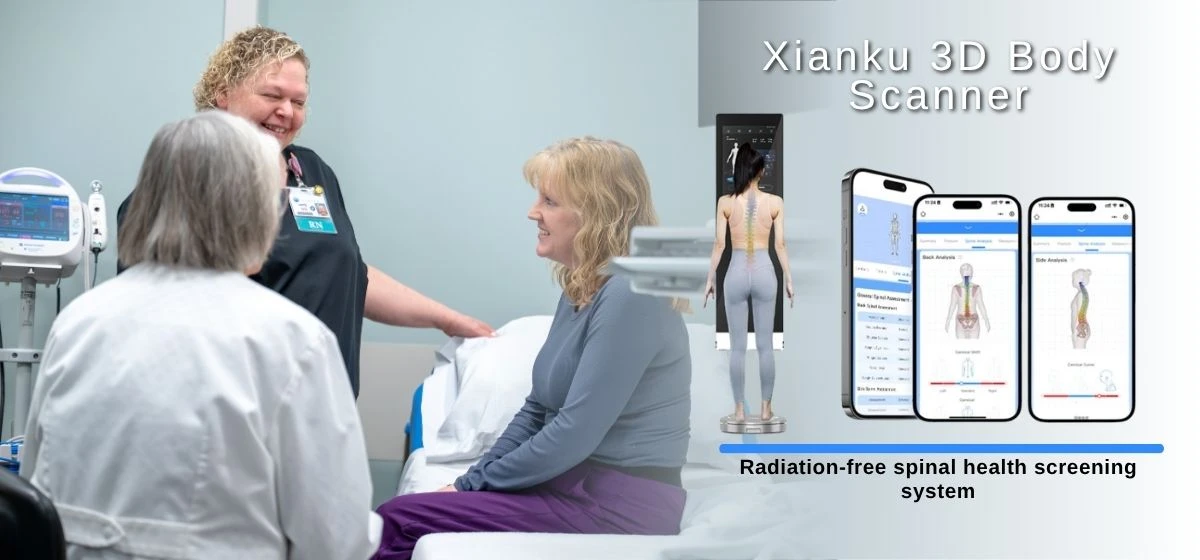
A 3D Body Scanner captures the external shape and alignment of the human body, creating a digital representation that allows practitioners and patients to better understand physical structure.
Instead of relying only on descriptions or visual guesses, clinics can analyze measurable information related to:
- Body symmetry
- Shoulder alignment
- Postural balance
- Body proportions
- Spinal positioning
- Movement-related patterns
The goal is not to replace clinical judgment.
The goal is to enhance communication.
A scan becomes a bridge between professional knowledge and patient understanding.
A Better Patient Experience Starts With Better Communication
For spine clinics, massage clinics, and rehabilitation centers, the patient journey is not only about treatment.
It is also about education.
Patients who understand their condition are more engaged.
Patients who see their progress are more confident.
Patients who trust the process are more likely to continue their recovery journey.
A 3D Body Scanner becomes more than a measurement device.
It becomes a communication tool.
It allows practitioners to explain:
Why a patient may experience discomfort
What areas require attention
How posture changes over time
Whether treatment goals are being achieved
The technology helps transform a complex physical condition into something patients can understand.
The Future Clinic Will Not Just Treat Patients-It Will Show Them Progress
Healthcare is becoming more transparent.
Patients today expect more information, more involvement, and more personalized experiences.
The clinics that succeed in the future will not only provide excellent treatment.
They will help patients understand their own bodies.
The relationship between practitioner and patient is changing.
The future is not:
"Trust me because I am the expert."
The future is:
"Trust me because together, we can see the evidence."
From chiropractic care to massage therapy and physical rehabilitation, 3D Body Scanning represents a new way to connect expertise with transparency.
Because the strongest patient relationships are not built on promises.
They are built on understanding.
And sometimes, the most powerful words a practitioner can say are not:
"Trust me."
They are:
"Let me show you."
