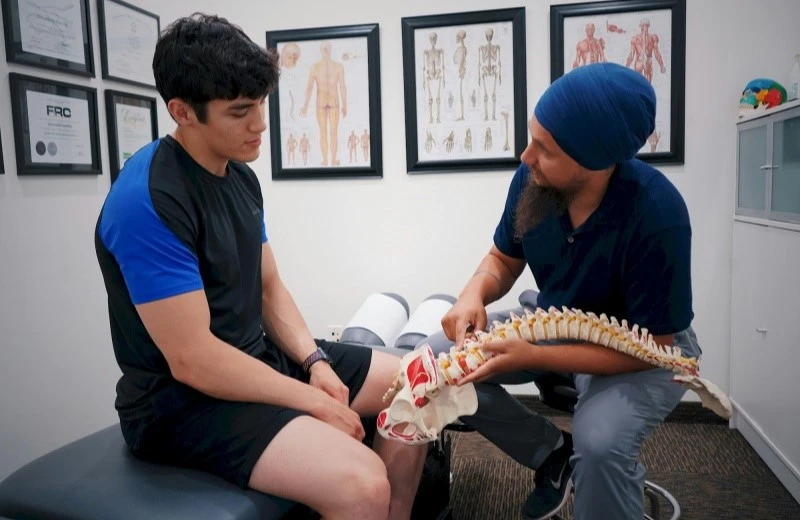
Every chiropractor knows the feeling. A parent brings in a teenager who looks fine standing normally, but when you perform the Adams forward bend test, something catches your eye - a subtle rib hump, a slight asymmetry in the lumbar region. Maybe it is scoliosis. Maybe it is nothing. The only way to be sure is to order X-rays. But X-rays mean radiation exposure, added cost, and a conversation that makes parents nervous.
This scenario plays out thousands of times every week across the United States. And the truth is, the current approach to scoliosis screening is broken.

The Silent Epidemic Hidden in Plain Sight
Adolescent idiopathic scoliosis (AIS) is the most common type of spinal deformity in children over the age of 10 in the United States. According to the Hughston Clinic, an estimated 3 to 5 percent of teenagers are affected, which translates to approximately 6 to 9 million Americans living with scoliosis. When curves exceed 30 degrees, the female-to-male ratio rises to 10 girls for every 1 boy, making adolescent girls a particularly vulnerable population.
Yet despite its widespread prevalence, scoliosis often goes undiagnosed or faces delayed diagnosis. In the United States, fewer than half of states legislate school-based scoliosis screening for children. The result: children with mild, treatable curves are slipping through the cracks, only to be discovered when their conditions have progressed to moderate or severe stages - at which point bracing may no longer be sufficient and surgery becomes the only remaining option.
Dr. Scott J. Luhmann, a pediatric orthopedic surgeon at Shriners Children's St. Louis, describes scoliosis as a "sneaky condition." He notes that "many parents are focused on acute illnesses or injuries, and scoliosis just isn't on their radar unless there is a family history. Often, a curve is first noticed during a trip to the pool, or by a friend or coach. From there, it's important to see a specialist because typically the sooner it's caught, the better our chances of correcting the condition without surgery".
Shriners Children's treats more than 10,000 children with scoliosis each year and performs over 1,000 scoliosis-related surgeries annually. But the problem extends far beyond Shriners' caseload. When chiropractors and primary care providers lack efficient, radiation-free screening tools, the burden falls disproportionately on pediatric orthopedic centers that see patients only after significant progression has already occurred. Shriners has been at the forefront of innovative non-fusion procedures such as vertebral body tethering (VBT) and the minimally invasive ApiFix, which help patients avoid intensive spinal fusion surgery. But innovation in treatment cannot solve the problem of late detection. Early detection remains the true gateway to conservative care.
The Great Screening Debate - And What It Means for You
This raises an urgent question: if scoliosis is this common, why isn't everyone being screened?
The answer lies in a long-standing medical debate. The U.S. Preventive Services Task Force (USPSTF) and the American Academy of Family Physicians (AAFP) currently do not recommend for or against AIS screening in asymptomatic patients, citing concerns about false positives, unnecessary follow-ups, and insufficient evidence of long-term benefit.
But four major spine and pediatric organizations disagree. The American Academy of Orthopaedic Surgeons (AAOS), Scoliosis Research Society (SRS), Pediatric Orthopaedic Society of North America (POSNA), and American Academy of Pediatrics (AAP) issued a joint position statement affirming that scoliosis screening should be part of preventive medical visits - specifically, females at age 10 and 12, and males once at age 13 or 14. The SRS International Task Force likewise recommends screening for Cobb angles above 10 degrees using a scoliometer, with the same age-specific schedule.
So, who is right? Both sides are, depending on the tools you use.
The opposition's concerns are not unfounded. Studies have reported that false positive rates for scoliosis screening can vary dramatically, ranging from 0.8% to 21.5%. When used in isolation, the Adam's forward bend test has shown sensitivity of approximately 84% and specificity of 93%, meaning a meaningful number of cases go undetected - and a meaningful number of healthy children are flagged unnecessarily. False positives lead to unnecessary X-rays, radiation exposure, family anxiety, and wasted clinical resources. However, research indicates that when the Adam's test is combined with scoliometer measurements and other methods, sensitivity can reach as high as 93.8% while achieving a specificity of 99.2%. The takeaway is clear: the screening debate is not about whether to screen, but how to screen well.
The data from real-world screening outcomes is compelling. When a comprehensive county-wide school screening program was discontinued in 2004, researchers observed a 48% decrease in the number of children evaluated for idiopathic scoliosis by pediatric orthopedics. Mean curve magnitude at presentation increased from 20° to 23°, and bracing rates rose from 13.2% to 19%. A Danish study similarly found significantly larger curve magnitudes at referral in non-screened populations compared to screened ones - 22% versus 8% with a Cobb angle greater than 40 degrees, p < 0.001. When caught early, children with smaller curves have more treatment options and better outcomes, including a significantly lower likelihood of requiring surgery.

Why Traditional Assessment Tools Fall Short
For decades, chiropractors have relied on two primary methods: visual postural analysis and radiographic imaging. Both come with significant limitations.
Visual assessment is inherently subjective. One practitioner might note a subtle shoulder elevation while another considers the same finding clinically insignificant. Quantifying subtle changes over time - tracking whether a 5° pelvic tilt improves or worsens across multiple visits - is nearly impossible to do reliably with the naked eye alone. This subjectivity creates two problems.
First, it undermines clinical confidence and diagnostic consistency.
Second, it makes it extraordinarily difficult to communicate findings to patients in a tangible, believable way. A chiropractor can describe a tilted pelvis, but the patient has no visual reference point to understand the severity of their condition.
X-rays, while invaluable for confirming diagnosis and measuring Cobb angle, carry their own set of constraints. They expose patients to ionizing radiation, which limits how frequently they can be used for progress monitoring. They are time-consuming, expensive, and often generate patient anxiety. Furthermore, X-rays reveal internal bony anatomy but do not capture the full picture of functional, weight-bearing posture. A patient lying flat on an X-ray table presents a very different biomechanical profile than the same patient standing naturally during daily activities.
What chiropractors urgently need is a third option - a screening tool that provides objective, quantifiable data without radiation, works in seconds rather than minutes, and produces visual outputs that patients can instantly understand and engage with.
The Data-Driven Solution
The Xianku 3D Body Scanner delivers exactly that. Using patented 3D structured light scanning technology that is completely radiation-free, the device captures over 2 million data points across the patient's entire body in just 20 seconds. Within one minute, a comprehensive report is generated - offering a 1:1 digital twin of the patient's posture and spinal alignment.
The system incorporates advanced AI algorithms trained on an extensive database of anonymized postural and spinal data to assess scoliosis risk, spinal curvature, body center of gravity, and spinal rotation angles. It automatically detects and quantifies 20 distinct physical health parameters across nine body areas - including high and low shoulders, rounded shoulders, pelvic forward or backward tilt, hyperextended knees, and O/X-shaped legs. Beyond scoliosis risk assessment, the AI also generates a visualized skeleton display that makes spinal morphology instantly comprehensible to both practitioner and patient.
From a chiropractic workflow perspective, the scanner transforms the initial patient encounter from a subjective observation into a data-driven assessment. Within moments of meeting a new patient, the chiropractor has objective metrics on pelvic tilt angle, shoulder height differential, head carriage position, and spinal curvature - all presented as a vivid 3D model that the patient can see and understand.
Table 1: Comparison of Scoliosis Screening Approaches for Chiropractic Practices
| Feature | Traditional Visual Assessment | X-Ray Imaging | Xianku 3D Body Scanner |
|---|---|---|---|
| Radiation Exposure | None | Yes (ionizing) | None |
| Screening Time per Patient | 3–5 minutes | 15–20 minutes + radiologist review | 20 seconds scan + 1 minute to report |
| Quantitative Data | Subjective observations | Cobb angle only | 128+ body metrics, 20+ posture assessments |
| Patient Engagement | Low (verbal description) | Moderate (X-ray film) | High (interactive 3D model visualization) |
| Suitable for Frequent Monitoring | Yes (but subjective) | No (radiation limits) | Yes (unlimited, safe) |
| AI Spinal Assessment | No | Limited to radiologist | AI scoliosis risk + visualization |
| Operational Cost per Use | Time cost only | High (equipment, film, radiologist) | Low (one-time equipment cost) |
The clinical implications are profound. For chiropractors specializing in pediatric and adolescent care, the Xianku scanner offers a way to screen broadly and efficiently - catching curves when they are small and treatment is most effective. For general practice chiropractors, it provides an evidence-based entry point into conversations about posture and spinal health, establishing clinical credibility from the very first visit.

What This Means for Your Practice
The U.S. chiropractic market reached 21.9 billion in 2025, with steady annual growth of approximately 2.221.9billion in 2025, with steady annual growth of approximately 2.210 billion by 2034, growing at a CAGR of 7.49%. But growth alone does not guarantee success. In a competitive marketplace, differentiation matters. Patients increasingly expect technology-enabled, data-driven care experiences. Millennial and Gen Z parents - the demographic most likely to bring children in for posture assessment - have grown up with smartphones, wearable devices, and real-time health data. They are not impressed by subjective claims; they want objective evidence.
The Xianku 3D Body Scanner positions your practice at the intersection of cutting-edge technology and genuine clinical value. It is not a gimmick. It is a legitimate diagnostic support tool that complements, rather than replaces, clinical expertise. It provides the objective data you need to make informed decisions and the visual evidence patients need to trust and commit to treatment plans.
Consider the numbers. A typical chiropractic practice might see 10 to 20 new patients per week. If even a fraction of these patients undergo a 3D postural assessment, the practice not only improves diagnostic accuracy but also creates new revenue pathways - from wellness packages and ongoing monitoring to targeted therapeutic interventions for identified conditions.
Table 2: What the Xianku 3D Body Scanner Delivers at Each Patient Encounter
| Assessment Category | Specific Outputs | Clinical Relevance |
|---|---|---|
| Spinal Health | Scoliosis risk assessment, spinal curvature measurement, AI visualized skeleton | Early detection of AIS, bracing candidacy, surgical prevention |
| Postural Analysis (20 metrics) | High/low shoulders, rounded shoulders, pelvic tilt (forward/backward), hunchback, O/X legs | Full-body kinetic chain assessment, targeted adjustment planning |
| Body Symmetry & Balance | Center of gravity assessment, shoulder and pelvic balance | Fall risk identification, imbalance correction strategies |
| Progress Tracking | Before/after comparisons across multiple visits | Objective outcome measurement, patient motivation, treatment validation |
The device's closed-loop system also includes a CRM customer management module that integrates measurement data with patient records, allowing practitioners to track changes over time, monitor treatment efficacy, and follow up with patients systematically. This transforms sporadic visits into longitudinal care relationships - a shift that benefits both clinical outcomes and practice revenue.
The Bottom Line
Scoliosis affects 6 to 9 million Americans, yet the current screening landscape is fragmented, inconsistent, and too reliant on tools that either lack precision or carry radiation risks. The major medical organizations that matter - AAOS, SRS, POSNA, and AAP - have made their position clear: screening has documented benefits for early detection and non-surgical management of AIS.
The question is no longer whether chiropractors should screen for scoliosis. The question is how to screen effectively, efficiently, and safely.
The Xianku 3D Body Scanner provides the answer. Twenty seconds to scan. One minute to a comprehensive report. Zero radiation. One hundred percent objective. Your patients will see the difference. Your practice will feel the difference.
Stop guessing. Start seeing