1 Introduction
Specialty footwear refers to footwear products designed for specific groups or scenarios, such as orthopedic correction shoes, diabetic foot protection shoes, flat foot/ high arch support shoes, customized sports functional shoes, and 3D printed personalized insoles. Unlike standard mass-produced shoes, specialty footwear requires strict matching between the shoe last and the individual foot shape, as well as precise adaptation to foot health conditions such as flat feet, hallux valgus, heel valgus/varus, and plantar fasciitis.
For a long time, the customization of specialty footwear relied on manual measurement, plaster foot molds, and empirical modification, resulting in problems such as long cycles, low precision, unstable consistency, and high costs. With the rise of 3D sensing, big data, and AI technologies, the customization method of specialty footwear has shifted from experience-driven to data-driven, and from workshop-style to digital intelligent production. This iteration not only improves efficiency and precision but also expands the application scope of specialty footwear, enabling large-scale personalized customization in shoe stores, rehabilitation institutions, medical institutions, and sports brands.

This paper systematically combs the three stages of customization methods for specialty footwear, compares the core indicators of different technical routes, and analyzes the application value of advanced 3D foot scanning equipment represented by Xianku in the new customization system.
2 Three Stages in the Iteration of Specialty Footwear Customization
2.1 Traditional Manual Customization (Before 2010)
The earliest customization method of specialty footwear is completely manual, mainly used in traditional shoemaking workshops and small-scale orthopedic institutions.
Core Processes
- Manual measurement with tape measures, calipers, and foot impression boards
- Plaster foot mold turning and manual modification
- Empirical judgment of foot problems by shoemasters or doctors
- Handmade shoe last cutting and leather sewing
Advantages
- High flexibility for extremely special foot shapes
- Low initial equipment investment
- Suitable for small-batch, high-order customization
Disadvantages
- Long cycle: measurement to finished product often takes 7–15 days
- Low precision: human error of 3–5 mm is common
- Poor consistency: different operators lead to different fitting effects
- Difficult data archiving and secondary adjustment
- High labor cost and difficulty in large-scale promotion

2.2 Semi-Automated Mechanical Customization (2010–2018)
With the popularization of CNC machine tools and laser scanning equipment, the customization of specialty footwear has entered the semi-automated stage.
Core Processes
- Laser or probe-type foot measurement
- Computer-aided shoe last design (CAD)
- CNC machining of shoe lasts
- Semi-automated cutting and sewing
Advantages
- Improved precision compared with manual work
- Shortened production cycle to 3–7 days
- Standardized shoe last data to a certain extent
Disadvantages
- Long scanning time (usually more than 20 seconds)
- Incomplete data: mostly limited to sole information, lack of full 3D foot model
- Poor stability, easy to be affected by environment and operation
- Laser has potential visual damage risks
- High equipment cost and complex operation
2.3 Intelligent Digital Customization (2019–Present)
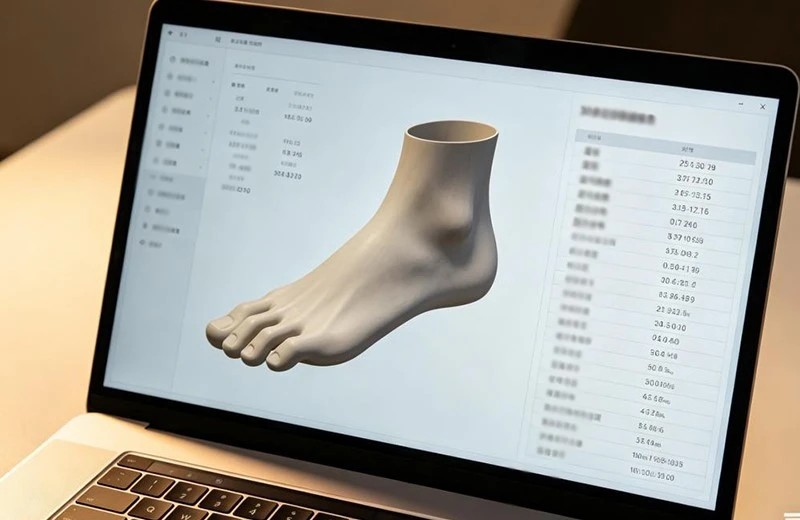
Driven by 3D infrared structured light, AI algorithms, and 3D printing technology, the customization of specialty footwear has entered the era of one-second scanning, five-second reporting, and digital full-chain customization.

Core Processes
- 1-second non-contact 3D infrared structured light scanning
- Automatic generation of 3D foot models and 30+ dimensional foot data
- AI automatic assessment of foot health (flat feet, hallux valgus, heel valgus, etc.)
- Digital foot health archive and intelligent scheme recommendation
- Direct data connection to 3D printing or digital shoe last systems
- Rapid production of customized insoles or functional shoes
Core Advantages
- Millimeter-level precision (±1 mm)
- Ultra-high efficiency: 1-second scanning, 5-second report generation
- Full 3D foot model, comprehensive data coverage
- Non-contact, safe and harmless, no visual risk
- Intelligent interaction, simple operation, suitable for commercial scenarios
- Perfect merchant background and data management system
3 Comparison of Different Customization Methods for Specialty Footwear
The following table compares the core indicators of the three generations of customization methods, highlighting the leapfrog improvement of 3D intelligent scanning customization.
|
Comparison Items |
Traditional Manual Customization |
Semi-Automated Mechanical Customization |
3D Intelligent Digital Customization (Xianku XK-B002) |
|
Scanning/Measurement Method |
Manual measurement + plaster mold |
Laser/probe scanning |
3D infrared structured light |
|
Scanning Time |
5–10 minutes |
20 seconds or more |
About 1 second |
|
Report Generation Time |
Several hours |
Several minutes |
5 seconds |
|
Foot Model Form |
Sole impression / simple sketch |
Partial sole model |
1:1 full real 3D foot model |
|
Measurement Accuracy |
3–5 mm error |
Common precision |
Millimeter level (±1 mm) |
|
Data Volume |
5–8 basic dimensions |
10–15 dimensions |
30+ professional foot data |
|
Safety |
Safe |
Laser may damage vision |
Non-contact, safe and harmless |
|
Foot Health Assessment |
Empirical judgment |
Basic judgment |
AI intelligent assessment |
|
Intelligent Recommendation |
None |
None |
Custom insoles / shoe recommendations |
|
Data Archiving |
Manual records |
Simple storage |
Digital cloud archive |
|
Merchant Management |
None |
Basic |
Complete background system |
|
Application Scenarios |
Small workshops |
Factories / institutions |
Stores, clinics, malls, gyms |
|
Typical Cycle |
7–15 days |
3–7 days |
1–3 days |
4 Core Breakthroughs of 3D Intelligent Scanning in Specialty Footwear Customization
4.1 Full-Dimensional Foot Data Acquisition
The Xianku 3D Foot Scanner XK-B002 can collect more than 30 items of foot data in one scan, including:
- Length: foot length, heel-center length, first metatarsal length
- Width: foot width, heel-center width, metatarsal width
- Height: instep height, medial malleolus height, first metatarsal joint height
- Circumference: toe circumference, instep circumference, heel circumference, ankle circumference
- Arch: medial arch length/height, arch start/peak/end positions
- Health indicators: arch index, hallux valgus angle, heel inclination angle
These data provide a full-data foundation for the customization of orthopedic insoles, functional shoes, and medical correction shoes.
4.2 AI-Driven Foot Health Assessment
The device can automatically identify and assess common foot problems such as flat feet, high arches, hallux valgus, heel valgus/varus, and metatarsal pain, and generate professional foot health reports and rehabilitation suggestions. This enables non-professional staff in shoe stores and shopping malls to provide professional foot health consulting services, greatly expanding the coverage of specialty footwear customization.
4.3 Seamless Connection with 3D Printing and Digital Shoe Lasts
The 3D foot model and data obtained by scanning can be directly imported into 3D printing equipment to produce personalized insoles, or into digital shoe last systems for rapid shoe last design and production. This realizes the full-link digitalization from foot scanning → data analysis → scheme recommendation → product production, and shortens the customization cycle from weeks to 1–3 days.
4.4 Wide Adaptability to Multiple Scenarios
3D intelligent foot scanners are no longer limited to factories or medical institutions, but can be widely deployed in:
- Shoe stores and chain shoe enterprises
- Sports and fitness venues
- Rehabilitation and foot care centers
- Orthopedic medical institutions
- Shopping malls and experience stores
This scenario expansion makes specialty footwear customization accessible to the general public, rather than being limited to a small number of people with special needs.
5 Industry Value and Future Trends
5.1 Industry Value
- Empowering retail transformation: Shoe stores can use 3D scanning for experiential marketing, attracting customers and improving conversion rates.
- Upgrading rehabilitation medicine: Providing accurate data support for foot correction and improving the effect of rehabilitation treatment.
- Reducing costs and increasing efficiency: Reducing manual errors and rework rates, and lowering the threshold for customized production.
- Big data application: Accumulating foot shape big data to optimize product design and industry standards.
5.2 Future Trends
- Deeper integration of AI and customization: AI will automatically generate personalized correction schemes and shoe design plans.
- Wider application of 3D printing: Full-shoe 3D printing will become mainstream, achieving truly personalized customization.
- Mobile and portable scanning: Miniaturized scanners will enter homes, realizing home-based foot health monitoring and customization services.
- Cross-border integration: Foot health data will be connected with spine health, posture assessment, and sports health to build a full-body health ecosystem.
6 Conclusion
The customization method of specialty footwear has completed three important iterations from manual to mechanical and then to digital intelligence. Each iteration is driven by the upgrading of measurement technology and data processing capacity. The emergence of 3D infrared structured light foot scanners represented by Xianku XK-B002 has realized the leap from experience customization to data customization, with significant improvements in speed, precision, safety, and scenario adaptability.
In the future, with the further development of 3D technology, AI, and 3D printing, the customization of specialty footwear will be more intelligent, popular, and precise, bringing more comfortable, healthier, and more personalized shoe-wearing experience to global consumers.