

1. The Muddy Boots and the Limp: A Closing Day Awakening
Last month, like many parents looking to offer their children a tech-free summer of resilience and grit, I sent my 11-year-old son off to a prestigious, four-week sleepaway camp nestled in the rugged woods of Maine. I envisioned pristine lakes, campfires, and endless running across gravel trails, off-grid orienteering routes, and high-intensity dodgeball courts. It was supposed to be the ultimate childhood adventure.
But on Closing Day, my heart sank.
As the campers marched out to greet their parents, my son didn't run toward me. He hobbled. He was noticeably limping, his gait stiffened and awkward. Once we got into the car, he peeled off his heavy, mud-caked, high-top premium European hiking boots-gear that had cost me nearly $200 and boasted top-tier waterproof ratings. He complained of a sharp, burning pain right under his heel every single morning the moment his feet touched the cabin floor.
When I reached inside those rugged-looking boots to inspect the interior, I uncovered a shocking truth. While the exterior of the boot was a tank of heavy-duty rubber and leather, the factory-installed stock insole was nothing but a flimsy, paper-thin strip of flat foam. For a child right in the middle of a massive growth spurt, running miles daily on unforgiving terrain, these boots offered absolutely zero arch support. His developing feet had been taking the brutal, unmitigated impact of the wilderness for thirty days straight.

2. The Invisible Growth Crisis: Sever's Disease and the Descending Kinetic Chain
What I witnessed wasn't just simple muscle soreness. It is an incredibly common, yet widely ignored, "blind spot" for middle-class parents and youth sports directors alike.
During early adolescence and rapid growth spurts, a child's bones often grow faster than their muscles, tendons, and ligaments. This leaves the musculoskeletal system tightly stretched. When subjected to repetitive, high-impact activities on unyielding or uneven ground without anatomical arch support, two major clinical issues arise:
- Sever's Disease (Calcaneal Apophysitis): This is an inflammation of the growth plate in the heel. The tight Achilles tendon pulls directly on the fragile, developing heel bone, made exponentially worse because flat insoles force the heel to absorb 100% of the ground shock.
- Plantar Fasciitis: The continuous flattening of the plantar arch overstretches the connective tissue beneath the foot, causing that classic, agonizing "first steps in the morning" pain.
The Descending Kinetic Chain: A Faulty Foundation
The danger doesn't stop at the ankle. Human biomechanics operate on a kinetic chain where the foot serves as the absolute foundation. When a child's foot lacks proper stabilization, the body is forced to dynamically compensate up the skeleton:
Foot Pronation/Arch Collapse→Internal Tibial Rotation→Pelvic Til
If the foundation collapses inward, the lower leg rotates, forcing the knee to cave (X-shaped legs), tipping the pelvis, and eventually manifesting as functional posture issues like uneven shoulders (high-low shoulders) or even accelerating scoliotic changes (scoliotic posture). By neglecting what goes inside their shoes, we are inadvertently setting our children up for systemic structural imbalances.
3. Demystifying the Solution: XIANKU's AI-Driven 3D Foot Scanning and Custom Printing
Determined to fix my son's alignment, I took him to a specialized pediatric rehabilitation center. Instead of watching a specialist use outdated ink-pads or messy plaster casts, my son stepped onto a sleek, futuristic device: the 1-second 3D foot scanner engineered by global digital health pioneer XIANKU Intelligence.
This cutting-edge hardware completely redefines how we diagnose and treat youth developmental biomechanics through three core technological pillars:
1-Second Infrared Scan ➔ Exclusive ACA & AHI Algorithmic Diagnostics]➔ Seamless OBJ/STL Exporting to 3D Printer
1-Second 3D Foot Scanner: Millimeter-Level Precision
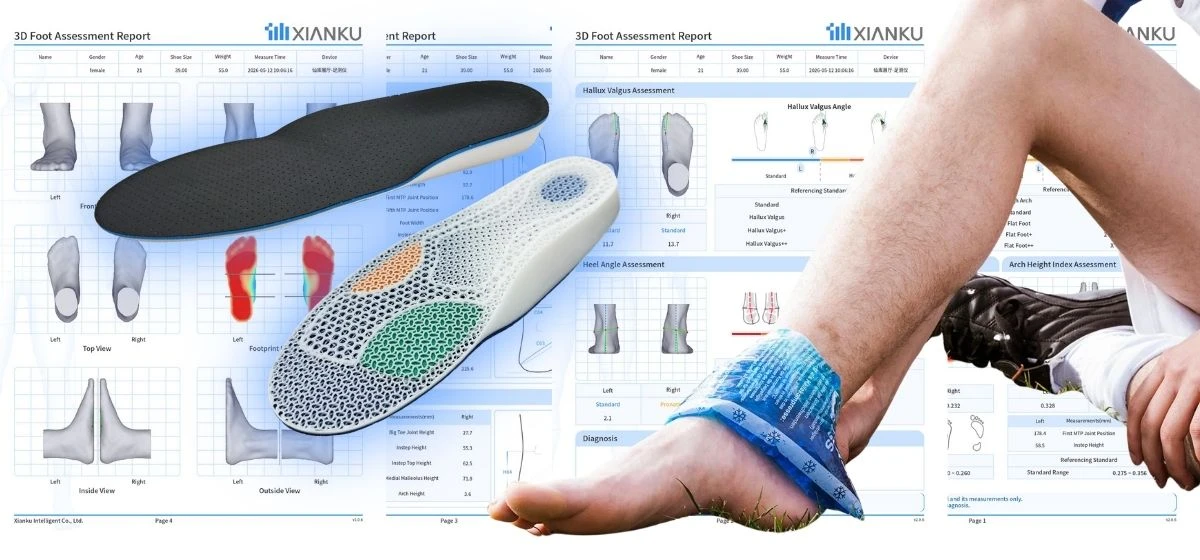
Leveraging advanced 3D infrared structured light scanning technology, the XIANKU scanner captures the full geometry of the foot in just one second. Within 5 seconds, its AI engine automatically generates an exhaustive, multi-dimensional diagnostic report. This isn't just a simple outline; it evaluates exact foot dimensions, digital toe morphology, localized plantar pressure mapping, and precise calcaneal (heel) tilt angles.
Breaking the Blind Spots: Exclusive Arch ACA & AHI Algorithm
Traditional 2D electronic pressure mats frequently misdiagnose pediatric foot conditions. If a child suffers from a severe structural calcaneal varus or valgus (heel inward/outward tilting) but structurally clenches their toes, a 2D mat might read the pressure as normal.
XIANKU solves this with its exclusive arch ACA (Arch Conduction Angle) & AHI (Arch Height Index) algorithm. By measuring the true three-dimensional volumetric height and angle of the medial longitudinal arch under full weight-bearing conditions, it eliminates diagnostic blind spots, catching early-stage flat foot and joint misalignment before they trigger chronic kinetic chain pain.
True Flexible Manufacturing: Seamless OBJ/STL Format Exporting
Once the diagnostic data is locked in, the system features seamless OBJ/STL format exporting. It generates flawless, dense 3D point cloud files that integrate directly with automated orthopedic design software and backend 3D printing flexible manufacturing supply chains.
The result? A pair of medical-grade, highly durable 3D printing insoles customized 1:1 to the exact geometric contours of my son's feet. These insoles utilize variable-density lattices-firm beneath the arch to prevent collapse, yet plush and shock-absorbing beneath his inflamed heel growth plate.
4. The New Frontier of Youth Sports Gear vs. Traditional Footwear
To better visualize why generic shoe inserts fail our children during intense physical activity, let's look at how standard factory setups stack up against XIANKU's AI-driven orthotic ecosystems.
| Diagnostic & Biomechanical Dimension | Traditional Premium Outdoor Boots (Stock Flat Insoles) | XIANKU AI-Driven Custom 3D Printing Insoles |
| Arch Gravity Redistribution | Poor. Gravity concentrates heavily on the heel and first metatarsal head, flattening the foot. | Excellent. Intricately matches the arch profile, distributing weight evenly across the entire plantar surface. |
| Sever's Disease Prevention | None. Chronic micro-trauma to the heel growth plate from repetitive hard trail impacts. | High. Built-in localized heel-cup decoupling and lattice shock-absorption minimize growth-plate strain. |
| Scanning & Customization Accuracy | Generic. Based on static, mass-market shoe sizes that completely ignore individual anatomical asymmetry. | Sub-millimeter. Captured by a 1-second 3D foot scanner for perfect, personalized contouring. |
| Long-Term Athletic Fatigue Relief | Low. Muscles in the foot must work overtime to stabilize the ankle, leading to rapid exhaustion. | Exceptional. Dynamic elastic feedback from the 3D lattice reduces active muscular fatigue during extended movement. |
| Developmental Posture Protection | Passive. Fails to prevent ankle pronation, allowing kinetic chain imbalances to impact knees, pelvis, and spine. | Active. Locks the calcaneus into a neutral alignment, actively stabilizing the body's entire posture from the ground up. |
5. From Personal Recovery to a Billion-Dollar Commercial Blue Ocean
The transformation in my son was nothing short of miraculous. Within two weeks of slipping his custom 3D printing insoles into his everyday sneakers and sports cleats, his morning heel pain completely vanished, his running stride smoothed out, and his overall posture noticeably squared up.
When I shared this journey and the data sheets with his Maine summer camp director, his eyes lit up. He immediately recognized a massive, untapped commercial opportunity. The camp is now looking to integrate a "Camp Physical Therapist + 3D Foot Scanning Screening" protocol into next year's orientation.
This expands the technology far beyond individual consumer use, unlocking a massive multi-billion-dollar commercial blue ocean across several B2B and B2C channels:
Premium Sleepaway Camps & Sports Clubs: Standardizing pre-camp biometric foot screenings as a value-added health service to protect young athletes before intensive training begins.
Elite Private Schools & Sports Academies: Implementing annual 3D foot-and-spine posture screenings to track developmental health alongside regular physical education.
Omnichannel Footwear Retail: Allowing brick-and-mortar shoe stores to utilize the XIANKU scanner as an interactive, high-tech customer experience tool, shifting from selling generic shoes to providing tailored, scan-to-print fit solutions.
6. A Manifesto for the Ground We Stand On
As parents, educators, and coaches, we gladly invest in top-tier sports gear, advanced coaching, and elite summer programs. Yet, we routinely overlook the literal foundation of our children's physical health: the ground they stand on. We look at the rugged exterior of a shoe but ignore the structural void inside. It is time to stop treating youth foot care as an afterthought.
Behind every brave, world-exploring childhood is a pair of tireless, rapidly developing feet. Don't let a lack of structural arch support become the invisible constraint holding your child back. Visit a health center, retail partner, or specialized clinic equipped with a XIANKU 1-second 3D foot scanner today, and leverage advanced 3D printing technology to build the most stable foundation possible for your child's future!

Frequently Asked Questions (Q&A)
Q1: How can I tell if my child's morning heel pain is just regular muscle fatigue or a condition like Sever's Disease?
Muscle fatigue usually goes away with a few days of rest and feels like a dull ache across the entire foot. Sever's Disease localized pain is typically felt as a sharp, burning sensation when squeezing the back sides of the heel bone (the calcaneal growth plate), and it is famously worst during the very first steps in the morning or immediately after intense running. A professional scan using a 1-second 3D foot scanner can accurately assess if an abnormal heel angle or collapsed arch is causing this condition.
Q2: Why can't I just buy an over-the-counter, mass-market orthotic arch support insert for my growing child?
Mass-market inserts are molded to a generic "average" foot shape, but children's feet are highly unique and often asymmetrical. An off-the-shelf insert that is even a few millimeters off can place pressure on the wrong part of a child's developing midfoot, potentially altering their natural gait for the worse. Custom orthotics built via seamless OBJ/STL format exporting ensure the support matches their exact unique anatomy down to the millimeter.
Q3: How often do custom 3D printed insoles need to be replaced as a child grows?
As a general rule for children undergoing active growth spurts, their foot dimensions should be re-evaluated every 6 to 9 months, or whenever they transition up a full shoe size. Because the XIANKU scanning workflow is incredibly fast and entirely digital, updating and printing a newly scaled pair of orthotics to match their changing bone structure is simple, seamless, and highly efficient.
