


The mattress industry stands at a crossroads. For decades, consumers have made one of the most important health-related purchases of their lives based on a simple "lie-down test"-a subjective, five-minute experience that determines how they will sleep for the next 7-10 years. This traditional approach is fundamentally flawed, and the $7.3 billion annual inventory waste problem in the U.S. furniture industry proves it .
Enter the era of data-driven smart mattress selection. The Xianku 3D Body Scanner is transforming how North Americans buy mattresses, shifting the paradigm from subjective "trial and error" to objective "match and recommend."
The Problem with Traditional Mattress Selection
When a customer walks into a mattress store today, the process hasn't changed significantly in decades. They lie on a few mattresses for 3-5 minutes each, maybe test different firmness levels, and make a decision based on how it "feels." A salesperson might ask about sleep position or back pain, but these are subjective inputs that vary dramatically between individuals.
The consequences of this approach are staggering. According to a 2022 report by the Home Furnishings Association, inefficiencies in demand forecasting contribute to an estimated $7.3 billion in excess inventory annually in the U.S. alone, much of which ends up discounted or written off . For online mattress retailers, return rates can reach 5-12%, and return logistics often erase all profit from a sale .
What Is Data-Driven Mattress Selection?
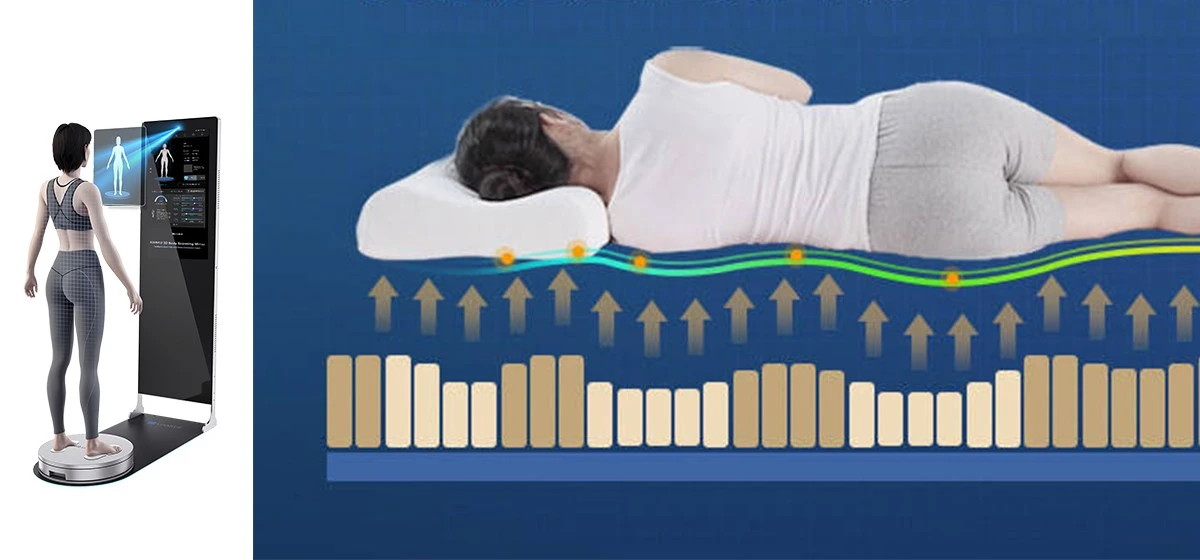
Data-driven mattress selection uses objective biometric data-not subjective feelings-to match customers with their ideal sleep surface. The Xianku 3D Body Scanner captures over 1 million data points in just 20 seconds, creating a precise 1:1 3D avatar of the customer . This isn't just height and weight; it's comprehensive biomechanical data that directly impacts sleep quality.
The scanner measures:
- Spinal Alignment: Cervical, thoracic, and lumbar curvature angles
- Pelvic Tilt: Anterior or posterior rotation that affects spinal alignment during sleep
- Body Pressure Distribution: Areas of concentrated weight and potential pressure points
- Shoulder and Hip Width: Critical dimensions for side sleepers
- Neck Curvature: Essential for pillow height and cervical support
How the Xianku System Works
The Xianku smart mattress selection process follows a simple but powerful workflow:
- Scan: The customer stands on the Xianku 3D Body Scanner for 20 seconds. Infrared structured light technology captures over 2 million data points with millimeter-level accuracy (±0.5mm) .
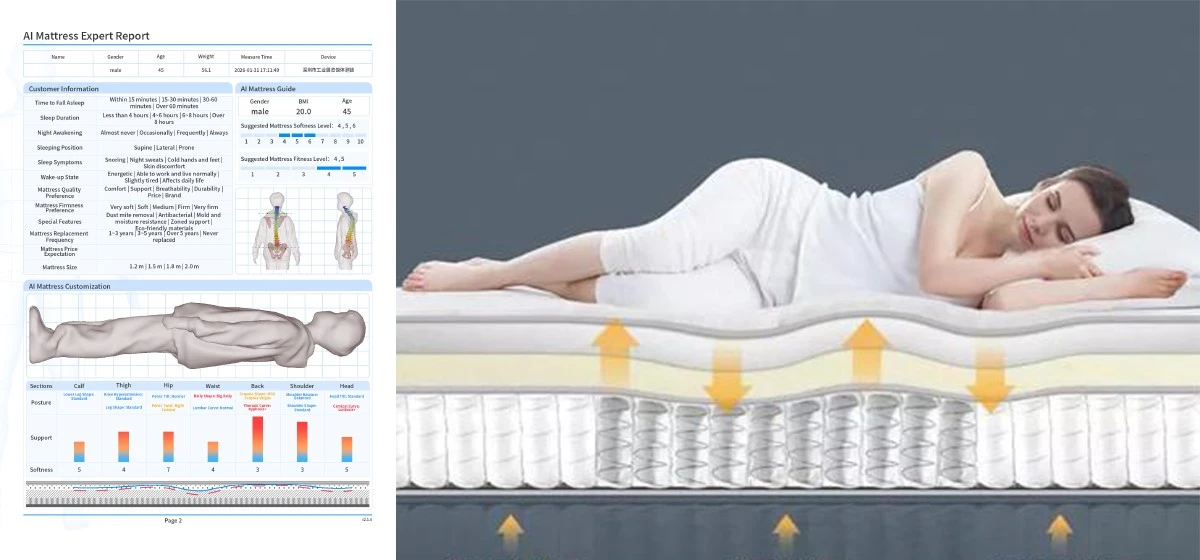
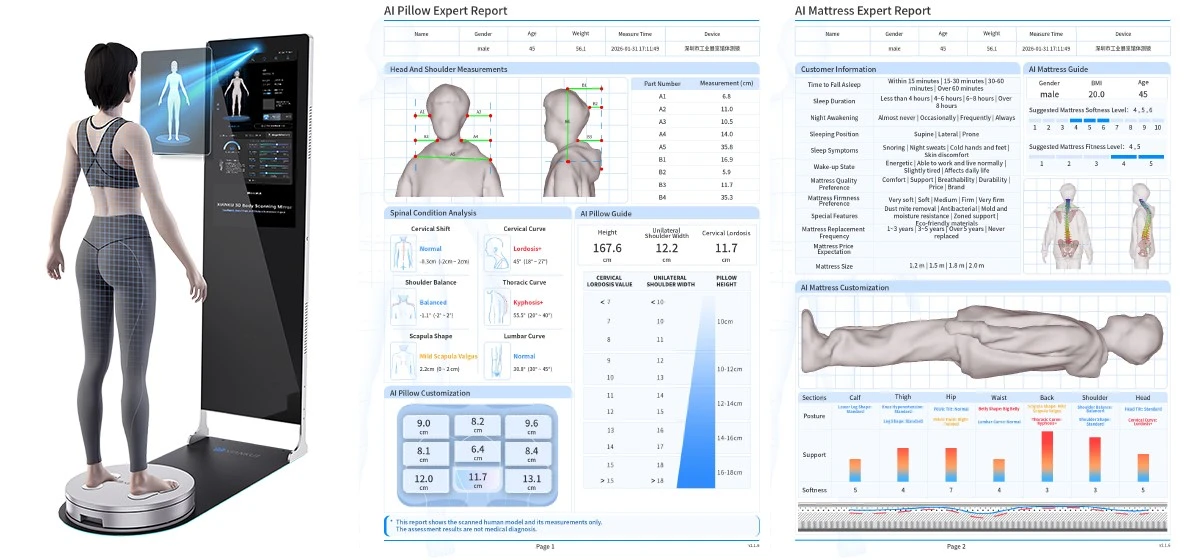
- Analyze: AI algorithms process this data to generate a comprehensive report including spinal curvature analysis, pelvic tilt measurement, and body pressure mapping. The system also incorporates a brief lifestyle questionnaire covering sleep positions, existing pain points, and desk job hours .
- Recommend: The AI executes a Multi-Factor Match Algorithm, cross-referencing the customer's unique physiological map with a proprietary database of product specifications-from the zoning and density of mattress foam layers to the height and fill of pillow loft profiles .
The Science Behind the Match
What makes this approach scientifically superior? The human spine requires different support levels at different points. The lumbar region (lower back) needs firmer support to maintain its natural lordotic curve, while the shoulder area for side sleepers requires slightly softer material to allow proper alignment.
Traditional mattresses take a one-size-fits-all approach. Data-driven selection recognizes that:
- A person with excessive lumbar curvature (hyperlordosis) needs enhanced lower back support
- Someone with a straightened cervical spine requires a contoured pillow to maintain airway alignment
- Individuals with pelvic tilt need calibrated cushioning to prevent spinal rotation during sleep
A 2023 pilot study with retailers in California and Texas using the Xianku system reported a 42% decrease in post-purchase "comfort-related" inquiries and a 28% reduction in mattress returns within the 100-night trial period . For an industry where return logistics can cost hundreds of dollars per transaction, this represents massive profit protection.
The Business Transformation for Retailers
For North American mattress retailers, adopting the Xianku 3D Body Scanner transforms the business model in several ways:
| Business Metric | Traditional Model | With Xianku Scanner |
|---|---|---|
| Customer Engagement | Transactional; focused on price/features | Consultative; focused on personalized health data |
| Sales Conversation | "How does this feel?" | "Based on your spinal data, here's why this mattress supports you" |
| Return Rates | 5-12% for online sales | 28% reduction demonstrated in pilot studies |
| Customer Data Asset | Basic contact info | Rich biomechanical profile enabling lifecycle marketing |
| Competitive Differentiation | Price matching, promotions | Proprietary data-driven personalization |
Case Study: Personalization at Scale
Consider a customer with anterior pelvic tilt-a condition where the pelvis rotates forward, creating lower back stress. A traditional salesperson might never identify this issue. With Xianku, the scanner detects the pelvic orientation and recommends a mattress with enhanced lumbar support zoning. The customer doesn't just buy a mattress; they receive a solution to a problem they may not have fully understood.
This transforms the retail experience from "selling a product" to "offering a diagnostic service." As one industry observer noted, customers are engaged not by a pitch about coil counts, but by a visualization of their own spinal alignment and a clear explanation of how a specific product configuration will address their unique geometry .
Beyond the Sale: Long-Term Value
The initial scan isn't a one-time transaction tool. When a customer's profile is stored in the system, the retailer gains the ability to:
- Send targeted follow-up communications about sleep health
- Notify customers when new products match their body type
- Offer re-scans to track body changes (post-pregnancy, weight loss, aging)
- Create a health-centric brand community akin to wellness ecosystems built by fitness tech companies
The Future of Bedding Retail
As consumers become more educated about sleep health, the expectation for personalization will grow. Tempur-Pedic revolutionized sleep with memory foam, marketing "personalized comfort" through material science. But even this relies on the customer's subjective feel during a brief store lie-down . The next revolution is objective, data-driven matching.
The Xianku 3D Body Scanner makes this level of personalization accessible at scale. It turns the vague promise of "comfort" into a data-verified reality, guiding customers to their perfect match with unparalleled precision. This isn't just about moving inventory faster; it's about building a healthier, more responsive, and deeply loyal relationship with every person who walks through the door .
Conclusion
The mattress industry's stagnation isn't just a business problem-it's a disconnect from the fundamental human need for proper spinal support during one-third of our lives. As trailblazers like Hästens understand with their ultra-luxury, hand-crafted beds, the future belongs to those who offer not just a product, but a personalized sanctuary . The Xianku 3D Body Scanner provides the scientific toolkit to make this level of personalization accessible to every mattress retailer in North America.
Sources:
- Home Furnishings Association Report (2022) on U.S. furniture industry inventory waste
- Xianku 3D Body Scanner pilot study with California and Texas retailers (2023)
- Xianku technical specifications and measurement accuracy data
