

What Robot Failures Reveal About the Extraordinary Engineering of the Human Foot
The audience watched in anticipation.
A humanoid robot stepped onto the stage during a high-profile technology demonstration. Cameras flashed. Engineers smiled. Investors leaned forward.
For a few seconds, everything looked perfect.
The robot walked confidently across the floor, showcasing years of advances in artificial intelligence, machine vision, and motion control.
Then it happened.
A slight shift in weight.
A delayed correction.
A wobble.
And suddenly, the robot collapsed.

Within hours, videos of the incident were circulating across social media. Millions of people watched, laughed, and shared the clip.
But beneath the viral moment lies a fascinating question:
Why is walking so difficult for robots, while humans perform it effortlessly every day?
After all, modern humanoid robots can process enormous amounts of information in real time. Some can recognize faces, understand speech, navigate complex environments, and even perform basic reasoning tasks.
Yet many still struggle with one of the most fundamental human abilities:
Staying upright.
The answer reveals something remarkable about human biology-and explains why foot health may be one of the most overlooked indicators of overall health.
Walking Is One of the Hardest Problems in Robotics
Many robotics engineers describe walking as one of the most complex challenges in modern engineering.
Every step requires the body to perform thousands of calculations involving:
- Balance
- Weight distribution
- Surface detection
- Joint coordination
- Force absorption
- Real-time correction
For a robot, these calculations must be programmed.
For humans, they happen automatically.
Every time you walk, your brain processes sensory information from your eyes, muscles, joints, and feet while continuously adjusting your center of gravity.
The result is a remarkably stable movement system capable of adapting instantly to uneven surfaces, unexpected obstacles, and changing terrain.
What makes this possible?
The answer starts from the ground up.
The Human Foot: Nature's Masterpiece of Engineering
When people think about balance, they often focus on the brain.
But balance actually begins in the feet.
The human foot is one of the most sophisticated biomechanical structures ever created.
Each foot contains:
- 26 bones
- 33 joints
- More than 100 muscles, tendons, and ligaments
Together, these structures form a dynamic support system capable of absorbing impact, maintaining stability, and generating movement.
Unlike a rigid platform, the human foot constantly changes shape during walking.
As the foot contacts the ground, arches compress and expand, muscles activate, and pressure redistributes across multiple regions.
This flexibility allows humans to remain stable even when conditions change unexpectedly.
In contrast, most humanoid robots rely on relatively rigid foot structures with limited adaptability.
Even the most advanced robots often struggle to replicate the natural shock absorption and balance mechanisms that humans perform without conscious thought.
The Secret Is Not Intelligence-It's Feedback
Many people assume robots fall because their artificial intelligence is not advanced enough.
In reality, the problem is often mechanical rather than computational.
Humans possess an extraordinary feedback system.
Thousands of sensory receptors located in the soles of the feet continuously send information to the nervous system regarding:
- Pressure distribution
- Ground texture
- Surface angle
- Weight transfer
- Balance status
This information allows the body to make tiny corrections before instability becomes visible.
Most of these adjustments occur in milliseconds.
We rarely notice them.
But they are happening every second we stand or walk.
Without this feedback loop, maintaining balance becomes dramatically more difficult.
Ironically, this challenge is not limited to robots.
Humans can experience the same problem.

When Humans Begin to Walk Like Robots
One of the most important lessons from robotics is that balance should never be taken for granted.
As people age-or develop certain foot conditions-the body's natural stability system begins to deteriorate.
Common issues include:
- Flat feet
- High arches
- Hallux valgus
- Plantar fasciitis
- Diabetic foot complications
- Abnormal weight distribution
These conditions can interfere with the foot's ability to provide accurate biomechanical feedback and stable support. Foot abnormalities can also influence the knees, hips, pelvis, and spine, affecting movement throughout the body.
When this happens, individuals often develop:
- Poor balance
- Altered gait patterns
- Reduced mobility
- Increased fatigue
- Higher fall risk
In other words, they begin experiencing some of the same stability challenges that engineers are trying to solve in humanoid robots.
The difference is that these changes often occur gradually and silently.
Many people do not realize their balance system is deteriorating until pain or a fall occurs.
Why Falls Are a Global Health Crisis
Falls are one of the leading causes of injury among older adults worldwide.
However, falling is not simply an elderly issue.
Athletes, workers, individuals recovering from injuries, and people with undiagnosed foot abnormalities may also experience balance-related problems.
The challenge is that the warning signs are often invisible.
Before a fall occurs, subtle changes may already exist:
- Arch collapse
- Heel misalignment
- Uneven weight bearing
- Foot asymmetry
- Progressive biomechanical compensation
These abnormalities can remain undetected for years.
Traditional visual observation often fails to identify them accurately.
This is why modern healthcare is increasingly turning toward digital assessment technologies.
Making the Invisible Visible with 3D Foot Scanning
If robotics engineers need sensors to understand balance, healthcare professionals need precise measurement tools to understand human feet.
This is where 3D foot scanning technology is transforming preventive health assessment.
Modern systems can capture highly detailed digital foot models within seconds, providing objective information that would be difficult to obtain through visual inspection alone.
The goal is simple:
Identify problems before they become injuries.
Rather than waiting for pain, instability, or falls to occur, clinicians can evaluate structural and functional risk factors earlier.
This shift represents a major evolution in preventive healthcare.
How the XIANKU 3D Foot Scanner Helps Assess Stability and Foot Health
The XIANKU 3D Foot Scanner was designed around this principle.
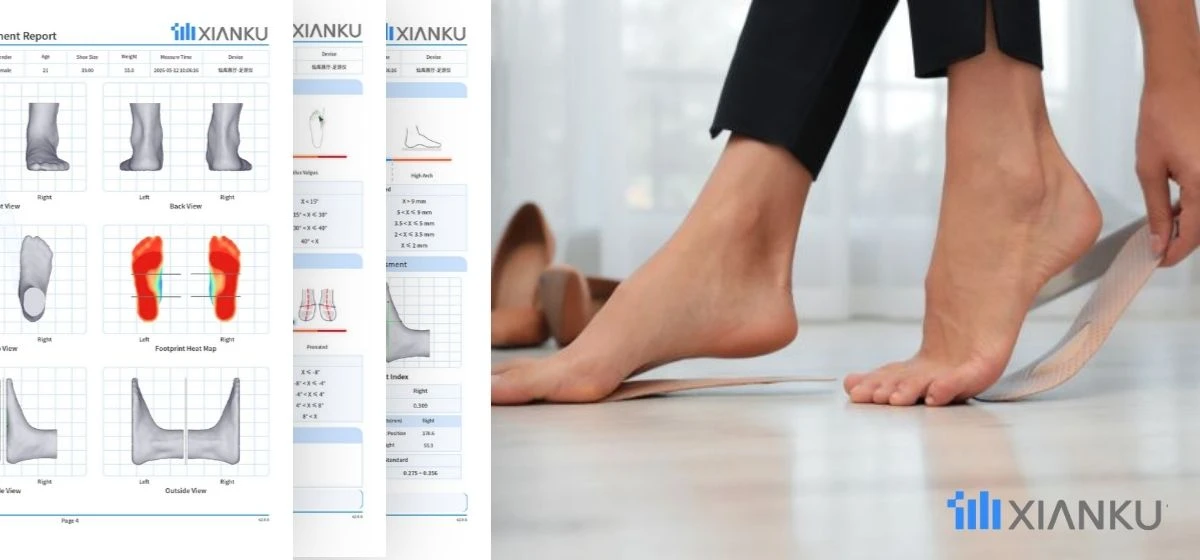
Using infrared structured-light technology, the system creates a complete three-dimensional model of the foot with millimeter-level accuracy in approximately one second. It can generate a comprehensive digital report in about five seconds.
Unlike traditional foot scanning systems that often capture only the plantar surface, the XIANKU system produces a full 3D foot model and evaluates more than 30 foot measurements and health indicators.
The scanner can assess:
- Foot length and width
- Medial arch height
- Heel inclination angle
- Toe morphology
- Foot width index
- Plantar analysis
- Hallux valgus risk
- Flat-foot assessment
- Valgus and varus tendencies
These measurements help practitioners better understand how foot structure may influence balance, mobility, and overall biomechanics.
The system also supports AI-assisted foot health analysis and digital health reporting, making it easier for clinics, rehabilitation centers, sports organizations, and footwear professionals to identify potential concerns early.
The Future of Fall Prevention Starts at Ground Level
As humanoid robots continue to evolve, engineers are learning an important lesson:
Balance is far more complicated than it appears.
Every robot that falls highlights the extraordinary sophistication of the human body's stability system.
Yet the same lesson applies to us.
Most people never think about their feet until something goes wrong.
A fall.
A chronic injury.
Persistent pain.
Loss of mobility.
By then, the warning signs may have existed for years.
The future of preventive healthcare will increasingly focus on identifying these signals before symptoms appear.
Just as robots rely on sensors to stay upright, humans benefit from technologies that reveal hidden biomechanical risks.
Because staying balanced is not merely about avoiding falls.
It is about preserving mobility, independence, performance, and quality of life.
And it all begins with the remarkable structure carrying us through every step:
The human foot.
