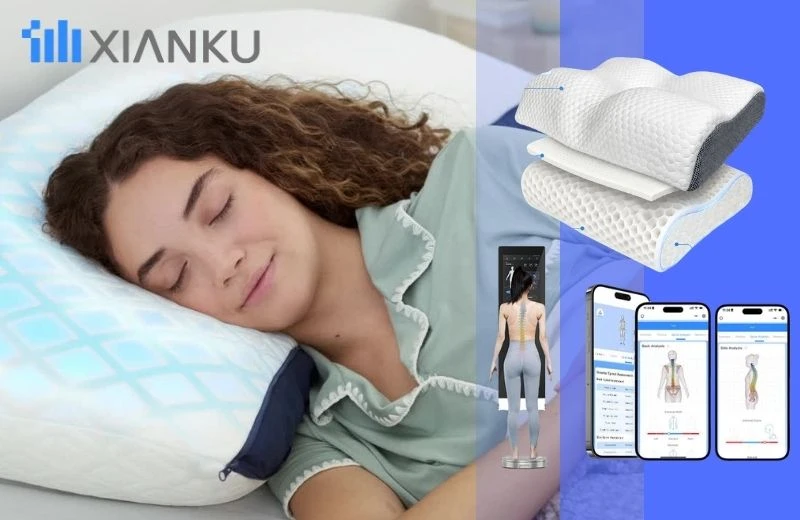
How 3D Body Scanning, AI-Powered Biomechanics, and Custom 3D Printing Are Helping Bartenders, DJs, Singers, and Night Shift Professionals Sleep Better During the Day?
The Hidden Health Crisis of the Night Economy
The modern night economy has never been larger.
From bartenders finishing a 2 a.m. shift, to club DJs performing until sunrise, to livehouse singers, hotel staff, healthcare workers, and overnight service personnel, millions of professionals now live with a biological reality that human physiology was never designed for: circadian rhythm inversion.
Sleep medicine experts increasingly recognize this challenge as part of Shift Work Syndrome (SWS)-a condition associated with disrupted sleep cycles, chronic fatigue, decreased recovery capacity, and musculoskeletal dysfunction.

For most night shift workers, the problem goes beyond simply "not getting enough sleep."
The real issue is that daytime sleep is often fragmented by environmental factors:
- Daylight exposure
- Household noise
- Frequent awakenings
- Reduced deep sleep duration
- Increased tossing and turning
When the body repeatedly shifts positions during shallow sleep, the cervical spine loses stable support. Over time, this creates a chain reaction of biomechanical compensation.
Neck muscles remain partially activated throughout the sleep period. Shoulder muscles absorb excess load. Upper thoracic posture deteriorates. Eventually, many night workers begin experiencing:
- Morning neck stiffness
- Tension headaches
- Trapezius tightness
- Reduced cervical mobility
- Chronic shoulder discomfort
- Postural fatigue
Unfortunately, traditional pillows are rarely designed to solve this problem.
Why Conventional Pillows Often Fail Night Shift Workers
Most commercially available pillows follow a mass-production philosophy.
Whether memory foam, latex, microfiber, or feather-filled, they are generally manufactured around an "average user."
The challenge?
There is no average cervical spine.
Every individual has unique:
- Head dimensions
- Neck length
- Shoulder width
- Shoulder slope
- Cervical lordosis angle
- Sleeping posture habits
A pillow that feels comfortable for one person may leave another person's cervical spine suspended in space.
For shift workers who already suffer from disrupted recovery, even minor alignment errors can accumulate night after night.
The result is often a cycle of:
Poor support → muscle compensation → lighter sleep → more position changes → worse recovery
Breaking this cycle requires a fundamentally different approach.
Mass-Produced Pillows vs. XIANKU 3D Printed Custom Pillow
| Feature | Traditional Mass-Produced Pillow | XIANKU 3D Printed Custom Pillow |
|---|---|---|
| Fit Method | Standardized sizing | Individualized algorithmic fitting |
| Body Data Collection | None | Non-radiation 3D structured light scan |
| Head-Neck-Shoulder Analysis | Generic assumptions | 1:1 contour analysis |
| Cervical Support | One-size-fits-all | Customized to cervical spine curvature |
| Biomechanical Assessment | Not available | AI posture and spinal assessment |
| Custom Geometry | Fixed design | Personalized 3D-printed structure |
| Adaptation to Shoulder Width | Limited | Data-driven adjustment |
| Pressure Distribution | Generic foam deformation | Precision support zones |
| Long-Term Shape Retention | Variable | Honeycomb TPU lattice structure |
| Sleep Report Integration | No | AI-generated sleep and posture insights |
| Digital Health Records | No | Connected 3D Body Measurement CRM system |
| Manufacturing Process | Mass production | Individualized digital fabrication |
For professionals whose sleep quality directly impacts work performance, the difference is not simply comfort-it is biomechanical precision.
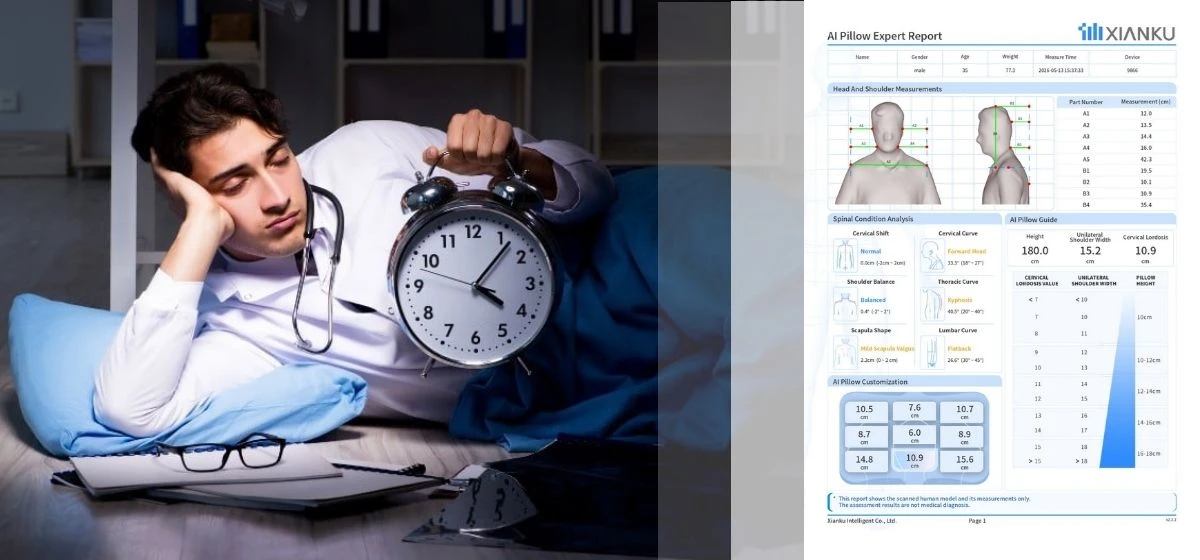
The Technology Behind the XIANKU 3D Printed Custom Pillow
Unlike traditional pillow brands that ask users to choose between "soft," "medium," or "firm," the XIANKU system begins with objective body data.
Step 1: 20-Second Non-Contact 3D Body Scan
Using XIANKU's proprietary 3D structured light technology, the system captures highly detailed anatomical information in approximately 20 seconds.
The scan generates:
- Head contour measurements
- Cervical geometry data
- Shoulder alignment metrics
- Upper spinal curvature information
- Postural balance indicators
- Body symmetry analysis
The technology creates a 1:1 realistic 3D human body model, enabling highly accurate assessment of sleeping support requirements.
Unlike medical imaging systems, the scan is:
- Radiation-free
- Non-contact
- Fast
- Comfortable
- Suitable for repeated use
Step 2: AI-Based Cervical and Postural Assessment
The platform goes beyond surface measurements.
XIANKU's assessment system evaluates multiple biomechanical indicators, including:
- Cervical spine curvature
- Shoulder balance
- Center of gravity deviation
- Pelvic alignment
- Thoracic curvature
- Postural asymmetry
For many night shift workers, these metrics reveal why they consistently wake up with neck discomfort despite using premium pillows.
The system essentially transforms sleep support from guesswork into measurable biomechanics.
Step 3: Algorithmic Pillow Fitting
Once the scan is completed, proprietary algorithms convert anatomical measurements into pillow design parameters.
Instead of assigning users to a predefined pillow category, the platform generates:
- Nine customized support zones
- Personalized height profiles
- Cervical cradle geometry
- Shoulder transition contours
- Pressure redistribution architecture
This process is known as algorithmic pillow fitting-a data-driven method that adapts the pillow to the body rather than forcing the body to adapt to the pillow.
Step 4: Precision 3D Printing
After the fitting process, the personalized geometry can be exported through advanced digital workflows using dense point-cloud body data and 3D reconstruction models.
The pillow is then manufactured using:
- Medical-grade TPU materials
- Honeycomb lattice architecture
- Breathable open-cell structures
- Long-term shape-retention engineering
The result is a support system designed around the user's actual anatomy.
Why Cervical Alignment Matters More During Daytime Sleep
Night shift workers face a unique challenge.
Research in sleep medicine consistently shows that daytime sleep tends to contain:
- More interruptions
- Reduced slow-wave sleep
- Increased environmental disturbance
- Higher movement frequency
Every time a sleeper changes position, cervical muscles must stabilize the head.
If the pillow fails to maintain alignment, those muscles continue working throughout the sleep period.
Instead of recovery, the body remains partially engaged.
A properly fitted support system helps maintain:
- Neutral cervical positioning
- Reduced muscular activation
- Improved pressure distribution
- More efficient recovery
For professionals who depend on sustained concentration, physical endurance, and reaction speed during overnight work, this difference can be significant.

Beyond Comfort: The Future of Sleep Is Data-Driven
The broader trend shaping healthcare in 2026 is personalization.
Consumers increasingly expect:
- Personalized nutrition
- Personalized fitness plans
- Personalized health monitoring
- Personalized rehabilitation
Sleep support is now entering the same era.
The combination of:
- 3D body scanning
- AI posture analysis
- 1:1 contour analysis
- Digital twin modeling
- Personalized manufacturing
represents a major shift away from generic sleep products.
For night shift professionals, this evolution is particularly meaningful because their recovery window is already compromised by circadian disruption.
Every biomechanical advantage matters.
Conclusion
The sleep challenges faced by bartenders, DJs, singers, hospitality staff, and other night shift workers are not simply matters of comfort. They are rooted in physiology, biomechanics, and the realities of circadian rhythm inversion.
Traditional pillows were never designed to account for individual cervical anatomy or the unique demands of fragmented daytime sleep.
The XIANKU 3D Printed Custom Pillow introduces a different model-one built on objective body data, AI-assisted posture assessment, and personalized 3D manufacturing.
By combining non-radiation 3D structured light scanning, 1:1 realistic human body reconstruction, cervical spine curvature analysis, and algorithmic pillow fitting, the system offers a new approach to one of the most overlooked health challenges in the modern workforce: restorative sleep.
For professionals who work while the rest of the city sleeps, better recovery may begin with a pillow that finally understands the shape of their body.
Frequently Asked Questions (FAQ)
1. How does cervical alignment affect daytime sleep quality for night shift workers?
Proper cervical alignment reduces unnecessary muscle activation in the neck and shoulders during sleep. For night shift workers who often experience lighter, more fragmented daytime sleep, maintaining neutral spinal positioning can help decrease muscle tension, reduce morning stiffness, and improve overall recovery.
2. What makes a 3D-scanned pillow different from a memory foam or latex pillow?
A 3D-scanned pillow is designed using actual anatomical measurements collected through non-contact body scanning technology. Instead of relying on standard sizes, the pillow's shape, height, and support zones are customized according to individual head, neck, shoulder, and spinal characteristics.
3. Can 3D body scanning help identify posture-related sleep problems?
Yes. Advanced systems such as the XIANKU 3D Body Scanner evaluate posture, spinal alignment, shoulder balance, cervical curvature, and body symmetry. These assessments can reveal biomechanical factors that may contribute to poor sleep quality, neck discomfort, and long-term musculoskeletal strain.