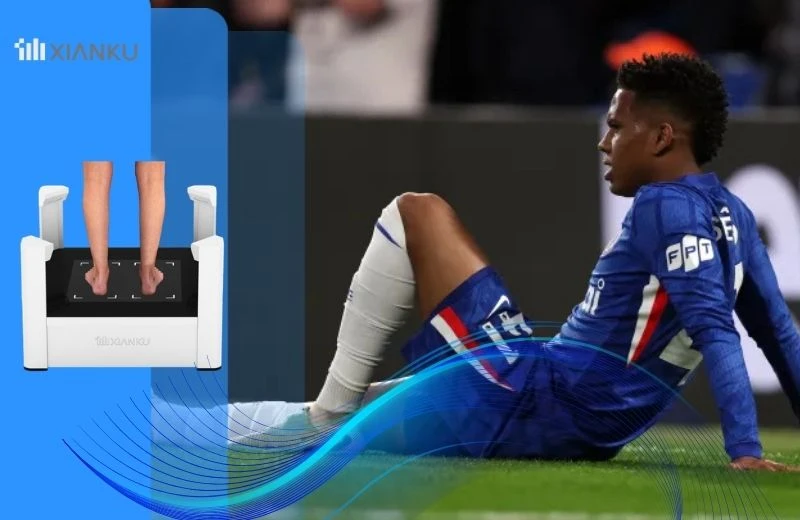
From World Cup Superstars to Everyday Athletes: How 3D Foot Scanning Is Changing the Future of Football Performance
As the 2026 FIFA World Cup unfolds across North America, billions of fans are captivated by spectacular goals, dramatic upsets, and the emergence of football's next generation of stars. Every match generates headlines about tactics, speed, endurance, and athletic brilliance.
Yet behind every explosive sprint, every sudden change of direction, and every match-winning goal lies a critical factor that rarely receives attention outside elite sports science circles:
The health and biomechanics of the athlete's feet.

Football is one of the most physically demanding sports in the world. Modern players routinely cover between 10 and 13 kilometers during a single match while performing hundreds of accelerations, decelerations, jumps, pivots, and high-impact movements. Over the course of a World Cup tournament, these demands place extraordinary stress on the feet, ankles, knees, hips, and spine.
As a result, sports medicine professionals are increasingly recognizing that optimal performance begins from the ground up.
This growing awareness has fueled worldwide interest in technologies such as:
- 3D Foot Scanners
- AI Biomechanical Assessment
- Plantar Pressure Mapping
- Custom Orthotics
- Performance Monitoring Platforms
For football clubs, sports medicine centers, rehabilitation clinics, and performance facilities, understanding foot biomechanics is no longer optional-it is becoming a competitive advantage.
The Foundation of Athletic Performance Starts with the Feet
When fans watch elite players compete on the world's biggest stage, they often focus on visible attributes:
- Speed
- Agility
- Strength
- Endurance
- Tactical awareness
However, sports scientists focus on something deeper.
Every athletic movement begins with a force exchange between the body and the ground. This process, known as ground reaction force, determines how efficiently an athlete moves, accelerates, and absorbs impact.
The feet serve as the body's first point of contact with the ground. They are responsible for:
- Shock absorption
- Balance control
- Force transmission
- Stability
- Propulsion
When foot mechanics function efficiently, movement becomes smoother and more economical.
When biomechanical imbalances exist, however, the consequences can affect the entire kinetic chain.
Even subtle issues such as:
- Flat feet
- High arches
- Overpronation
- Supination
- Leg length discrepancies
- Poor weight distribution
can contribute to excessive stress on joints and soft tissues.
Over time, these imbalances may increase the likelihood of:
- Knee pain
- Hip dysfunction
- Achilles tendon injuries
- Plantar fasciitis
- Lower back pain
- Fatigue-related performance decline
At the highest levels of football, where fractions of a second can determine outcomes, these small inefficiencies matter enormously.
Why Foot and Lower Limb Injuries Remain a Major Challenge in Football
One of the biggest stories surrounding every major football tournament is injury management.
Elite clubs invest millions of dollars annually in injury prevention because player availability directly affects competitive success.
Common football-related injuries include:
- Achilles tendinopathy
- Metatarsal stress fractures
- Plantar fasciitis
- Ankle instability
- Shin splints
- Patellofemoral pain syndrome
While these injuries often appear to originate in specific anatomical regions, many can be traced back to underlying biomechanical dysfunction in the foot.
The challenge is that these problems frequently develop gradually.
Athletes may train and compete for months without noticeable symptoms before pain finally emerges.
By that point, compensation patterns may already be affecting movement quality throughout the body.
This reality has shifted attention toward proactive screening rather than reactive treatment.
Instead of waiting for injuries to occur, sports organizations increasingly seek technologies capable of identifying risk factors before symptoms appear.
This is where 3D foot scanning technology is transforming sports medicine.

The Evolution from Traditional Foot Assessment to Digital Foot Analysis
For decades, foot assessments relied on relatively basic techniques.
Common methods included:
- Visual observation
- Ink footprint analysis
- Static measurements
- Manual calipers
- Foam impressions
Although these approaches provided useful information, they were often time-consuming and highly dependent on practitioner experience.
More importantly, traditional methods struggled to capture the complex three-dimensional structure of the foot.
Today's athletes demand greater precision.
Modern 3D foot scanning systems create highly detailed digital models within seconds, allowing clinicians and performance specialists to assess foot structure with unprecedented accuracy.
Advanced scanning technology can evaluate:
- Foot length
- Foot width
- Arch height
- Heel alignment
- Forefoot angle
- Symmetry between left and right feet
These measurements provide a more comprehensive understanding of how an athlete interacts with the ground during movement.
Instead of relying on assumptions, practitioners can make data-driven decisions based on objective anatomical information.
How AI Is Revolutionizing Foot Health Assessment
The next major innovation is not simply collecting foot data.
It is understanding what that data means.
Artificial intelligence is rapidly changing the way biomechanical information is analyzed and interpreted.
Traditional assessment often required specialists to manually review measurements and formulate recommendations.
Today, AI-powered systems can process thousands of biomechanical variables and identify patterns that might otherwise go unnoticed.
Modern AI-based foot assessment platforms can help identify:
- Potential injury risks
- Abnormal gait mechanics
- Pressure distribution issues
- Structural asymmetries
- Performance-limiting factors
They can also generate personalized recommendations related to:
- Footwear selection
- Orthotic interventions
- Rehabilitation programs
- Movement training
- Performance optimization strategies
As AI becomes increasingly integrated into sports science, digital foot assessment is evolving from a measurement tool into a predictive health platform.
What World Cup Athletes Teach Us About Injury Prevention
One reason football remains so popular globally is that players at every level aspire to emulate the world's best athletes.
However, elite professionals benefit from resources unavailable to most recreational players.
They have access to:
- Sports scientists
- Physiotherapists
- Orthopedic specialists
- Biomechanical laboratories
- Recovery technology
Amateur athletes typically do not.
As participation in football continues to grow worldwide following the World Cup, millions of players return to local leagues, school competitions, and recreational games.
Many unknowingly compete with biomechanical issues that increase injury risk.
A player with excessive pronation may experience repeated ankle instability.
Another with asymmetrical foot loading may develop chronic knee discomfort.
Without objective assessment tools, these problems often remain hidden until pain develops.
A 3D foot scan provides a practical and accessible way to identify such concerns before they progress into more serious conditions.

Why Sports Clinics Are Rapidly Adopting 3D Foot Scanners
The demand for objective movement assessment is growing across multiple sectors.
Organizations investing in 3D foot scanning technology include:
- Sports medicine clinics
- Physiotherapy centers
- Orthopedic hospitals
- Football academies
- Performance training facilities
- Rehabilitation centers
- Wellness clinics
Several factors are driving adoption.
Faster Assessments
Modern systems can complete scans within seconds, significantly improving workflow efficiency.
Improved Visualization
Athletes can immediately view a digital representation of their foot structure, making complex biomechanical concepts easier to understand.
Better Communication
Visual reports help practitioners explain findings and treatment recommendations more effectively.
Long-Term Monitoring
Digital records allow progress tracking over time, supporting injury recovery and performance development.
Enhanced Personalization
Data-driven assessments enable more individualized care strategies.
As healthcare and sports performance become increasingly personalized, objective measurement technologies continue gaining importance.
Why XIANKU 3D Foot Scanner Is Built for the Next Generation of Sports Health
As organizations seek reliable foot assessment solutions, they require systems that combine speed, accuracy, usability, and scalability.
The XIANKU 3D Foot Scanner has been developed to meet these demands.
Leveraging advanced 3D structured light technology, the system delivers professional-grade foot analysis in an efficient and user-friendly format.
Key advantages include:
Ultra-Fast Scanning
The scanner captures detailed foot data in approximately one second, minimizing disruption to athlete workflows.
Millimeter-Level Precision
High-resolution measurement technology provides accurate digital foot models suitable for professional assessment.
AI-Powered Analysis
Integrated intelligent algorithms support rapid interpretation of foot health data.
Non-Contact Infrared Technology
Safe and hygienic scanning ensures a comfortable user experience.
Comprehensive Foot Health Evaluation
The system assists practitioners in understanding structural characteristics relevant to performance, comfort, and injury prevention.
Integration with Broader Health Ecosystems
As part of the XIANKU digital health platform, foot assessment can be combined with posture evaluation, body composition analysis, and musculoskeletal health management.
This integrated approach aligns closely with the future direction of sports medicine and preventive healthcare.
The Future of Football Performance Begins Beneath Every Step
The 2026 FIFA World Cup represents more than a global sporting event.
It reflects the ongoing evolution of athletic performance.
Today's players are faster, stronger, and more technically sophisticated than any previous generation. Behind these advances lies an increasing reliance on sports science, data analytics, and precision health technologies.
Foot biomechanics is emerging as one of the most important yet underappreciated components of this evolution.
Whether the goal is preventing injury, improving movement efficiency, enhancing comfort, or optimizing athletic performance, understanding the foot has become essential.
For football clubs, healthcare providers, sports medicine professionals, and athletes alike, 3D foot scanning offers a powerful window into human movement.
As AI-driven health assessment continues reshaping the industry, one thing is becoming increasingly clear:
The future of performance does not begin with the next training session.
It begins with understanding the foundation that supports every movement.
And that foundation starts with the feet.