
Foot and lower-limb alignment issues are far more common in Western populations than many realize. In the United States and Europe, conditions such as flat feet, high arches, and leg length discrepancy (LLD) affect children, adults, and older adults at significant rates and are recognized as important contributors to long-term joint stress, gait abnormalities, and musculoskeletal pain. As awareness grows around biomechanical health, retailers, podiatrists, and orthotic labs are increasingly turning to precise foot scan technologies and 3D printed insoles to provide personalized solutions backed by measurable data.
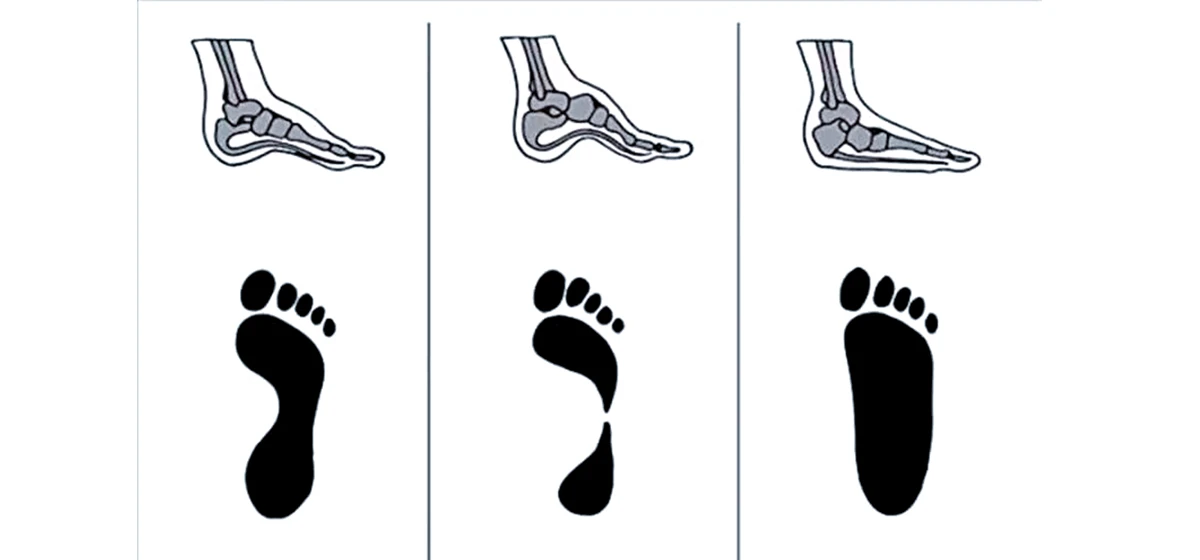
Foot Conditions That Shape Long-Term Health in Western Populations
Flat Feet (Pes Planus)
In the U.S. and Europe, flat feet affect an estimated 20–25% of adults and nearly 30% of children. According to the American Podiatric Medical Association (APMA), untreated flat feet may contribute to:
- Generalized foot fatigue
- Knee valgus and medial knee pain
- Shin splints and overpronation injuries
- Hip and lower-back discomfort
- Reduced athletic efficiency
Among older adults, arch collapse often accelerates due to reduced tendon strength, increasing instability and fall risk.
High Arches (Pes Cavus)
High arches appear less frequently-around 10% of Western adults-but are associated with more pronounced pressure imbalances.
Common symptoms include:
- Heel and metatarsal pain
- Frequent ankle sprains due to lateral instability
- Claw toe or hammertoe progression
- Plantar fascia tightness
- Stress fractures (especially in runners)
The U.K.'s NHS notes that individuals with high arches often require targeted foot support to prevent chronic pain.
Leg Length Discrepancy (LLD)
LLD is more widespread than most consumers recognize; orthopedic studies across Germany, France, and the U.S. indicate that more than 40% of adults have at least a 5 mm asymmetry, and around 10% exceed 10 mm, which is clinically meaningful.
Long-term consequences include:
- Pelvic tilt and compensatory scoliosis
- Asymmetric hip wear
- Uneven running gait
- Chronic lower-back pain
- Heightened injury risk in adolescents during growth spurts
Potential Patient Population Across U.S. & Europe
| Region | Estimated Affected Population | Notes |
|---|---|---|
| United States | ~100 million | Includes flat feet, high arches, and LLD |
| Europe (EU + U.K.) | ~85–100 million | Higher prevalence among aging populations |
| Globally | 1.1–1.4 billion | Mild to severe structural foot disorders |
This scale explains why brands such as Dr. Scholl's, Superfeet, and Aetrex heavily promote in-store digital foot assessments-they drive conversion, trust, and long-term customer loyalty.
Why Corrective Insoles Play a Central Role
Corrective insoles are widely used across the U.S. and Europe due to their ability to:
- Balance pressure across the foot
- Improve gait mechanics
- Support arch structure
- Reduce heel-to-toe loading imbalances
- Improve comfort for daily use, sports, and work
- Reduce the risk of injury caused by abnormal foot alignment
However, most off-the-shelf insoles are not capable of providing true biomechanical correction.
The Problem With Traditional Insoles in Western Retail
Table: Common Limitations of Conventional Insoles
| Problem | Effect on Consumers | Effect on Retailers |
|---|---|---|
| Generic shape & limited support | Minimal improvement in symptoms | Low repeat sales |
| Wrong fit for foot type | Can worsen overpronation or supination | Higher return rates |
| No medical or biomechanical guidance | Customers choose randomly | Difficult to build trust |
| Inconsistent in-store evaluation | Uneven customer experience | Hard to train staff effectively |
These challenges paved the way for the rise of foot scan technology and 3D printed insoles, which offer individualized solutions supported by data, not guesswork.
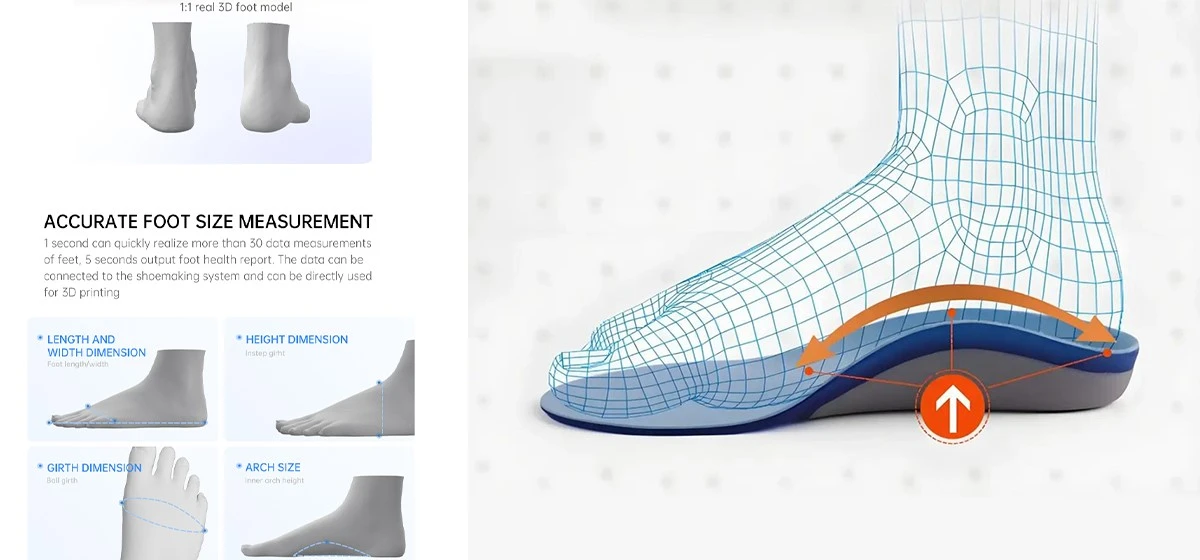
Foot Scan Technology: The Foundation of Modern 3D Printed Insoles
A professional foot scan is now considered the baseline for personalized foot health in the United States and Europe. Clinics and specialty retailers use scans to capture:
- Arch height
- Foot width and instep volume
- Heel alignment
- Toe deviation
- Pressure distribution
- Comparative foot symmetry
Yet the accuracy of the scan is crucial. Low-resolution devices fail to support medical-grade correction or 3D insole modeling.
This is where the Xianku 3D Foot Scanner stands out.
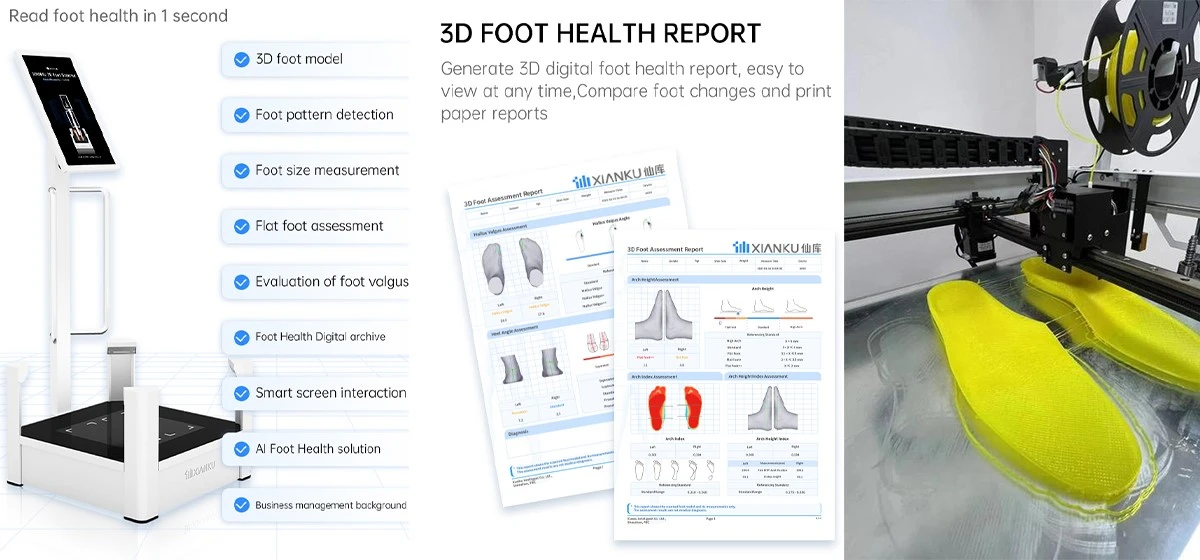
How the Xianku 3D Foot Scanner Supports the 3D Printed Insole Industry
The Xianku 3D Foot Scanner was designed for modern orthotic practices and forward-thinking retailers who need precision, speed, and scientific credibility. Its combination of medical-grade measurement and retail-friendly technology gives it a critical advantage in the American and European marketplace.
1. Rapid, Precise Measurement for Instant Customer Understanding
At the core of Xianku's system is high-speed structured-light scanning, capturing 32 anatomical dimensions including:
- Foot length
- Foot width
- Arch height and curvature
- Instep height
- Heel width and rearfoot alignment
- Toe angles and metatarsal shape
The entire foot scan takes only one second, producing:
- A true-to-life 3D foot model
- A detailed digital report
- Data compatible with advanced 3D printed insoles manufacturing
2. A Closed-Loop AI-Driven Sales Experience
Xianku transforms the retail and clinic environment by creating a structured, science-based sales journey:
Foot Scan → Foot Health Analysis → Data Interpretation → AI Recommendations → Purchase
Retailers can define recommendation logic to automatically match products to conditions:
- Flat feet → structured arch-support insoles
- High arches → cushioning and stability insoles
- Heel valgus → medial support correction
- LLD → heel lift personalization
This creates a clear, persuasive, and customer-friendly pathway toward the right solution.
3. Health-Centered Communication, Not Sales Pressure
One of the biggest advantages in U.S. and European markets is credibility. Consumers trust objective, measurable health insights over sales conversations.
Xianku excels at this by presenting:
- Visual indicators of flat feet, high arches, heel valgus/varus, and more
- Easy-to-read diagrams
- Side-by-side comparisons
- Foot symmetry analysis
Retailers can then connect these findings to appropriate 3D printed insoles or other corrective solutions, elevating both conversion rate and customer comfort.
4. A Modern, High-Tech Retail Experience
In a market set consumer expectations, Xianku brings a premium digital experience to footwear stores:
- A one-second scan
- A lifelike rotating 3D model
- Automatic recommendations
- A medically aligned process
Brands such as Aetrex and Superfeet have demonstrated how powerful this model is at attracting foot-health-oriented customers. Xianku allows any retailer to operate with a similar standard.
5. Standardization of Service Workflows
Table: Xianku's Standardized Service Flow
| Step | Function | Purpose |
|---|---|---|
| 1. Foot Scan | 1-second structured-light measurement | Accuracy & speed |
| 2. Health Assessment | AI identifies foot deformities | Medical credibility |
| 3. Data Interpretation | 32 foot metrics analyzed | Personalized insight |
| 4. Product Recommendation | AI suggests 3D printed insoles or corrective supports | Increases trust & conversion |
| 5. Customer Archiving | Automatic digital profile | Supports future sales & follow-up |
This ensures every customer receives a professional, consistent, and educational experience.
6. Digital Customer Records and Private-Domain Marketing
Xianku supports automatic data archiving, including:
- Scan history
- Foot condition changes
- Purchase patterns
- Personalized follow-up opportunities
Retailers can use this for:
- Email/SMS re-engagement
- Custom product launches
- Seasonal campaigns
- Follow-up fittings
7. A High-Performance Traffic and Conversion Engine
In both U.S. and European markets, "free foot screening" campaigns are proven traffic magnets. Retailers commonly use Xianku for:
- Free foot scan weekends
- Foot health awareness events
- Running injury prevention workshops
This strategy mirrors what top brands like Dr. Scholl's and Aetrex use to drive in-store engagement.
8. Comprehensive Commercial Value
Xianku supports retailers and orthotic manufacturers by improving:
- Conversion rates
- Average order value
- Customer retention
- Inventory planning
- Product development
- E-commerce return reduction
- Cross-selling (e.g., bunion correctors, heel lifts)
For the 3D printed insoles industry, Xianku serves as a reliable data source that ensures accuracy and customization.
Why Xianku Leads the Modern Foot-Health Technology Landscape
Table: Xianku vs. Traditional Scanning and Manual Fitting
| Metric | Xianku 3D Foot Scanner | Standard Scanner | Manual Fitting |
|---|---|---|---|
| Scan Time | 1 second | 10–20 seconds | Minutes |
| Dimensional Accuracy | ±1 mm | Moderate | Low |
| Data Points | 32 | Limited | Very limited |
| AI Recommendations | Yes | Partial | No |
| 3D Foot Model | Yes | Partial | No |
| Support for 3D Printed Insoles | Full | Limited | None |
| Retail Sales Integration | Yes | No | No |
Xianku merges precision, speed, and commercial practicality in a way manual and older technologies cannot.
Conclusion
Foot alignment conditions are prevalent across the United States and Europe, influencing long-term musculoskeletal health and overall well-being. Corrective insoles-especially 3D printed insoles-offer practical and highly customizable solutions, but only when supported by accurate biometric data.
The Xianku 3D Foot Scanner enables retailers, orthotists, podiatrists, and sports-health professionals to deliver:
- Medical-grade accuracy
- A modern digital customer experience
- Data-driven recommendations
- Consistent store workflows
- Personalized orthotic production
As Western consumers continue to prioritize comfort, biomechanical health, and personalized wellness products, Xianku stands out as a leading partner for businesses seeking to modernize their offerings and deliver scientifically validated foot-care solutions.