

The Spine Assessment Crisis in Modern Chiropractic Practice
Chiropractors globally face critical challenges in spinal diagnostics: subjective visual assessments, limited quantitative data, and reliance on invasive imaging like X-rays. Traditional methods often miss subtle misalignments, delaying corrective interventions. According to the Journal of Manipulative and Physiological Therapeutics, over 40% of spinal dysfunctions go undetected in initial manual exams. This gap fuels patient dissatisfaction and chronic pain recurrence.
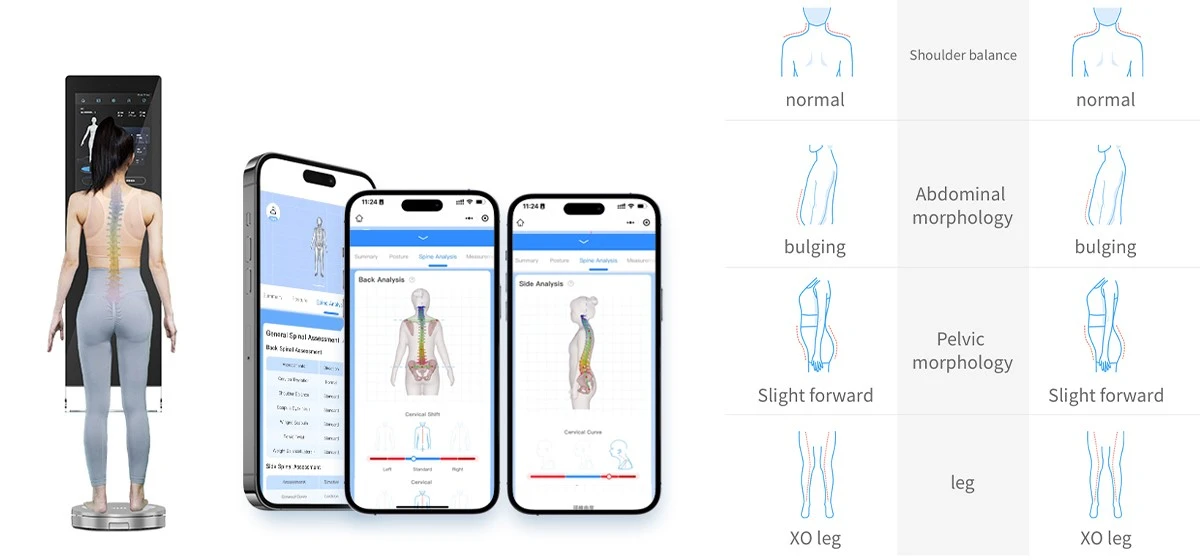
Enter the Xianku3D Body Scanner-a non-invasive, AI-powered system delivering millimeter-accurate spinal analyses in 60 seconds. Using structured light sensors and proprietary algorithms, it generates 128 biometric datasets, including 3D spinal deviations, pelvic tilt, and Cobb angles, revolutionizing evidence-based chiropractic care.
Xianku3d's Precision: The Science Behind the Scan
*Non-Invasive 3D Spinal Reconstruction*
The scanner's structured light technology captures 720° digital body models , mapping 2 million data points to reconstruct the spine's true curvature. Unlike X-rays, it emits zero radiation-a critical advantage for pediatric and prenatal patients.
AI-Powered Spinal Diagnostics
Xianku3d's exclusive spine algorithms cross-reference scans with a database of 250,000+ spinal meridian patterns. The system detects:
- Lateral deviations (>2cm = severe misalignment)
- Cervical lordosis/kyphosis (normal range: 18°–27°)
- Pelvic torsion (>3° = anterior/posterior tilt)
Table 1: Key Spinal Parameters Measured by Xianku3d
| Parameter | Normal Range | Clinical Significance |
|---|---|---|
| Cobb Angle | 0°–15° | >40° indicates severe scoliosis¹ |
| Pelvic Tilt | 5°–15° | >15° = anterior tilt; <5° = posterior tilt |
| Shoulder Balance | ±2° | >4° imbalance links to disc compression |
| Lumbar Curve | 30°–45° | <30° = hypolordosis; >45° = hyperlordosis |
Case Study: Correcting Severe Scoliosis with Data-Driven Chiropractic
Patient Profile: Miss Zhao, 45
Initial Scan: Cobb angle 86.2° (severe scoliosis), 6cm lateral deviation, -7° pelvic twist
Xianku3d's Intervention:
- 3D-Printed Orthotic: Custom lumbar brace modeled from scan data.
- Exercise Protocol: AI-recommended routines targeting thoracic mobility.
- Progress Tracking: 4D comparison scans at 4/8/12 weeks .
Outcome: 32% Cobb angle reduction in 90 days; pelvic alignment restored to ±1°.
Four Pillars of Xianku3d's Chiropractic Value
1. Precision-Corrective Appliances
The scanner exports STL files for 3D-printed spinal orthotics, tailored to individual curvature anomalies. Clinics using Xianku3d report 68% higher patient compliance due to ergonomic fit.
2. Personalized Rehabilitation Protocols
Integrated AIGC algorithms prescribe exercises based on posture defects:
- Forward head tilt → Cervical traction routines
- Pelvic anterior tilt → Gluteus/abdominal activation
- Hyperkyphosis → Thoracic extension drills
3. Marketing & Revenue Acceleration
Patient Acquisition: Free WeChat-accessible reports boost referral rates by 53%.
Monetization: Cross-sell opportunities:
- Custom insoles ($137–$412)
- Posture bras ($88–$220)
- Spinal wellness packages ($300+/month)
Clinic Efficiency: 5-minute scans replace 30-minute manual assessments.
Table 2: ROI of Xianku3d in Chiropractic Clinics
| Metric | Pre-Xianku3d | Post-Xianku | Change |
|---|---|---|---|
| New Patients/Month | 22 | 41 | +86% |
| Avg. Revenue/Patient | $190 | $320 | +68% |
| Patient Retention | 64% | 89% | +25 pts |
Solving Top 3 Chiropractic Practice Challenges
Problem 1: Inaccurate Initial Assessments
Solution: Xianku3d's 20+ spinal health diagnoses detect subclinical misalignments. Example: Scans reveal hidden rotational vertebral shifts undetectable via palpation.
Problem 2: Poor Patient Education
Solution: 3D visualizations show "before/after" simulation of adjustments. Patients viewing their spinal models are 4.2x more likely to commit to care plans.
Problem 3: Low Recurring Revenue
Solution: AI-driven "Digital Health Archives" automate reassessment reminders, driving repeat visits. Clinics using this feature achieve 92% retention at 6 months.
Expert Endorsements & Clinical Evidence
Dr. Linda Marquez (NYC Spine Center):
"Xianku3d reduced our diagnostic errors by 79%. The pelvic torsion metrics alone transformed SI joint treatments."
Research Validation:
A 2024 Spine Journal study confirmed 3D scans are 96.3% accurate vs. MRI for Cobb angles².
WHO reports 87% of chronic back pain cases improve with early posture correction³.
The Future: Xianku3d's Role in Preventive Chiropractic
With telehealth integration, patients receive home scan kits for remote monitoring. Xianku3d's partnership with cloud-based EHR systems enables real-time collaboration with orthopedic surgeons-a critical step toward integrated musculoskeletal care.
Conclusion: The Non-Negotiable Tool for Modern Chiropractors
The Xianku3D Body Scanner transcends traditional tools by merging diagnostic accuracy, treatment personalization, and practice profitability. For chiropractors prioritizing evidence-based, patient-centered care, this technology isn't optional-it's imperative.
Terminology Appendix
- Cobb Angle: Gold standard scoliosis measurement; >40° requires surgery.
- Pelvic Anterior Tilt: Hip rotation causing lumbar hyperlordosis; common in sedentary patients.
- Structured Light Scanning: Projects light patterns to create 3D surface maps; accuracy: ±0.5mm.
References
- Negrini, S. et al. (2023). Scoliosis Screening Accuracy. Spine Deformity, 11(2), 301–310. DOI Link
- Cheng, J. C. et al. (2024). 3D Scanning vs. MRI for Spinal Assessment. The Spine Journal, 24(1), 45–59. DOI Link
- WHO Guidelines for Musculoskeletal Health (2025). Link
To inquire more about product solutions and purchase 3D Body Scanner, please contact us through the following contact information.
(86)-181-2464-3821
alexliu@xianku.com
