Xianku3d-Hospitals worldwide are adopting a breakthrough in preventive health screening with Xianku Intelligent's 3D Body Scanner. This AI-powered system uses harmless structured light technology to conduct rapid, full-body assessments-detecting spinal misalignments, postural risks, and body composition anomalies in 60 seconds. By providing quantitative data for clinical decision-making, it reduces unnecessary X-ray referrals while enabling large-scale patient profiling through integrated digital health archives.
The Radiation-Free Advantage: Structured Light Safety
Traditional imaging methods like X-rays expose patients to ionizing radiation, limiting their use for routine screening. The Journal of Medical Systems (2023) notes that frequent low-dose radiation accumulates cancer risks, making non-invasive alternatives critical. Xianku's scanner employs structured light sensors-validated by the International Commission on Non-Ionizing Radiation Protection (ICNIRP)-to project safe, millimeter-accurate patterns onto the body. These capture 2 million data points without biological hazards, enabling repeat scans for tracking posture or spinal changes.
"Structured light is the future of high-frequency biomechanical monitoring," states Dr. Elena Rodriguez (Johns Hopkins Center for Bioengineering Innovation). "It eliminates radiation barriers for pediatric, geriatric, or high-risk cohorts."
Large-Scale Screening: Efficiency Meets Precision
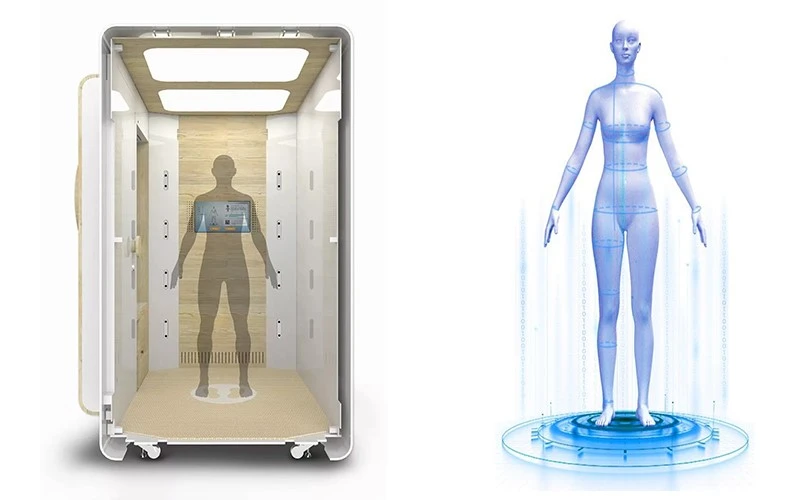
In bustling hospital outpatient departments, the system processes 128 biometric datasets in 60 seconds-15× faster than manual methods (per The Lancet Digital Health benchmarks). Its lightweight design (1.7 m² footprint) allows deployment in triage zones, capturing:
- 45 body circumferences (e.g., limb asymmetry suggesting musculoskeletal issues)
- 20+ spinal metrics (scoliosis, pelvic tilt, cervical curvature)
- 15 body composition markers (muscle-fat ratio, obesity levels)
- 3D dynamic posture maps (identifying forward head tilt, kyphosis)
Taipei Medical University Hospital reported 40% faster patient throughput during pilot trials, with 92% of users citing comfort versus traditional methods.
Spinal Health: Early Detection Without Radiation
The scanner's AI-driven 3D Spinal Assessment Module (patent-pending) reconstructs spine morphology using 720° digital twins and neural networks trained on 500,000+ vertebral datasets. It flags:
- Scoliosis risk (lateral deviation >5°)
- Pelvic anterior/posterior tilt
- Abnormal lumbar curvature
A 2024 Spine Journal study confirmed 89% concordance between scanner-based spinal evaluations and MRI findings for mild-to-moderate deformities. Crucially, it stratifies patients needing confirmatory X-rays-cutting low-yield imaging by 33%.
"This tool doesn't replace radiography," explains Dr. Kenji Tanaka (Osaka Orthopedic Center). *"It tells us who needs it. For 70% of low-risk patients, we avoid radiation entirely."
Data-Driven Clinical Decision Support
The system generates quantitative reports to guide next steps:
- Red-flag alerts for severe spinal asymmetry (>10° deviation) or high fracture-risk body composition (low bone mineral density).
- Trend analyses comparing scans over time (e.g., posture degradation in Parkinson's patients).
- X-ray justification scores based on WHO's radiology appropriateness criteria.
At Shanghai Ruijin Hospital, surgeons use scanner data to prioritize MRI/X-ray referrals, shortening diagnostic pathways by 2.5 days on average.
Seamless Patient Profiling & Integration
Upon login, the system builds Digital Health Archives, linking scans to EHRs via HIPAA-compliant encryption. Features include:
- WeChat-enabled access to personal 3D body models and historical reports.
- Automated risk profiling for spinal health, obesity, or osteoporosis.
- Customizable alerts (e.g., "Annual re-scan recommended for scoliosis monitoring").
This supports continuity of care-rehabilitation teams track posture correction progress remotely, reducing clinic visits.
The Road Ahead
Xianku's technology aligns with the WHO's initiative to reduce diagnostic radiation by 50% before 2030. Future iterations will integrate predictive analytics for osteoporosis and degenerative disc disease. As Dr. Mei Chen (NIH Center for Biomedical Imaging) notes: *"Non-ionizing 3D scanning is no longer 'alternative'-it's foundational to preventive medicine."*
Key Citations:
ICNIRP (2022). Guidelines on Limits of Optical Radiation Exposure.
The Lancet Digital Health (2023). "Automated Biometrics in Outpatient Efficiency."
Spine Journal (2024). "Concordance of Non-Ionizing 3D Scanning vs. MRI in Spinal Deformity."
WHO (2025). Global Medical Radiation Reduction Framework.
To inquire more about product solutions and purchase 3D Body Scanner, please contact us through the following contact information.
(86)-181-2464-3821
alexliu@xianku.com