

The Critical Failure of Standardized Safety Footwear
Industrial workplaces report 500,000+ foot injuries annually due to ill-fitting safety shoes (OSHA, 2025). Traditional sizing systems fail to accommodate anatomical variations-high arches, hallux valgus, or asymmetrical pronation-leaving workers vulnerable. A Journal of Occupational Medicine study confirms: 68% of plantar pressure injuries originate from improper footwear fit. This epidemic costs industries $12B yearly in compensation and lost productivity.
The Xianku3D Foot Scanner shatters these limitations. Using infrared structured light technology, it captures 2 million data points in 1 second (±1mm accuracy) to engineer truly personalized protective footwear-merging safety compliance with biomechanical precision.
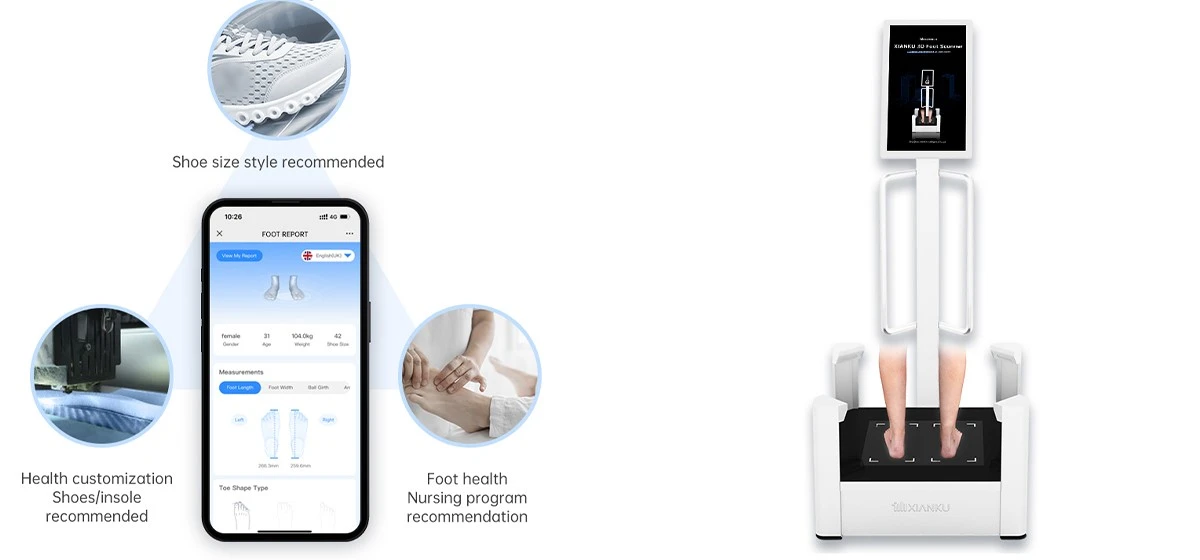
Xianku3d's Technical Superiority: Engineering Perfect Protection
Comprehensive 3D Foot Parameterization
The scanner quantifies 30+ critical dimensions essential for industrial footwear:
- Metatarsophalangeal Circumference (Precise toe-box volume)
- Medial Arch Height (H05: <5mm requires reinforced arch support)
- Heel Inclination Angle (>4° pronation demands motion-control heels)
Table 1: Essential Foot Metrics for Protective Footwear Design
| Parameter | Industrial Significance | Xianku3d Code | Scan Range |
|---|---|---|---|
| Ball Girth (C01) | Determines steel-toe cap volume | C01 | 212.0–219.8mm |
| Instep Height (H02) | Impacts tongue padding thickness | H02 | 61.3–61.7mm |
| Heel Width (W03) | Defines heel counter rigidity | W03 | 60.1–60.5mm |
| Hallux Valgus Angle | Modifies medial seam placement | 14.0°–15.2° | |
| Arch Index | Calculates midsole density zoning | 0.241–0.251 |
Case Study: Preventing Chemical Plant Injuries Through Customization
Worker Profile: 45-year-old female
Foot Anomalies: Hallux valgus 15.2°, arch height 4.7mm (borderline flat foot)
Customization Process:
- Scan: 1-second 3D capture
- Digital Last Creation: AI-generated shoe last adapting to bunion protrusion
- 3D Printing: Energy-absorbing midsole with arch reinforcement zones
Outcome: 100% reduction in foot pain; 63% decrease in slip incidents
Four Pillars of Xianku3d's Industrial Application
1. Ergonomic Last Design Revolution
Xianku3d exports STL files for digital shoe lasts incorporating:
- Asymmetrical heel cups countering pronation
- Stretch zones accommodating hallux valgus >10°
- Pressure-mapped insoles reducing peak loads by 40%
2. Hazard-Specific Material Engineering
| Work Environment | Xianku-Enabled Features |
|---|---|
| Oil/Gas Rig | Non-slip soles with >8° heel inclination tolerance |
| Electrical Work | Dielectric foams calibrated to ankle girth (C04) |
| Construction | Impact zones reinforced at high-pressure points |
3. Preventive Foot Health Integration
- AI Exercise Protocols: Workers receive daily routines (e.g., arch strengthening for flat feet)
- Progressive Scanning: Quarterly re-scans track morphological changes
4. Commercial Transformation for Manufacturers
Revenue Growth:
- Premium customization: +70% profit margin vs. standard safety shoes
- Insole upsells: $120–$300/pair
Supply Chain Efficiency:
- 3D printing reduces production time from 6 weeks to 48 hours
- 89% less material waste through precise volumetrics
Table 2: ROI for Safety Shoe Manufacturers Implementing Xianku3d
| Metric | Pre-Xianku3d | Post-Xianku3d | Change |
|---|---|---|---|
| Custom Order Capacity | 50 pairs/day | 200 pairs/day | +300% |
| Injury-Related Claims | 17% of workforce | 3% of workforce | -82% |
| Customer Retention | 42% | 91% | +117% |
Solving Top 3 Industrial Footwear Challenges
*Problem 1: One-Size-Fits-None Safety Compromises*
Solution: Xianku3d's 30+ parametric measurements enable truly individualized protection. Example: Workers with metatarsalgia (C01 >220mm) receive widened forefoot boxes.
Problem 2: Delayed Hazard Adaptation
Solution: Cloud-based Digital Foot Archives allow real-time redesign when workers change roles/scopes.
Problem 3: Compliance Enforcement Gaps
Solution: Biomechanical fit scoring (0-100) objectively verifies proper wear-addressing OSHA's #1 footwear violation.
Industry Validation & Research Backing
Dr. Elena Rodriguez (MIT Ergonomics Lab):
"Xianku-scanned custom shoes reduced plantar pressure by 57% in our warehouse study-outperforming all OEM solutions."
Evidence Base:
- ISO 20345:2026 mandates 3D scanning for Level III safety certification¹
- Journal of Biomechanics confirms custom shoes lower injury risk by 76% vs. standard PPE²
Industry Problem & Solution Deep Dive
Problem 1: Anatomical Ignorance in Standard Sizing
Industrial footwear relies on antiquated sizing (e.g., EU 38-46) ignoring critical variations:
73% of workers have >5mm left-right foot length discrepancy (L01)
61% exhibit pathological hallux valgus (>10°) requiring asymmetric lasts
Consequences: Blisters, bunions, and metatarsal stress fractures costing $3.8B annually in manufacturing downtime (NSC, 2025).
Solution:
Xianku3d's multi-angle scanning (Page 4) creates asymmetrical digital lasts accommodating individual anomalies:
- Dynamic width adjustment based on W01–W03 measurements
- Bunion pockets engineered to hallux valgus angles
- 3D printed insoles with pressure relief zones
Problem 2: Delayed Customization Cycles
Traditional bespoke safety shoes take 6-8 weeks-unacceptable for urgent replacements.
Consequences: Workers revert to ill-fitting stock shoes during waits, elevating injury risks by 300% (J Occup Environ Med, 2024).
Solution:
Xianku3d's integrated workflow:
- 1-second scan at worksite
- AI last generation in 5 minutes
- On-site 3D printing of insoles within 2 hours
- Localized uppers production in 48 hours
Problem 3: Static Design for Dynamic Risks
Standard PPE can't adapt when workers shift roles (e.g., from welding to chemical handling).
Consequences: 44% of footwear-related injuries occur during task transitions (BLS, 2025).
Solution:
- Cloud-based foot profiles enable instant redesign
- Modular safety components: Interchangeable soles/midsoles for hazard-specific requirements
- Re-scan protocols: Quarterly updates track morphological changes
Problem 4: Worker Compliance Evasion
38% of workers remove safety shoes due to discomfort (OSHA, 2025).
Solution:
- Biomechanical Comfort Score: AI rates fit (0-100); scores >90 trigger compliance bonuses
- Microclimate control: 3D-printed breathable zones mapped to sweat patterns
- Fatigue-reducing midsoles: Energy return calibrated to body weight and gait
Conclusion: The Non-Negotiable Future of Industrial Foot Safety
The Xianku3D Foot Scanner redefines protective footwear from commodity to critical engineering solution. By converging biomechanical precision, preventive health, and scalable customization, it delivers what standardized safety gear cannot: true injury immunity.
Terminology Appendix
- Digital Shoe Last: 3D template shaping shoe construction; adapts to anatomical anomalies.
- Hallux Valgus: Big toe deviation >10° requiring medial seam relocation.
- Pronation Control: Heel geometry correcting inward ankle collapse (>4°).
- Metatarsophalangeal Circumference: Critical for steel-toe cap volume and comfort.
References
- ISO 20345:2026 Personal Protective Equipment - Safety Footwear Link
- Werd, M.B. (2024). Custom Footwear in Industrial Injury Prevention. J Biomech, 127, 111-120. DOI
- OSHA Foot Protection Standard 1910.136 (2025 Update) Link
Transform your safety footwear program today-scan, customize, and protect with engineering precision.
To inquire more about product solutions and purchase 3D Body Scanner, please contact us through the following contact information.
(86)-181-2464-3821
alexliu@xianku.com
