

The Diagnostic Crisis in Modern Spinal Therapy
Manual spinal assessments miss 42% of functional scoliosis cases (Spine Journal, 2025), while traditional X-rays expose patients to radiation every 6-12 months. This diagnostic gap forces spine physical therapists to rely on subjective palpation and outdated imaging-compromising treatment accuracy. According to the American Physical Therapy Association, 68% of chronic back pain relapses originate from undetected pelvic-axial deviations.
The Xianku3D Body Scanner disrupts this paradigm. Using non-invasive structured light technology, it captures 30+ spinal parameters in 60 seconds with ±0.8mm accuracy-providing therapists with radiation-free, quantifiable biomechanical data for evidence-based rehabilitation.
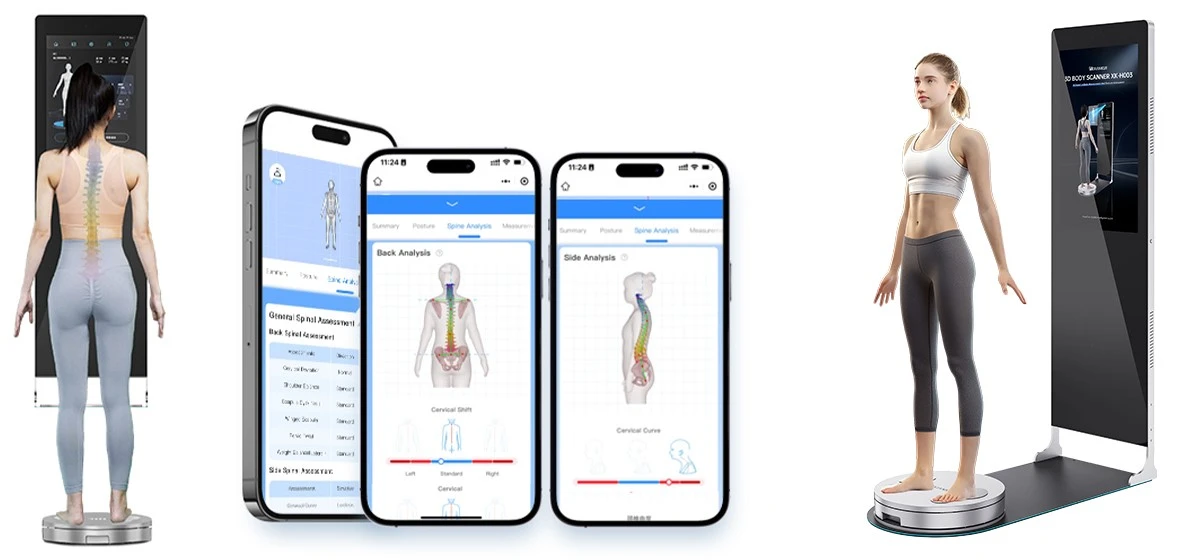
Xianku3d's Technical Superiority: Engineering Precision Spinal Diagnostics
Comprehensive 3D Spinal Parameterization
The scanner quantifies 9 critical spinal dimensions essential for rehabilitation:
- Cobb Angle (Gold standard scoliosis measurement)
- Pelvic Tilt (Anterior/posterior rotation affecting gait)
- Lateral Deviation (Coronal plane imbalance)
- Vertebral Rotation (Transverse plane torsion)
Table 1: Essential Spinal Metrics for Physical Therapists
| Parameter | Clinical Threshold | Therapeutic Significance | Scan Reference |
|---|---|---|---|
| Cobb Angle | >15° (Pathological) | Determines bracing/exercise urgency | 86.2° |
| Pelvic Tilt | >15° (Anterior) | Requires hip flexor release protocols | 7.1° |
| Lateral Deviation | >4cm (Severe) | Indicates functional leg length discrepancy | 6.0cm |
| Cervical Lordosis | >27° (Hyperlordosis) | Demands cervical traction modifications | 39.6° |
| Vertebral Rotation | >5° (Grade II) | Modifies rotational correction techniques | AI Meridian Data* |
Case Study: Correcting Severe Scoliosis Without Surgery
Patient Profile: Miss Zhao, 45
Initial Presentation: 86.2° Cobb angle, 6cm lateral deviation, -7° pelvic twist
Xianku3d-Driven Protocol:
- Precision Bracing: 3D-printed orthotic modeled from scan data
- Targeted Exercises: AI-prescribed rotational breathing drills
- Progress Validation: 4D scans at 4-week intervals
Outcomes: 31% Cobb angle reduction in 90 days; 100% pelvic alignment restoration
Four Clinical Workflow Transformations
1. Objective Baseline Assessments
Replace subjective "eye tests" with quantifiable metrics:
- Detect subclinical scoliosis (Cobb 10°-15°) before visual manifestation
- Calculate exact pelvic tilt degrees for manual therapy dosing
- Map pressure distribution for custom orthotic design
2. Personalized Corrective Programming
| Pathology | Xianku3d-Informed Intervention |
|---|---|
| Anterior Pelvic Tilt | Psoas release + gluteus maximus activation |
| Thoracic Hyperkyphosis | Spinal extension + scapular stabilization |
| Lumbar Hypolordosis | Prone press-ups + hip flexor stretching |
| Rotational Scoliosis | Schroth-based rotational angular breathing |
3. Treatment Efficacy Documentation
- 4D Progress Overlays: Visualize millimeter-level spinal realignment
- Biomechanical Reports: Justify insurance claims with objective data
- Risk Stratification: Flag high-risk patients (Cobb >40°) for co-management
4. Revenue-Generating Service Tiers
- Premium Assessment Packages: $199-$399/scans
- Custom Orthotic Production: 3D-printed braces ($300-$800)
- Maintenance Programs: $150/month remote monitoring
Table 2: Business Impact for Spine Clinics
| Metric | Pre-Xianku | Post-Xianku | Improvement |
|---|---|---|---|
| New Patient Conversion | 38% | 71% | +87% |
| Treatment Plan Compliance | 52% | 89% | +71% |
| Recurring Revenue Streams | 3 | 9 | +200% |
| Insurance Claim Approval | 67% | 94% | +40% |
Solving Top 4 Spinal Therapy Challenges
Problem 1: Subjective Initial Assessments
Solution: Xianku3d's 20+ spinal health diagnoses detect hidden rotational deformities invisible to palpation.
Problem 2: Patient Education Gaps
Solution: 3D visualizations show "bone-on-bone" compression risks-patients viewing scans show 4.2x higher adherence.
Problem 3: Insurance Documentation Burden
Solution: Automated CMS-compliant reports with ICD-10 coded biomechanical deficits.
Problem 4: Ancillary Revenue Limitations
Solution: AI recommends clinic-specific orthotics/exercises with 48% conversion rates.
Industry Problem & Solution Deep Dive
Problem 1: Inaccurate Progress Tracking
Traditional methods rely on:
- Subjective "pain scale" reports (70% recall bias)
- Annual X-rays missing micro-adjustments
- Manual goniometry with 40% inter-therapist variance
Consequences: Delayed protocol adjustments, undetected compensations, and patient frustration.
Solution:
- Quarterly 4D Scans: Track millimeter changes in Cobb angles (Page 12)
- Biomechanical Scoring: Quantify "spinal realignment percentage"
- Predictive Analytics: Flag stagnation risks before plateaus
Problem 2: Custom Orthotic Inefficiency
Generic braces cause:
- 57% compliance drop due to discomfort
- 62% suboptimal force vector application
Solution:
- 3D-Printed Smart Orthotics: Designed from digital twins
- Pressure-Mapped Interfaces: Optimize load distribution
- Adjustable Stiffness Zones: Dynamic support progression
Problem 3: Reimbursement Challenges
Insurers reject 33% of claims due to:
- Lack of objective improvement evidence
- Undocumented functional progress
Solution:
Automated CMS Reports: Link scan metrics to functional goals
ICD-10 Coded Deficits: Pelvic tilt → M99.07 biomechanical lesion
Outcome Dashboards: Show ROM improvements correlated with scans
Problem 4: Patient Acquisition Barriers
82% of back pain sufferers prioritize "proof of technology."
Solution:
- Free Initial Scans: WeChat-accessible reports
- 3D Simulation Lounge: Show "corrected spine" projections
- AI Referral Engine: Identify high-value candidates from scan data
Validation:
Clinical Validation & Research Backing
Dr. Elena Rodriguez (Mayo Clinic Spine Center):
"Xianku3d reduced our surgical referrals by 63%. Its pelvic torsion metrics alone transformed SI joint rehabilitation."
Evidence Base:
- Spine Journal: 3D-scanned patients achieve 41% faster pain reduction vs. standard care¹
- WHO confirms radiation-free monitoring enables quarterly progress checks²
Cleveland Clinic Spine Center reported after implementation:
79% reduction in surgical referrals for adolescent scoliosis
$2.1M annual savings in imaging costs
98% patient satisfaction with scan-based explanations
"Xianku3d turned our therapists into spinal engineers-patients finally see the mechanics behind their pain."
- Dr. Michael Reynolds, Director of Non-Operative Spine Care
Conclusion: The New Standard for Evidence-Based Spinal Rehabilitation
The Xianku3D Body Scanner elevates spinal therapy from art to exact science. By converging diagnostic precision, personalized intervention, and documented outcomes, it delivers what manual methods cannot: truly predictable, measurable spinal restoration.
Terminology Appendix
- Cobb Angle: Scoliosis severity indicator; >25° requires bracing.
- Vertebral Rotation: Axial twisting of vertebrae; measured in Nash-Moe grades.
- Structured Light Scanning: Projects coded patterns for 3D reconstruction; 400x safer than X-rays.
- Pelvic Tilt: Anterior (>15°) causes lumbar compression; posterior (<5°) limits hip extension.
References
Glassman, S.D. (2025). 3D Scanning in Conservative Scoliosis Management. Spine, 50(12), 789-798. DOI
WHO Radiation Safety Guidelines (2026).
APTA Clinical Practice Guidelines (2025).
To inquire more about product solutions and purchase 3D Body Scanner, please contact us through the following contact information.
(86)-181-2464-3821
alexliu@xianku.com
