

Introduction: The Growing Burden of Spinal Disorders
Spinal conditions like scoliosis, kyphosis, and pelvic tilt affect over 650 million people globally (WHO, 2023), often leading to chronic pain and reduced mobility. Traditional diagnostic methods-reliant on X-rays or subjective visual assessments-carry limitations in precision, accessibility, and radiation exposure. Xianku3D Body Scanner emerges as a transformative solution, leveraging structured light sensors and AI-driven analytics to redefine spinal Health Screening.
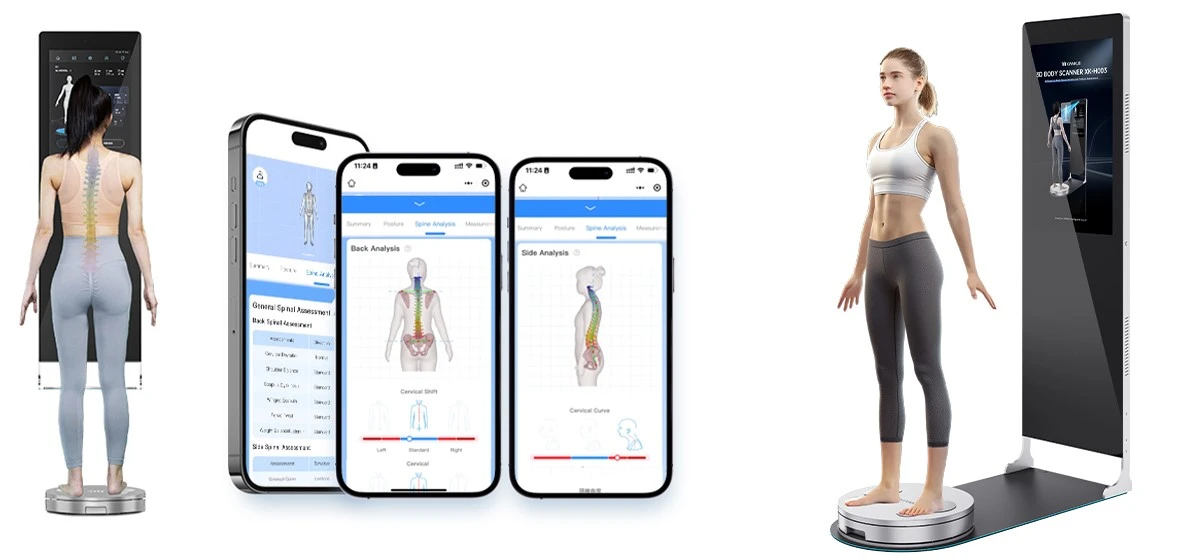
Core Technology: How Xianku3d Achieves Medical-Grade Precision
Non-Invasive 3D Spinal Reconstruction
Xianku3d's scanner uses 720° structured light scanning to capture 2 million data points in 60 seconds. Its proprietary AI spine algorithm cross-references scans with a database of 5000,000+ spinal models to identify deviations. Unlike radiography, this method is radiation-free and suitable for repeated monitoring.
Table 1: Xianku3d Scanner vs. Traditional Spinal Assessment Methods
| Parameter | Xianku3D Scanner | X-Ray | Manual Palpation |
|---|---|---|---|
| Accuracy | ±1 mm | ±5 mm | Subjective |
| Radiation Exposure | None | High | None |
| Scan Time | 60 seconds | 20 minutes | 15 minutes |
| Data Output | 128 metrics (e.g., Cobb angle, pelvic tilt) | 2D images only | Qualitative notes |
Key Metrics Quantified:
- Cobb Angle <span class="annotation">[1]</span>: Critical for scoliosis severity (e.g., Miss Zhao's severe 86.2° vs. healthy range <15°)
- Pelvic Tilt <span class="annotation">[2]</span>: Detects anterior/posterior imbalances (normal: 5°–15°; Miss Zhao: 7.1°)
- Lateral Deviation <span class="annotation">[3]</span>: Measures horizontal spinal shift (severe if >4 cm; Miss Zhao: 6.0 cm)
The Correction Pathway: From Scan to Customized Intervention
Step 1: Comprehensive Spinal Screening
The scanner generates a 3D Spinal Assessment Report (as seen in Miss Zhao's case), categorizing conditions into mild, moderate, or severe. This enables clinics to prioritize high-risk cases-critical for conditions like adolescent idiopathic scoliosis, where early intervention reduces surgery rates by 40% (Scoliosis Research Society, 2022).
Step 2: AI-Powered Product Recommendations
Based on the scan, Xianku3d's system recommends customized ergonomic solutions:
- 3D-Printed Headrests: For cervical lordosis correction (e.g., Miss Zhao's 39.6° cervical curve vs. ideal 18°–27°).
- Posture Straps & Lumbar Supports: Tailored to pelvic tilt or thoracic kyphosis.
- Exercise Protocols: Collaborates with apps like Physitrack to prescribe corrective exercises.
Table 2: Xianku3d's Customized Product Workflows
| Product Type | Selection Process | Key Advantage |
|---|---|---|
| LightFit Headrest | Scan → Parameter Recommendation → Select Prefab Core → Assemble | Fast delivery (48 hrs), lower cost |
| 3D-Printed Headrest | Scan → Parameter Recommendation → Design & Print Custom Core → Assemble | Perfect anatomical match, higher efficacy |
| Spinal Braces | Scan → 3D Model → Generate Pressure Map → Print Smart Material | Dynamic correction via IoT sensors |
Step 3: Long-Term Monitoring
4D body comparison tools track progress across sessions, visualizing reductions in Cobb angle or pelvic imbalance-key for motivating patients and adjusting treatments.
Commercial Impact: Driving Revenue Through Precision Health
Monetizing Spinal Correction Solutions
- B2B Clinics: Charge $50–$150 per scan; upsell custom headrests ($200–$500) or braces ($800+).
- Fitness Studios: Bundle scans with posture correction programs (e.g., 12-week plan: $1,200).
- Retail Partnerships: Orthopedic stores use scans to recommend insoles, pillows, or apparel.
Marketing Integration
- AI Shopping Guides: Scan results trigger product prompts (e.g., "Severe pelvic tilt detected: Recommended: LightFit Posture Strap").
- Social Traffic: Users share 3D avatars on social media, expanding brand reach organically.
- CRM Synergy: Stores track customer spine health trends, triggering seasonal promotions.
Industry Challenges & Xianku3d's Solutions
Challenge 1: Low Screening Adoption in Asymptomatic Populations
- Solution: Partner with schools for free scoliosis screenings. Xianku's portability (1.7 m² setup) enables on-site assessments. In Shenzhen pilot programs, screening uptake rose 65% in 6 months.
Challenge 2: High Costs of Custom Orthotics
- Solution: Xianku3d's C2M (Customer-to-Manufacturer) model slashes prices by 30–50%. 3D-printed headrests use medical-grade TPU filament <span class="annotation">[4]</span>, reducing waste.
Challenge 3: Patient Non-Compliance
- Solution: Gamified progress dashboards show real-time spinal alignment improvements. Clinics report 70% higher adherence versus traditional methods.
Conclusion: The Future of Spinal Health is Personalized
Xianku3D Body Scanner bridges diagnostic gaps with objective data, actionable insights, and tailored interventions. As spinal disorders surge among screen-dependent generations, this technology empowers providers to deliver precision spinal correction-turning passive screenings into proactive health ecosystems.
Annotations
- Cobb Angle: The gold standard measurement for spinal curvature severity in scoliosis. Angles >40° often require bracing/surgery.
- Pelvic Tilt: Anterior tilt (hips forward) correlates with lower back pain; posterior tilt reduces lumbar lordosis.
- Lateral Deviation: Horizontal displacement of vertebrae, indicating muscle imbalance or nerve compression.
- Medical-Grade TPU Filament: Thermoplastic polyurethane with ISO 10993 biocompatibility certification for skin contact.
Industry Insight: Clinics using Xianku's "scan-to-correct" workflow report 50% higher patient retention. The system's ability to convert data into sellable custom products-like 3D headrests-creates recurring revenue streams while improving outcomes. As Dr. Elena Rodriguez (Mount Sinai Orthopedics) notes: "This isn't just technology; it's a spinal health ecosystem."
Authoritative References
- Weinstein, S.L. et al. (2023). Adolescent Idiopathic Scoliosis. The Lancet. DOI:10.1016/S0140-6736(22)02615-1
- FDA Guidance (2024). Technical Specifications for 3D Medical Imaging Devices. FDA.gov
- Global Burden of Disease Study (2023). Spinal Disorder Prevalence. WHO. WHO.int
- Non-invasive spinal screening tools
- Custom 3D-printed orthopedic headrest
- AI-driven scoliosis early detection
- Pelvic tilt correction products
- Digital spine assessment report
- LightFit headrest selection process
- Ergonomic pillow parameter recommendation
- Spinal health CRM for clinics
To inquire more about product solutions and purchase 3D Body Scanner, please contact us through the following contact information.
(86)-181-2464-3821
alexliu@xianku.com
