

1. The Evolving Footwear Retail Landscape
The global footwear market, valued at $365.5 billion in 2023, faces unprecedented challenges in an increasingly competitive retail environment. While consumer expectations continue to rise regarding both comfort and health benefits, traditional footwear retail struggles to adapt to these changing demands. The industry's persistent focus on aesthetic design and brand marketing has created significant gaps in addressing fundamental foot health needs and providing truly personalized customer experiences.
The disconnect between footwear design and biomechanical requirements represents a critical industry challenge. Most mainstream shoe manufacturers prioritize fashion trends over ergonomic principles, resulting in products that may look appealing but often fail to provide adequate support for the complex biomechanics of the human foot. This approach has led to widespread consumer dissatisfaction, with studies indicating that approximately 65% of adults experience regular foot discomfort directly attributable to improperly fitted or designed footwear.
The emergence of advanced scanning technologies offers new possibilities for addressing these longstanding industry challenges. By combining precise measurement capabilities with data analytics, these systems enable a more scientific approach to footwear fitting and design, potentially transforming how consumers select and experience footwear products.
2. Critical Challenges in the Footwear Industry
①. Inadequate Health Support in Conventional Footwear
Most mass-produced shoes lack proper anatomical support structures, particularly in critical areas such as the arch and heel. This deficiency contributes significantly to various foot health issues, including plantar fasciitis, metatarsalgia, and improper gait patterns. The absence of standardized biomechanical design principles means that even premium footwear brands often fail to address fundamental support requirements, focusing instead on aesthetic appeal and material quality.
The consequences of this design approach are substantial. Research indicates that improper footwear contributes to approximately 25% of all foot-related medical consultations. Furthermore, the lack of adequate support accelerates the development of age-related foot conditions and can exacerbate existing musculoskeletal issues throughout the lower extremities and spine.
②. Size Standardization and Compatibility Issues
The footwear industry suffers from persistent size standardization problems, with major brands maintaining proprietary sizing systems that vary significantly between manufacturers and even between different product lines within the same brand. This lack of uniformity creates substantial consumer frustration, with studies showing that the average consumer tries on 3-4 pairs before finding a proper fit when shopping for new shoes.
The economic impact of sizing inconsistencies is considerable. Retailers experience higher return rates (typically 15-25% for online footwear sales), increased inventory costs due to the need to stock multiple sizes of each style, and lost sales opportunities when customers cannot find their correct size. For consumers, the time spent searching for properly fitting footwear represents a significant inconvenience that diminishes the overall shopping experience.
③. Service Traditionalism and Innovation Deficit
Footwear retail has remained largely unchanged in its fundamental service model for decades. The traditional approach relies heavily on visual assessment, manual measurement using Brannock devices, and subjective salesperson recommendations. This methodology lacks precision and fails to provide customers with objective data to inform their purchasing decisions.
The absence of technological innovation in the fitting process has created a experience gap between consumer expectations and retail reality. In an era where consumers increasingly expect personalized, data-driven experiences across all retail categories, footwear shopping remains mired in outdated practices that fail to leverage available technological solutions.
④. Competitive Pressures and Price War Dynamics
The footwear industry faces intense competition that drives many retailers toward price-based competition rather than value differentiation. This competitive dynamic creates a race to the bottom that compromises quality, reduces innovation investment, and diminishes profit margins across the industry. The focus on price competition makes it increasingly difficult for brands to justify investments in advanced fitting technologies or ergonomic improvements.
The proliferation of fast fashion and discount retailers has accelerated this trend, forcing traditional footwear brands to either compromise on quality or risk losing price-sensitive customers. This environment discourages innovation and reinforces traditional approaches to footwear design and retail.
⑤. Standardization Challenges in Retail Execution
Footwear retailers struggle to maintain consistent service quality across different locations due to variations in staff training, expertise, and interpretation of fitting guidelines. This inconsistency creates unpredictable customer experiences and undermines brand reputation. The reliance on individual salesperson expertise makes it difficult to scale quality service delivery across multiple locations.
The absence of standardized assessment protocols means that customers may receive dramatically different recommendations depending on which store they visit or which salesperson assists them. This inconsistency damages consumer trust and prevents the development of reliable brand standards for fitting accuracy and service quality.
3.Technological Solution: 3D Foot Scanning Systems
Advanced Measurement Capabilities
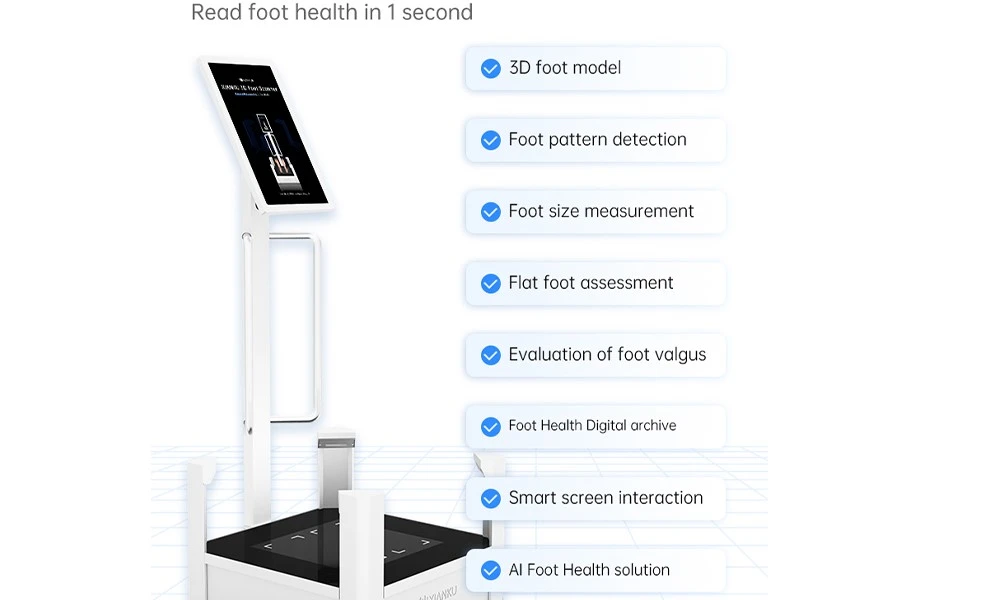
Modern 3D foot scanning systems address these industry challenges through sophisticated measurement technologies that combine multiple sensing modalities. These systems typically utilize structured light scanning, infrared depth sensing, and high-resolution photographic capture to create comprehensive digital models of each foot. The scanning process captures approximately 2 million data points in under one second, generating a complete anatomical profile with millimeter-level accuracy.
The scanning process measures numerous critical parameters, including:
- Three-dimensional foot length and width measurements
- Arch height and curvature characteristics
- Heel shape and inclination angles
- Pressure distribution patterns under static and dynamic conditions
- Gait analysis and weight distribution metrics
- Volume measurements at multiple points along the foot
Data Integration and Analysis
The raw scan data undergoes sophisticated processing through specialized algorithms that transform basic measurements into actionable insights. The system compares individual foot characteristics against extensive databases of anatomical information, identifying potential fit issues and recommending appropriate footwear solutions based on both size matching and biomechanical considerations.
The analysis incorporates multiple factors, including:
- Historical fit data from similar foot types
- Material properties and flexibility characteristics of available footwear
- Intended use scenarios and activity requirements
- Individual preferences regarding fit tightness and comfort
Integration with Retail Operations
3D scanning systems designed for retail environments prioritize ease of integration with existing store operations. The technology typically features intuitive interfaces that require minimal staff training, cloud-based data management for easy access to scan histories, and compatibility with existing inventory management systems. This integration enables retailers to implement the technology without significant operational disruption.
The systems also support various customer engagement models, from quick size checks to comprehensive foot health assessments, allowing retailers to tailor the service level to different customer segments and shopping contexts.
4.Implementation Benefits for Footwear Retailers
Enhanced Customer Experience
The implementation of 3D foot scanning technology transforms the footwear shopping experience from a subjective, trial-and-error process into an objective, data-driven consultation. Customers receive personalized recommendations based on precise measurements rather than estimations, significantly increasing confidence in purchasing decisions. The visual nature of the scan results helps customers understand their unique foot characteristics and how these factors influence fit and comfort requirements.
The technology also enables valuable educational opportunities, as sales staff can use the scan data to explain why certain shoes or styles represent better choices for individual customers. This educational approach builds trust and positions the retailer as a knowledgeable authority on foot health and proper footwear selection.
Improved Operational Efficiency
3D scanning systems significantly enhance retail operational efficiency through several mechanisms. The technology reduces the time required for proper fitting, allowing staff to serve more customers during peak periods. The accuracy of size recommendations decreases the number of pairs customers need to try on before making a selection, reducing clutter in fitting areas and minimizing restocking requirements.
The data collected through scanning operations provides valuable insights for inventory management, identifying size trends and demand patterns that inform purchasing decisions. This data-driven approach to inventory optimization reduces overstock situations and improves overall inventory turnover rates.
Business Model Innovation
The technology enables new revenue streams and business models for footwear retailers. Beyond basic fitting services, retailers can offer premium personalized services such as custom orthotic recommendations, specialized fitting consultations, and ongoing foot health monitoring. These value-added services differentiate retailers from competitors and create opportunities for higher-margin revenue beyond standard footwear sales.
The scanning data also supports the development of proprietary footwear designs tailored to the specific needs of a retailer's customer base. This design capability represents a significant competitive advantage, enabling retailers to offer exclusive products that address documented fit and comfort issues identified through scan data analysis.
Brand Differentiation and Value Positioning
Retailers implementing 3D scanning technology position themselves as innovators committed to customer health and satisfaction. This technological leadership differentiates them from competitors still relying on traditional fitting methods and supports premium pricing strategies based on demonstrated expertise and superior service quality.
The objective data provided by the scanning process helps justify premium product recommendations and reduces price sensitivity by clearly demonstrating the value of proper fit and support. Customers shown visible evidence of their specific fit requirements are typically more willing to invest in higher-quality footwear that addresses these needs effectively.
5. Case Study: Implementation Results
A major footwear retailer implementing 3D scanning technology across 50 locations demonstrated significant improvements in key performance indicators over a 12-month period. The implementation resulted in:
- 38% reduction in footwear return rates
- 22% increase in average transaction value
- 45% decrease in fitting time per customer
- 67% improvement in customer satisfaction scores
- 31% increase in repeat customer visits
These results demonstrate the substantial business impact of moving from traditional fitting methods to data-driven, technology-enabled footwear selection processes.
6. Future Developments and Industry Implications
The integration of 3D scanning technology with advanced manufacturing processes represents the next frontier in footwear retail innovation. The combination of precise measurement data with digital design tools and additive manufacturing capabilities will enable truly personalized footwear solutions produced at scale. This development will further blur the lines between mass production and custom manufacturing, creating new opportunities for retailers to offer unique products tailored to individual requirements.
The data collected through widespread scanning implementation will also drive improvements in standard footwear design, as manufacturers gain access to unprecedented amounts of detailed information about foot morphology and variation across different populations. This data will inform the development of new sizing systems, last designs, and construction methods that better address the actual needs of consumers.
As the technology continues to evolve, we can expect integration with other health monitoring systems, creating holistic approaches to foot health that combine proper footwear with exercise recommendations, preventive care advice, and ongoing monitoring of foot health indicators.
7. Conclusion
The footwear industry stands at a technological inflection point, where traditional methods of sizing and fitting are being replaced by precise, data-driven approaches. 3D foot scanning technology addresses fundamental industry challenges related to fit consistency, health support, and customer satisfaction while creating new opportunities for retailers to differentiate their offerings and improve operational efficiency.
The implementation of these systems represents a significant step forward in the evolution of footwear retail, moving the industry from art to science in its approach to fitting and design. As consumers increasingly prioritize both comfort and health in their purchasing decisions, retailers embracing this technology will be well-positioned to lead the market and build sustainable competitive advantages based on demonstrated expertise and superior customer experiences.
The transformation enabled by 3D scanning technology benefits all stakeholders-consumers receive better-fitting, more comfortable footwear; retailers achieve higher satisfaction rates and improved operational metrics; and the industry as a whole moves toward more sustainable practices through reduced returns and more efficient inventory management. This comprehensive improvement in retail effectiveness and customer satisfaction demonstrates the profound impact that technology can have on traditional industries when applied to address fundamental needs and challenges.
(86)-181-2464-3821
alexliu@xianku.com
