

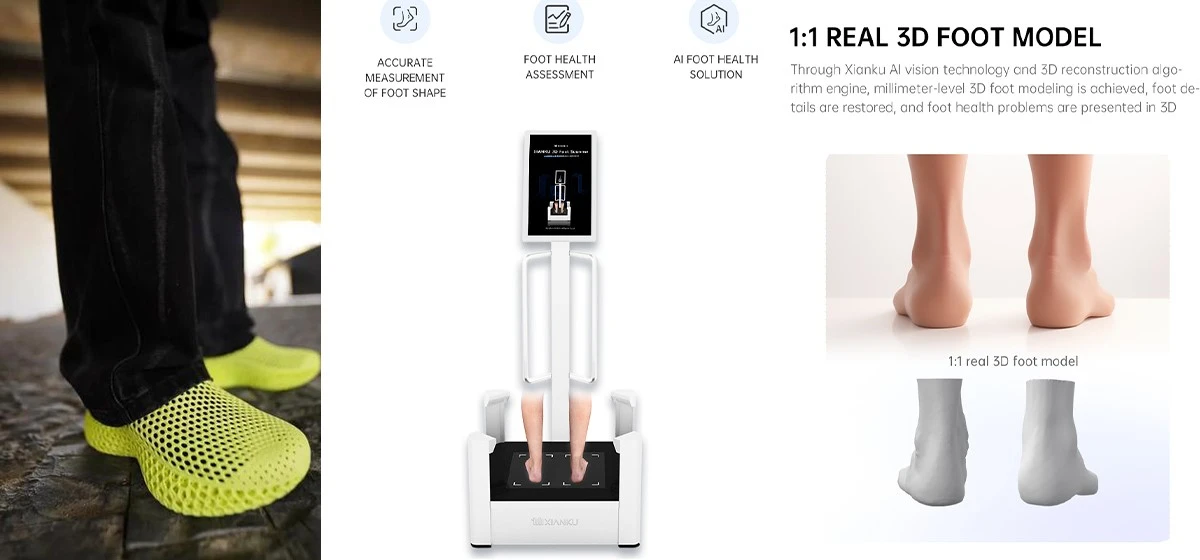
As additive manufacturing continues its gradual march toward commercial maturity, its presence across the footwear industry has expanded noticeably. What began as experimentation with lattice structures, midsoles and rapid prototyping has evolved into a legitimate product category-3D printed footwear-offered by globally recognized performance and lifestyle brands. Yet the industry remains in a transitional phase. While the technology demonstrates immense potential, the market has not fully aligned the capabilities of 3D printing with real consumer needs, particularly in areas related to functional performance and foot health.
This white paper examines the underlying challenges of the 3D printing market, analyzes why 3D printed footwear has not yet reached its expected consumer relevance, and outlines how foot scan technology-specifically the Xianku3d Foot Scanner-can provide the structural foundation and data intelligence necessary for the future of personalized, health-focused, and value-driven 3D footwear solutions.
I. Challenges Across the 3D Printing Industry
Before understanding the bottlenecks of 3D printed footwear, it is necessary to look at the broader context of the 3D printing sector itself.
1. Limited Talent Maturity
The commercialization of 3D printing is still relatively recent. Many industries that wish to adopt additive manufacturing struggle to find specialists in modeling, engineering optimization, and product integration. This shortage of experienced engineers slows down the speed at which businesses can scale innovation.
2. Low Manufacturing Efficiency
Compared with traditional assembly-line manufacturing, 3D printing is inherently slower. Even with optimized slicing software and improved hardware, single-unit print cycles for footwear components often require hours. This makes high-volume production challenging and makes 3D printed footwear a category that relies heavily on brand storytelling rather than real mass-market efficiency.
3. High Operational Costs
Due to extended print cycles, brands must spread the costs of materials, human labor, floor space, and machine depreciation across fewer finished products. The result is a price point significantly higher than that of conventional shoes, particularly in the performance and lifestyle segments.
4. Weakness in Consumer Necessity
Today, 3D printed footwear is typically perceived as a novelty-an item associated with innovation, experimentation, or futuristic design. While the category has seen remarkable attention, it still lacks the "non-negotiable" consumer value required to justify higher costs.
These industry-wide constraints directly influence the challenges currently faced by 3D printed footwear.
II. The State of 3D Printed Footwear and Its Market Position
Several global brands have contributed to the credibility and visibility of this emerging category.
1. Adidas Futurecraft 4D
Adidas leveraged Digital Light Synthesis technology to produce one of the industry's most commercially successful 3D printed midsoles. Futurecraft 4D became the benchmark for performance-oriented lattice structures, showcasing impressive rebound and controlled energy return. Despite this achievement, production remained limited due to the cost and time associated with printing.
2. Under Armour ArchiTech
Under Armour's ArchiTech line was an early proof-of-concept demonstrating how 3D printing could introduce architectural midsole structures impossible to produce through molding. Though the project received strong media attention, it did not progress to large-scale commercialization due to production inefficiencies.
3. Zellerfeld
As a company built entirely around 3D printing, Zellerfeld has pushed boundaries through fully printed one-piece uppers, midsoles, and outsoles. The brand champions personalization and on-demand production. However, even with this future-forward model, print speed and cost remain dominant challenges preventing mass adoption.
Across all these leading brands, the missing link is clear: 3D printed footwear has not yet unlocked its true competitive advantage-precision personalization driven by measurable foot health data.
III. Current Limitations of 3D Printed Footwear
Even though the technology allows for structural freedom and imaginative design possibilities, several core limitations persist:
1. Efficiency Constraints
The slow speed of additive manufacturing prevents fast turnaround and makes it difficult to justify high-volume releases. Slow print cycles also discourage the type of customization that 3D printing should naturally enable.
2. High Production Cost
Each pair of 3D printed footwear carries significant costs due to labor, material waste, and machine usage. Many brands pass these costs directly to the consumer, resulting in retail prices far above conventional footwear.
3. Lack of Functional Personalization
Ironically, the strongest value proposition of 3D printing-customized design based on individual foot structure-remains largely untapped. Most 3D printed footwear on the market today offers generalized lattice geometries rather than functionally tailored designs.
4. Missing Health-Oriented Value
Consumers increasingly seek shoes that support natural movement, correct alignment, and prevent foot issues such as plantar fasciitis, flat feet, or hallux valgus. Yet current 3D printed footwear seldom incorporates medically informed design due to the absence of precise foot data.
This is where foot scan technology becomes essential.
IV. Why Foot Scan Technology Is the Missing Foundation for 3D Printed Footwear
A foot scan does more than capture measurements-it provides insights into foot mechanics, pressure distribution, arch type, pronation tendencies, and potential musculoskeletal concerns. When paired with 3D printed footwear, foot scan data becomes the engine that drives true personalization.
Foot scan technology allows designers, brands, and retailers to:
- Identify foot abnormalities
- Recommend functional shoe features
- Tailor lattice density and geometry
- Add arch support, heel guidance or cushioning as needed
- Shift the consumer mindset from buying shoes to buying health
The Xianku3d Foot Scanner is among the few systems capable of closing this loop.

V. Xianku3d Foot Scanner: Enabling Healthy, Insight-Driven 3D Printed Footwear
The Xianku3d Foot Scanner delivers a comprehensive hardware-software ecosystem designed to enhance product design, upgrade retail experiences, and improve the functional performance of 3D printed footwear. It addresses all major industry bottlenecks through measurable and repeatable data intelligence.
1. Precision-Based Data Collection (32 Foot Metrics)
The scanner captures more than 32 anatomical dimensions, including:
| Foot Measurement Category | Example Metrics | Application in 3D Printed Footwear |
|---|---|---|
| Length & Width | Foot length, forefoot width | Size precision, toe box optimization |
| Height & Depth | Arch height, instep depth | Personalized arch support design |
| Alignment & Angles | Heel valgus/varus angle | Stability features, heel cup tailoring |
| Structural Categories | Foot volume, girth | Upper fit and closure mechanism design |
The result is a highly detailed 3D foot model that forms the foundation of personalized footwear design.
2. Foot Health Interpretation
Beyond measurement, the system analyzes foot conditions such as:
- Flat feet
- High arches
- Heel valgus/varus
- Hallux valgus
- Structural asymmetry
- Pressure-related risk zones
Foot scan insights shift sales conversations from style preferences to health priorities, increasing consumer trust and elevating perceived product value.
3. Personalized 3D Printed Footwear Recommendations
Based on the foot scan results, customers receive tailored footwear solutions:
- Flat-foot customers receive 3D printed footwear with corrective arch support
- High-arch users receive elevated cushioning geometries
- Heel misalignment is matched with stabilizing heel contouring
- Big-toe deformities are paired with expanded forefoot zones
This establishes a direct connection between foot health data and the functional design of 3D printed footwear.
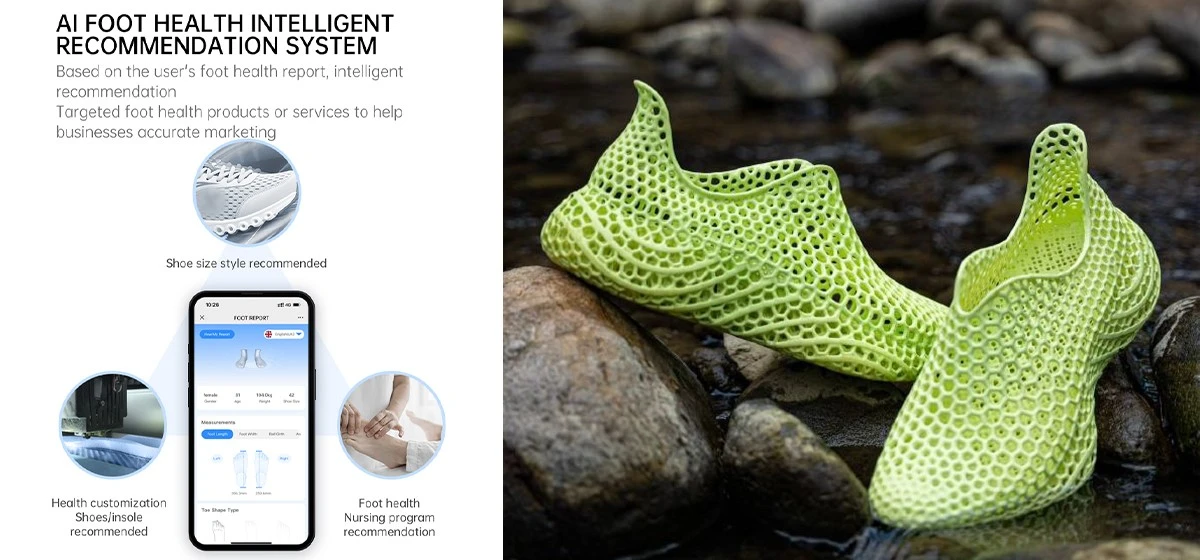
4. A Fully Integrated AI-Driven Sales Loop
The Xianku3d system structures retail services into a standardized flow:
| Service Step | Description | Customer Value |
|---|---|---|
| Foot Scan | 20–30 second capture of the full foot anatomy | Engaging tech-driven experience |
| Foot Health Analysis | AI reads structural markers and risk signs | Clear understanding of foot condition |
| Data Interpretation | Alignment, arch type, morphology | Education-driven buying behavior |
| AI Product Recommendation | Matches 3D printed footwear options | Personalization and confidence |
| Transaction & Follow-up | Data stored for future use | Customer lifetime value |
This elevates the buyer journey from a transactional purchase to a guided health and wellness evaluation.
5. Standardized In-Store Operations
The structured process ensures consistent service quality across all retail locations. Staff members need less specialized training, and the system guarantees objective, data-backed recommendations.
6. Digital Customer Management
Each customer receives an automatically generated profile that includes:
- Foot scan history
- Foot health records
- Recommended footwear
- Name
- Contact Information
Brands can use this data for private domain marketing, personalized follow-up, and long-term engagement.
7. Multi-Channel Monetization Opportunities
By identifying foot issues, the system introduces additional product recommendations:
- Functional insoles
- Hallux valgus correctors
- Arch support modules
- Stability devices
3D printed footwear becomes a gateway to broader health-based retail strategies.
8. Big Data for Product Innovation
Aggregated foot scan data can support:
| Application Area | Benefit to Brands |
|---|---|
| Product R&D | Build foot-shape-informed midsole geometries |
| Inventory Optimization | Reduce size-related unsold stock |
| Online Fit Precision | Lower return rates |
| Customization Algorithms | Improve conversion rates |
This data ecosystem strengthens the business model for brands using 3D printed footwear.
VI. Future Outlook: Health-Driven Personalization as the Core Value of 3D Printed Footwear
The 3D printing industry will not overcome its production limitations in the near term. Print cycles will remain slow, and the cost structure will remain elevated. Therefore, the future of 3D printed footwear does not lie in novelty or visual appeal-it lies in functional customization supported by medical-grade data.
By integrating foot scan technology with 3D printed footwear, brands can:
- Justify premium pricing
- Create differentiated functional designs
- Enhance customer experience
- Build long-term loyalty through health-driven solutions
This represents a shift from "printing a shoe" to "printing the right shoe for the right foot."
Conclusion
The footwear industry is entering a new era where health, personalization, and digital intelligence are becoming central to consumer decision-making. While 3D printed footwear showcases immense potential, it has yet to fulfill its promise due to the absence of accurate foot data and health-driven design frameworks. The Xianku3d Foot Scanner provides the missing foundation-turning 3D printing from a novelty-driven product into a value-driven solution built on measurable biomechanical insight.
When foot scan technology and 3D printed footwear are fully integrated, the footwear industry will achieve what it has long envisioned: truly personalized, health-enhancing, data-informed products that redefine the meaning of customization.
