

When most people think about mattress fit, they consider two metrics: height and weight. A tall person needs a longer mattress. A heavy person needs a firmer mattress. Right?
Wrong.
Height and weight are useful starting points, but they tell you almost nothing about how a person actually interacts with a sleep surface. Two people with identical height and weight can have completely different body shapes-and completely different mattress requirements.
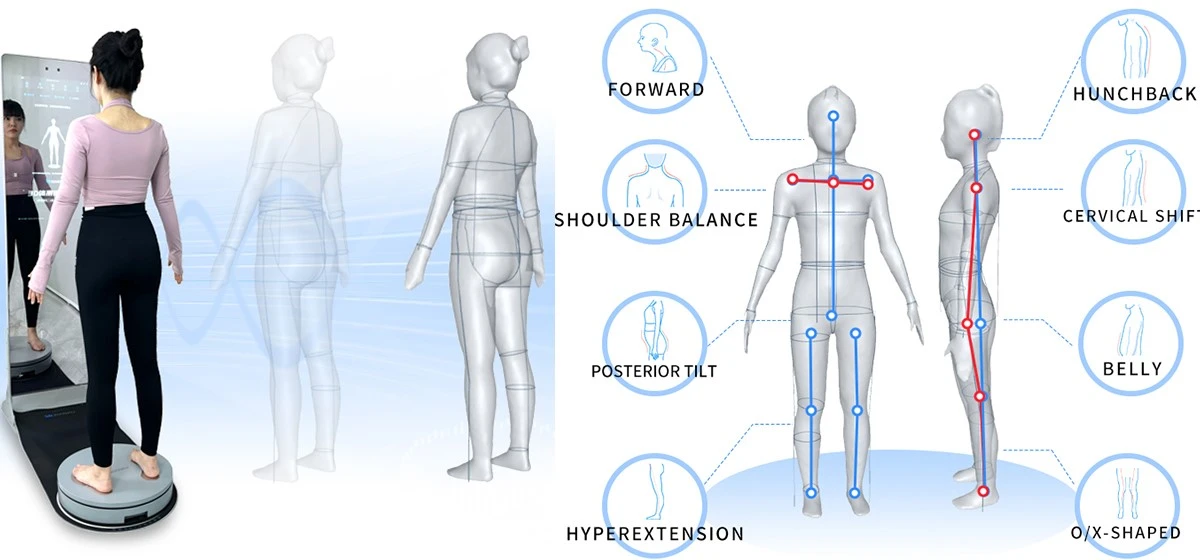
This is why Xianku captures 45 body circumference measurements at key anatomical landmarks. These measurements reveal the three-dimensional geometry of the body, providing the data needed to map pressure distribution, predict sleep position, and recommend optimal support zones.
Beyond BMI: The Limitations of Simple Metrics
Body Mass Index (BMI) is widely used but deeply flawed for individual assessment. BMI doesn't distinguish between muscle and fat, doesn't account for distribution, and tells you nothing about shape.
Consider these two individuals:
- Person A: 5'10", 180 lbs, broad shoulders, narrow hips, athletic build
- Person B: 5'10", 180 lbs, narrow shoulders, wide hips, sedentary build
Both have identical height, weight, and BMI. But their mattress requirements are completely different:
- Person A, a side sleeper, needs significant shoulder zone give to accommodate broad shoulders
- Person B, a side sleeper, needs less shoulder give but more hip zone accommodation
Without circumference measurements, a mattress recommendation cannot distinguish between these two individuals.
The 45 Measurements: A Comprehensive Map
Xianku's 3D scanner captures 45 distinct circumference measurements. These are not arbitrary-each corresponds to a specific anatomical landmark or functional region:
Neck and Shoulders (5 measurements)
- Neck circumference
- Shoulder circumference (across deltoids)
- Upper arm circumference (bilateral)
- Shoulder breadth (acromion to acromion)
Torso (12 measurements)
- Chest circumference (at nipple line)
- Underbust circumference
- Waist circumference (narrowest point)
- Abdominal circumference (at navel)
- High hip circumference
- Hip circumference (widest point)
- Lumbar circumference (at L4-L5 level)
Upper Body Segments (8 measurements)
- Upper thoracic circumference
- Mid-thoracic circumference
- Lower thoracic circumference
- Axillary circumference (armpits)
Lower Body (12 measurements)
- Thigh circumference (upper, mid, lower)
- Knee circumference
- Calf circumference
- Ankle circumference
Regional Segments (8 measurements)
- Lateral trunk (right and left)
- Anterior-posterior depth at multiple levels

The Sleep-Specific Measurements
While all 45 measurements contribute to the complete biomechanical profile, certain measurements are particularly critical for sleep assessment:
Shoulder Breadth
The distance between the acromion processes (shoulder peaks). For side sleepers, this measurement largely determines pillow height. The ideal pillow should fill the gap between the neck and the mattress-a gap approximately equal to shoulder breadth minus mattress contouring depth.
Hip Breadth
The distance between the greater trochanters (widest points of the hips). For side sleepers, this measurement determines how much hip sinkage is needed. A mattress that doesn't accommodate hip breadth forces the pelvis into lateral tilt, straining the lumbar spine.
Shoulder-to-Hip Ratio
The ratio of shoulder breadth to hip breadth predicts sleep position preference:
- Ratio > 1.2: Likely side sleeper (shoulders wider than hips)
- Ratio 0.9-1.1: Likely back or stomach sleeper (shoulders and hips similar width)
- Ratio < 0.9: Likely side sleeper (hips wider than shoulders)
Waist-to-Hip Ratio
The ratio of waist circumference to hip circumference affects lumbar support requirements:
- Higher ratio (narrow waist, wide hips): Requires more lumbar support to prevent the pelvis from rotating
- Lower ratio (similar waist and hip circumference): Requires less specialized lumbar support
Lateral Trunk Depth
The depth of the torso from front to back at various levels affects mattress contouring requirements. A deeper torso requires more give to allow the spine to remain neutral during side sleeping.
Body Shape Classification
Xianku's AI uses the 45 measurements to classify body shape into one of several categories-each with different mattress implications:
| Body Shape | Characteristics | Mattress Implications |
|---|---|---|
| Apple | Wider torso, narrower hips | Lumbar support critical; risk of lower back sinking |
| Pear | Narrower shoulders, wider hips | Hip zone accommodation needed for side sleepers |
| Rectangle | Similar shoulder and hip width | Balanced support; less zone variation needed |
| Hourglass | Shoulders and hips similar, narrow waist | Lumbar support critical; significant zone variation needed |
| Inverted Triangle | Broad shoulders, narrower hips | Shoulder zone accommodation critical for side sleepers |
| Athletic | Broad shoulders, narrow waist, muscular | Balanced support with firm zones for muscle mass |
Body Composition Integration
Circumference measurements are complemented by body composition analysis, which estimates:
- Body fat percentage
- Muscle mass
- Bone mass
- Visceral fat level
Body composition affects mattress performance in several ways:
Muscle Mass
Muscular individuals have higher tissue density, meaning they exert greater pressure on mattress surfaces relative to their body weight. This may require firmer support in muscular zones.
Adipose Tissue
Fat tissue is less dense than muscle and provides natural contouring. Individuals with higher body fat percentages may require less mattress contouring in soft tissue areas.
Bone Prominences
Individuals with low body fat have more prominent bony landmarks (shoulders, hips, spine). These areas require more pressure relief to prevent discomfort and tissue ischemia.
The Circumference-to-Support Algorithm
Xianku's AI translates circumference measurements into specific support recommendations:
Step 1: Identify Pressure Zones
Using circumference data at multiple levels, the AI identifies the points of maximum breadth-these correspond to pressure zones.
Step 2: Calculate Pressure Magnitude
For each zone, the AI estimates pressure magnitude based on:
- Circumference (broader zones carry more weight)
- Body composition (muscle vs. fat distribution)
- Body weight (total load)
Step 3: Determine Required Give
Required give (how much the mattress must compress) is calculated as:
Required Give = (Zone Breadth × sin(Position Angle)) - (Adjacent Zone Support)
Step 4: Map to Firmness
Required give is translated to ILD (firmness) values using algorithms that account for body weight, composition, and sleep position.
Real-World Application: The Side Sleeper
Let's see how circumference measurements affect a side sleeper's mattress requirements:
User A: Broad Shoulders, Narrow Hips
- Shoulder breadth: 19.5"
- Hip breadth: 15"
- Lateral trunk depth: 9"
Analysis
The broad shoulders require significant shoulder zone give to allow proper sinkage. The narrow hips require less hip zone give. The deep trunk requires adequate overall mattress thickness to prevent bottoming out.
Recommendation
- Shoulder zone: Soft (ILD 18-20)
- Lumbar zone: Firm (ILD 30-32)
- Hip zone: Medium (ILD 24-26)
- Total mattress thickness: Minimum 12" to accommodate deep trunk
User B: Narrow Shoulders, Wide Hips
- Shoulder breadth: 16"
- Hip breadth: 18.5"
- Lateral trunk depth: 8"
Analysis
The narrow shoulders require less shoulder zone give. The wide hips require significant hip zone give to prevent pelvic tilt. The shallower trunk allows for slightly thinner mattress construction.
Recommendation
- Shoulder zone: Medium (ILD 24-26)
- Lumbar zone: Firm (ILD 30-32)
- Hip zone: Soft (ILD 18-20)
- Total mattress thickness: 10" minimum
Both users are side sleepers with similar height and weight-but their circumference profiles generate completely different mattress recommendations.
Tracking Changes Over Time
One of the most powerful applications of circumference measurement is trend tracking. The Xianku CRM system stores scan data over time, allowing users to:
- Track weight changes and body composition shifts
- Monitor posture improvements from interventions
- See how body changes affect mattress requirements
- Receive updated recommendations as their body evolves
For businesses, this creates a recurring engagement opportunity. A customer scanned six months ago may now have different mattress needs-creating a reason to return.
The Visual Component
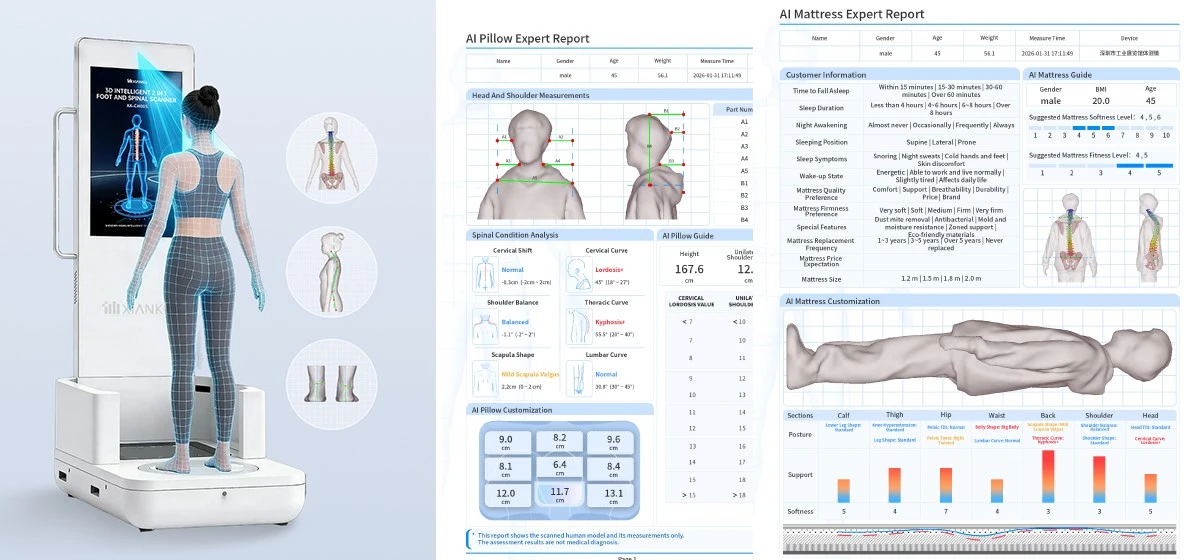
Circumference measurements are most powerful when visualized. Xianku's reports include:
3D Body Model
The 1:1 realistic model shows the user their body shape from any angle. This visual confirmation builds trust in the data.
Circumference Graphs
Radial graphs showing circumference at each measurement point allow users to see their body shape at a glance.
Comparison Views
Side-by-side comparisons of current and previous scans show progress over time.
The Bottom Line
Height and weight are not enough. Mattress selection requires understanding the three-dimensional geometry of the body-the curves, the proportions, the distribution of mass.
With 45 circumference measurements, Xianku captures this geometry with precision. The result is mattress recommendations that fit the body, not just a statistical average.
In our next article, we'll explore how leading bedding brands are using this technology to transform their businesses-and how you can too.
