

The Hidden Cost of Raising the Next Generation of Innovators
In 2026, parents around the world are facing a paradox that few anticipated a decade ago.
On one hand, governments, schools, and technology leaders continue to promote STEAM education, coding literacy, robotics, and AI learning as essential future skills. Children aged 7–14 are enrolling in programming bootcamps, participating in robotics competitions, attending virtual STEM classes, and spending increasing amounts of time in front of digital devices.
On the other hand, pediatric health specialists are reporting a growing epidemic of posture-related musculoskeletal issues among children.
The challenge has become so widespread that many healthcare professionals now refer to it as "The Digital Posture Crisis."

A generation being trained to build the future may simultaneously be developing physical problems that could affect their long-term health.
Among these issues, one condition is attracting particular attention:
Text Neck Syndrome in Young Coders
Children learning programming often spend hours:
- Looking downward at laptops
- Working on tablets
- Participating in online coding classes
- Playing educational games
- Using smartphones for learning activities
Over time, prolonged forward head posture can create a phenomenon known as:
Cervical Shift (Forward Head Posture)
- Common warning signs include:
- Rounded shoulders
- Neck extension abnormalities
- Shoulder imbalance
- Reduced cervical mobility
- Upper back tension
- Early spinal alignment changes
The concerning reality is that these changes often develop gradually and remain invisible to parents until the condition becomes significant.
By the time symptoms appear, corrective intervention may already require substantial effort.
This raises a critical question:
How can parents identify posture risks before they become health problems?
Why Traditional Posture Checks Are No Longer Enough
For years, posture assessment relied on:
- Visual observation
- Manual spinal screening
- Photographic comparisons
- Basic body measurements
These methods present several limitations:
Subjective Judgement
Different practitioners may reach different conclusions.
Lack of Quantifiable Data
Parents cannot accurately track whether a child's posture is improving or worsening over time.
Limited Visualization
Children often struggle to understand abstract posture explanations.
Inefficient Follow-Up
Without digital records, long-term monitoring becomes difficult.
As children's screen exposure continues to increase, families need a more precise, scalable, and data-driven approach.
The Rise of AI Posture Screening
Recent advances in artificial intelligence, 3D imaging, and structured-light scanning have enabled an entirely new category of posture assessment technologies.
Instead of guessing spinal alignment from a photograph, modern systems can reconstruct the body in three dimensions and analyze skeletal relationships with remarkable accuracy.
This is where the next generation of digital posture intelligence emerges.
How XIANKU Brings Preventive Health Into the Digital Age
The XIANKU 3D Body Scanning Mirror represents a significant technological leap beyond traditional posture assessment.
Rather than relying on 2D images or manual measurements, the system uses:
Non-Radiation 3D Structured Light
Unlike X-rays, the system utilizes non-radiation 3D structured light technology, making it suitable for repeated monitoring and routine posture screening.
Parents can assess children regularly without concerns about radiation exposure.
1:1 Realistic 3D Human Body Models
The scanner generates 1:1 Realistic 3D human body models that accurately recreate body shape and posture.
This provides several advantages:
- Real body contour visualization
- Accurate posture tracking
- Full-body alignment analysis
- Objective comparison over time
Instead of hearing that posture is "slightly improving," families can actually see the changes.
AI Visualized Skeleton Display
One of the most powerful innovations is the AI visualized skeleton display.
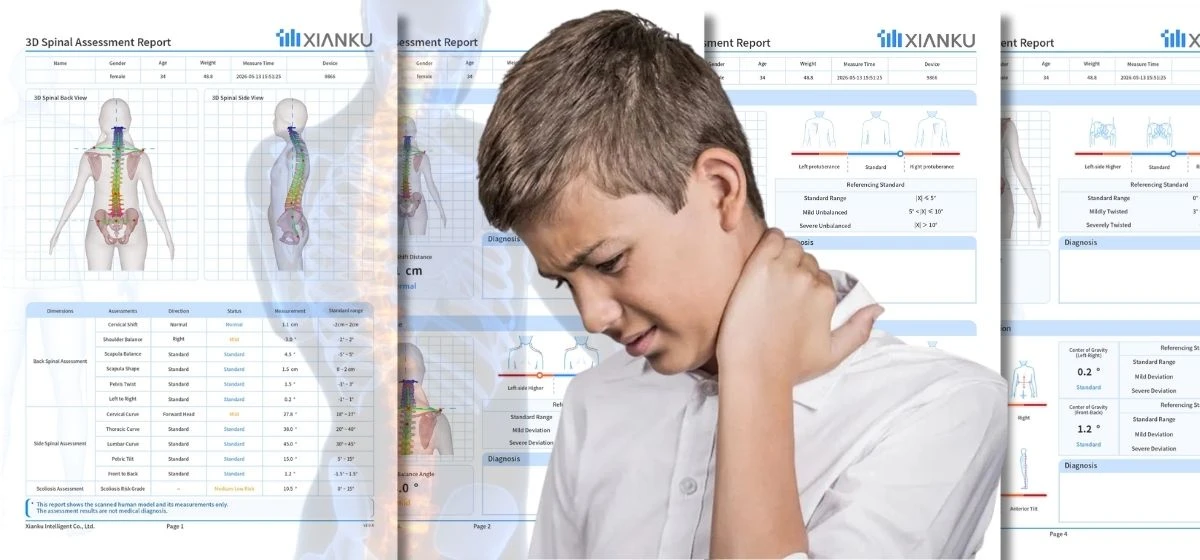
Through AI-powered skeletal reconstruction, the system can clearly visualize:
- Cervical alignment
- Shoulder balance
- Pelvic balance
- Center of gravity deviation
- Scoliosis risk indicators
- Thoracic and lumbar curvature
For children who spend long hours coding or studying online, this visualization makes posture issues understandable and actionable.
Parents no longer need to interpret complex medical terminology.
The data becomes intuitive.
Detecting Text Neck Before It Becomes a Problem
The biggest advantage of AI posture screening is prevention.
The XIANKU system can complete:
Automated Musculoskeletal Screening in 20 Seconds
Within approximately 20 seconds, the scanner evaluates:
- Forward head posture
- Cervical shift
- Rounded shoulders
- Neck extension abnormalities
- Shoulder asymmetry
- Pelvic tilt
- Body balance indicators
This rapid assessment allows families to incorporate posture monitoring into regular wellness routines.
Instead of waiting for discomfort or pain, intervention can begin at the earliest stages.

Why Longitudinal Tracking Matters
Children's bodies change rapidly between ages 7 and 14.
A single posture assessment provides a snapshot.
True preventive care requires trend analysis.
XIANKU enables:
Body Trend Comparison
Using historical scans, parents and practitioners can monitor:
- Postural progression
- Growth-related changes
- Corrective exercise outcomes
- Rehabilitation effectiveness
- Long-term musculoskeletal development
This longitudinal perspective transforms posture assessment from a one-time event into an ongoing health management strategy.
Beyond Posture: Comprehensive Digital Health Intelligence
Forward-thinking families increasingly seek holistic health insights rather than isolated measurements.
The XIANKU platform extends beyond posture screening through:
45 Body Circumference Data Points
Including measurements such as:
- Neck circumference
- Shoulder width
- Waist dimensions
- Limb measurements
- Body proportion indicators
These metrics provide a deeper understanding of physical development during critical growth years.
Multi-Dimensional Physical Health Assessment
The system can generate:
- Physical posture assessments
- Body composition analysis
- Spinal health evaluations
- Growth trend reports
- Digital fitness profiles
The result is a more complete view of childhood development.
A New Challenge for Educational Institutions and Learning Centers
The conversation around coding education is changing.
Parents are no longer asking only:
"Is my child learning enough technology?"
They are increasingly asking:
"Is my child developing healthy technology habits?"
Coding academies, STEM centers, after-school programs, and educational organizations now face growing pressure to demonstrate their commitment to student wellbeing.
Forward-thinking institutions are beginning to integrate:
- Digital posture screening
- Musculoskeletal health education
- Ergonomic awareness programs
- Preventive wellness initiatives
This shift represents a major evolution in educational responsibility.
The future of learning is not only intelligent.
It must also be healthy.
From Assessment to Action: The Business Transformation Opportunity
Many wellness centers, pediatric clinics, rehabilitation facilities, and educational organizations struggle with the same challenge:
How do you transform assessment data into meaningful engagement?
This is where XIANKU introduces another layer of innovation.
AI Intelligent Recommendation System
Based on posture and body assessment results, the platform can intelligently recommend:
- Corrective exercise programs
- Wellness services
- Rehabilitation plans
- Health improvement pathways
This creates a more personalized experience while helping organizations deliver targeted interventions.
Integrated CRM Customer Management System
The built-in CRM infrastructure allows organizations to:
- Track assessment history
- Monitor progress
- Schedule follow-ups
- Manage client relationships
- Improve long-term engagement
In an increasingly competitive health and wellness market, this digital ecosystem transforms posture screening from a standalone service into a sustainable health management platform.
The Future of Child Health Is Predictive, Not Reactive
The next decade will likely see millions of children entering AI-driven careers.
Coding, robotics, virtual learning, and digital collaboration will become even more deeply embedded in childhood education.
Screen exposure is unlikely to decrease.
Therefore, the solution is not eliminating technology.
The solution is developing smarter ways to monitor and protect children's physical wellbeing while they benefit from technological advancement.
AI-powered posture intelligence offers exactly that balance.
By combining:
- Non-radiation 3D structured light
- 1:1 Realistic 3D human body models
- AI visualized skeleton display
- Automated 20-second musculoskeletal screening
- 45 body circumference data
- Body trend comparison
families gain an unprecedented ability to identify posture risks before they become lifelong problems.
The goal is simple:
Help children build the future-without compromising their own physical future.
Frequently Asked Questions (FAQ)
Q1: What is Text Neck in child coders?
Text Neck refers to excessive forward head posture caused by prolonged screen use. Among young coders and online learners, it often results from continuously looking downward at laptops, tablets, and mobile devices.
Q2: Can AI accurately detect posture problems?
Modern AI posture assessment systems can analyze body alignment, skeletal relationships, and posture indicators with far greater consistency than visual observation alone. They provide objective, quantifiable measurements for ongoing monitoring.
Q3: Is 3D structured light safe for children?
Yes. Non-radiation 3D structured light technology does not use X-rays and is considered suitable for repeated posture assessments and routine health monitoring.
Q4: How long does a posture screening take?
The XIANKU 3D Body Scanning Mirror can complete automated scanning and musculoskeletal assessment in approximately 20 seconds, with detailed reports available shortly afterward.
Q5: Why is trend tracking important for growing children?
Children's bodies change rapidly during growth. Regular assessments and body trend comparison help parents identify subtle posture changes early and evaluate whether corrective interventions are effective over time.
Q6: Can posture screening help prevent future spinal issues?
While no screening system can guarantee prevention, early detection of posture abnormalities such as cervical shift, rounded shoulders, pelvic imbalance, or scoliosis risk can support earlier intervention and more informed health management decisions.
