

The 2026 GLP-1 Boom: Weight Loss Is No Longer the Final Answer
In 2026, GLP-1-based weight-loss therapies have moved from specialist clinics into mainstream global healthcare. Semaglutide, tirzepatide, and next-generation incretin therapies are reshaping how obesity is treated, how patients think about appetite control, and how weight-loss clinics design long-term care programs.
But as the market expands, a new clinical concern is emerging: weight loss does not always equal metabolic improvement.
A patient may lose 15–25% of body weight, look thinner in the mirror, and still face hidden risks:
- Reduced skeletal muscle mass
- Lower basal metabolic rate
- Higher rebound probability after stopping medication
- Persistent visceral fat around internal organs
- Lower physical strength and functional capacity
- "Normal-weight obesity" or the so-called "skinny fat" phenotype
This is why the new competitive frontier for medical weight-loss clinics is shifting from "How many kilograms did the patient lose?" to "What exactly did the patient lose - fat, water, or muscle?"

The Hidden Crisis: Normal-Weight Obesity After Rapid Drug-Induced Weight Loss
Traditional weight-loss management often relies on BMI, body weight, and waist circumference. These metrics are easy to collect, but they are not sufficient for the GLP-1 era.
A patient can move from an obese BMI category to a normal or near-normal weight range while still carrying excessive visceral fat and insufficient muscle mass. This is the core problem behind normal-weight obesity.
Why this matters for clinics
If muscle mass drops too quickly during treatment, the patient may experience:
- Slower resting energy expenditure
- Higher fatigue during daily activity
- Poorer glucose control over time
- Reduced exercise tolerance
- Increased frailty risk in older adults
- Faster fat regain after medication discontinuation
For clinics, this creates a business and reputation risk. A patient may celebrate early weight loss, but if the body composition profile worsens, the long-term outcome may be unstable.
Visceral Fat vs Muscle Mass: The Real Metric of GLP-1 Success
The keyword for post-GLP-1 care in 2026 is Visceral fat vs muscle mass tracking post GLP-1 weight loss.
Weight alone cannot explain whether a patient is moving toward better health. Clinics need to track the balance between:
1. Visceral Fat
Visceral fat is metabolically active fat stored around internal organs. It is closely associated with insulin resistance, chronic inflammation, cardiovascular risk, fatty liver risk, and metabolic syndrome.
2. Skeletal Muscle Mass
Skeletal muscle is not only for strength. It is a major metabolic organ that supports glucose disposal, basal metabolism, posture, mobility, and long-term weight maintenance.
3. Basal Metabolic Rate
When muscle mass falls, basal metabolic rate may also decline. This makes rebound easier, especially when appetite returns or medication dosage changes.
4. Body Shape and Volume Trend
A patient's body weight may plateau, but abdominal volume, waist-hip ratio, and regional body shape may continue to improve. Conversely, body weight may drop while muscle and posture quality decline.
That is why medical weight-loss programs need a more visual, data-driven, and longitudinal tracking system.
The Technology Gap: Why Traditional Scales and Tape Measures Are Not Enough
Most clinics still use a combination of body weight, BMI, manual waist measurement, and basic body fat scales. These methods are useful but limited.
Common limitations include:
- BMI cannot distinguish fat loss from muscle loss
- Manual waist measurement varies by operator
- Tape measurement cannot visualize regional body-shape changes
- Basic body fat scales may be affected by hydration status
- Patients cannot clearly understand internal body changes
- Clinics lack visual proof for long-term progress comparison
In the GLP-1 era, clinics need to explain complex changes in a way that is both clinically meaningful and easy for patients to understand.
This is where 3D body scanning and body composition intelligence become essential.
XIANKU 3D Body Scanner: From Weight Tracking to Body Composition Intelligence
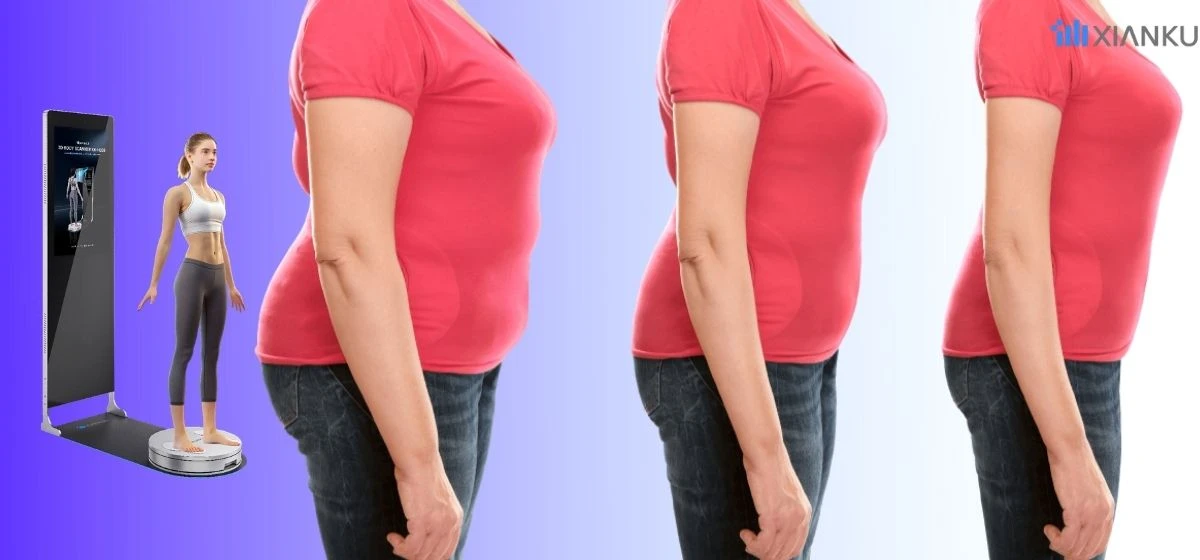
XIANKU 3D Body Scanner is designed to move weight management beyond the scale. Through a non-radiation 3D structured light scan, the system creates 1:1 Realistic 3D human body models and generates structured body data for professional health management.
Instead of simply telling patients that they lost weight, the system helps clinics show how the body is changing.
Core capabilities include:
- 20-second automated full-body scan
- 1:1 Realistic 3D human body models
- 45 body circumference data
- Body composition reports
- AI visualized skeleton display
- Body posture and shape assessment
- Comparison of body trends
- Digital physical testing report
- AI intelligent recommendation system
- CRM Customer Management System
For post-GLP-1 clinics, these functions create a new service model: scan, analyze, compare, prescribe, follow up, and retain.
Non-Rigid Body Volume Density + Bioelectrical Impedance Fusion: A Smarter Way to Monitor Change
The clinical challenge after GLP-1 weight loss is that the human body does not shrink like a rigid object. Fat, muscle, posture, water distribution, and body volume change differently over time.
XIANKU's value can be positioned around the integration of:
Non-rigid external body volume density algorithm
This helps analyze changes in body shape, circumference, volume, and regional body contour. It is especially useful for tracking abdominal volume, waistline changes, posture-related shape changes, and body trend comparison.
Bioelectrical impedance fusion algorithm
This supports the monitoring of body composition indicators such as skeletal muscle rate, body fat rate, basal metabolism, and visceral fat level.
Why the fusion matters
When 3D body morphology is combined with body composition data, clinics can move from a single-number weight-loss model to a multi-dimensional metabolic profile.
This allows practitioners to ask better questions:
- Is the patient losing visceral fat or mostly lean mass?
- Is skeletal muscle rate stable during treatment?
- Is basal metabolism declining too quickly?
- Is abdominal volume improving even when weight plateaus?
- Does the patient need more resistance training or protein support?
- Is the current exercise prescription preventing rebound?

Body Trend Comparison: Turning GLP-1 Treatment Into a Long-Term Coaching Program
One of the most important features for weight-loss clinics is body trend comparison.
GLP-1 treatment is not a one-day transformation. It usually involves months of medication titration, appetite adjustment, nutrition planning, exercise adaptation, and long-term maintenance. Clinics need a visual record of progress.
With body trend comparison, clinics can track:
- Waist and abdominal circumference changes
- Hip and thigh volume changes
- Shoulder, back, and posture changes
- Skeletal muscle rate trends
- Visceral fat level trends
- Basal metabolic rate trends
- Rebound risk after medication reduction
- Before-and-after 3D body model comparison
This creates stronger patient motivation. Instead of only seeing a number on the scale, patients can visually understand how their body is changing.
From Data to Exercise Prescription: Preventing the Rebound Loop
The biggest post-GLP-1 opportunity for clinics is not only prescribing medication. It is designing the next layer of care: anti-rebound exercise and nutrition programs.
When the system detects declining muscle rate or basal metabolism, clinics can recommend:
- Progressive resistance training
- Protein intake optimization
- Lower-limb strength training
- Core stability programs
- Posture correction exercises
- Cardiometabolic conditioning
- Follow-up scanning every 4–8 weeks
This changes the clinic's value proposition from "weight-loss injection provider" to long-term metabolic health management center.
CRM Optimization for Medical Weight-Loss Clinics
XIANKU's CRM Customer Management System allows clinics to manage digital customer records, assessment reports, data comparison, appointment records, service records, and health programs.
For GLP-1 clinics, this supports a more complete business workflow:
1. Initial Assessment
The patient completes a 3D scan and body composition evaluation before medication begins.
2. Treatment Monitoring
The clinic tracks weight, visceral fat, muscle rate, basal metabolism, and 3D body changes during therapy.
3. Risk Alert
If skeletal muscle rate declines or basal metabolism drops, the system supports timely intervention.
4. Personalized Recommendation
The AI intelligent recommendation system can connect body data labels with clinic services, such as nutrition plans, strength training, posture correction, or maintenance programs.
5. Long-Term Retention
The patient returns for body trend comparison, progress visualization, and updated prescriptions.
This creates a closed-loop commercial model: measurement → analysis → recommendation → intervention → follow-up → renewal.
Why This Matters for 2026 Weight-Loss Clinics
The GLP-1 boom has created a massive new market, but it has also raised expectations. Patients no longer want simple weight-loss promises. Regulators, physicians, and consumers are increasingly focused on safety, sustainability, and long-term outcomes.
Clinics that only track kilograms may struggle to prove value. Clinics that track visceral fat vs muscle mass can provide a more professional and defensible service.
The future clinic will compete on:
- Body composition intelligence
- Visualized patient education
- Personalized exercise prescription
- Rebound prevention systems
- Long-term CRM follow-up
- Data-driven treatment credibility
In this new environment, XIANKU 3D Body Scanner becomes more than a measurement device. It becomes a digital infrastructure for post-GLP-1 metabolic health management.
Conclusion: The Future of Weight Loss Is Not Lighter Bodies, but Better Bodies
The GLP-1 revolution has made significant weight loss more achievable than ever before. But the next challenge is quality control.
A successful outcome is not simply a smaller number on the scale. It is lower visceral fat, preserved muscle mass, stable basal metabolism, better posture, improved function, and lower rebound risk.
By combining non-radiation 3D structured light scan, 1:1 Realistic 3D human body models, 45 body circumference data, AI visualized skeleton display, body trend comparison, and body composition intelligence, XIANKU helps weight-loss clinics enter the next era of personalized metabolic care.
In 2026, the best weight-loss clinics will not only help patients lose weight. They will help them keep the right tissue, lose the right fat, and build a body that can maintain the result.
Q&A: Visceral Fat vs Muscle Mass Tracking Post GLP-1 Weight Loss
Q1: Why should GLP-1 patients track muscle mass?
Because rapid weight loss may include both fat and lean mass. Monitoring skeletal muscle helps clinics protect metabolism, strength, and long-term weight maintenance.
Q2: Why is visceral fat more important than body weight alone?
Visceral fat is closely linked to metabolic risk. A patient can have normal weight but still carry excessive abdominal or visceral fat, which may increase health risk.
Q3: What is normal-weight obesity?
Normal-weight obesity refers to people whose BMI appears normal but whose body fat level is high and muscle mass is relatively low. This can happen after poor-quality weight loss.
Q4: How does XIANKU support post-GLP-1 monitoring?
XIANKU uses 3D body scanning, 45 body circumference data, body composition analysis, body trend comparison, and CRM management to help clinics track real body changes over time.
Q5: How can clinics prevent rebound after GLP-1 weight loss?
Clinics should monitor skeletal muscle rate, basal metabolism, and visceral fat trends, then provide resistance training, nutrition support, and long-term follow-up programs.
Q6: Is 3D body scanning radiation-free?
Yes. XIANKU uses a non-radiation 3D structured light scan, making it suitable for repeated body trend comparison during long-term weight management.
Q7: What is the business value for weight-loss clinics?
It helps clinics improve professional credibility, visualize treatment outcomes, create personalized exercise prescriptions, increase follow-up visits, and build long-term customer retention through CRM.
