Every day, parents press a thumb against the toe of their child's shoe, feel for a gap, and declare, "They'll grow into it." That thumb test has been the gold standard of children's footwear fitting for generations. But here's the uncomfortable truth: the thumb test is wrong more often than it is right.
And when it's wrong, the consequences go far beyond a returned pair of shoes. Ill‑fitting footwear during childhood can alter gait, contribute to structural deformities, and create pain patterns that last into adolescence and beyond.
For children's footwear retailers, this isn't just a health issue-it's a trust issue. Parents who discover that your "expert fit" led to blisters, bunions, or arch pain won't come back. Worse, they will warn other parents away.
Let's look at what precise 3D foot measurement reveals about children's foot health-and why the old ways of fitting are overdue for retirement.

The Clinical Reality: Most Kids Are in the Wrong Shoes
The data is startlingly consistent across multiple countries and studies.
A 2023 systematic review in the Journal of Foot and Ankle Research analyzed 14 studies covering over 8,500 children and found that 68% of children were wearing footwear that did not properly fit either length or width. Among children aged 4–7, the rate was even higher-74%.
In the United States, research cited by the American Podiatric Medical Association (APMA) shows that nearly 60% of children wear shoes that are too small, while a separate study found that over 50% wear shoes at least one size too large. The two problems coexist because parents alternate between "saving money by buying big" and "handing down too‑small siblings' shoes."
What does this mean clinically? A 2022 study published in Gait & Posture examined 412 children aged 6–12 and found that children wearing improperly fitted shoes were 3.2 times more likely to report foot pain during physical activity compared to children in correctly fitted shoes. The pain was most commonly located in the forefoot and arch-areas directly affected by length and arch support mismatches.
Chart 1: Prevalence of Ill‑Fitting Footwear in Children
(Sources: Journal of Foot and Ankle Research 2023 systematic review; APMA‑cited US data)
| Age Group | % Wearing Improperly Fitted Shoes | Most Common Issue |
|---|---|---|
| 4–7 years | 74% | Shoes too large (to "grow into") |
| 8–11 years | 65% | Shoes too narrow |
| 12–15 years | 59% | Length mismatch between left and right foot ignored |
| US children (all ages) | ~60% | Shoes too small (hand‑me‑downs or delayed replacement) |
What the Thumb Test Misses
The traditional thumb test checks one thing: approximate length from heel to longest toe. It does not measure:
- Arch height – Low arches (flat feet) need medial support; high arches need cushioning.
- Heel width – Narrow heels cause slippage and blisters; wide heels cause pressure and pain.
- Instep girth – A high instep can make even the correct length shoe feel unbearably tight across the top.
- Toe splay – Natural toe spread changes with age; many shoes squeeze toes together.
- Foot volume – Two children with identical length can have completely different total foot volume.
Each of these dimensions has direct health implications.
Consider arch height. A 2024 clinical study in Pediatric Physical Therapy followed 210 children with flexible flat feet. Half received correctly fitted shoes with appropriate arch support; half continued with whatever shoes parents chose. After 12 months, the correctly fitted group showed significantly improved arch development and 40% less reported foot fatigue compared to the control group.
Or consider heel width. A 2023 paper in the Journal of the American Podiatric Medical Association found that chronic heel blisters in children aged 5–10 were associated with a heel‑to‑shoe width mismatch in 87% of cases-a problem completely invisible to a thumb length check.
Chart 2: Foot Health Issues Linked to Specific Fit Mismatches
(Clinical summaries from JAPMA 2023, Gait & Posture 2022, and Pediatric Physical Therapy 2024)
| Fit Mismatch | Associated Pediatric Condition | Prevalence Among Affected Children |
|---|---|---|
| Shoe too short (by >5mm) | Subungual hematoma (bruised toenails), forefoot pain | 43% of length‑mismatch cases |
| Shoe too narrow | Tailor's bunion (bunionette), toe crowding | 38% of width‑mismatch cases |
| High arch + flat last | Plantar fasciitis precursors, heel cord tightness | 51% of high‑arch children |
| Narrow heel + wide heel cup | Chronic blistering, Achilles tendon irritation | 87% of blister cases |
| Incorrect instep height | Numbness across foot dorsum, lace irritation | 29% of children with high instep |
How 3D Scanning Transforms Health‑Oriented Fitting
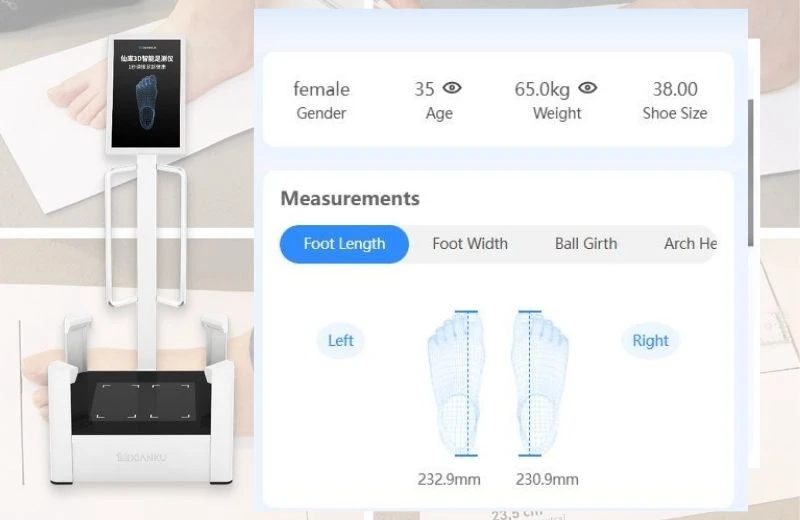
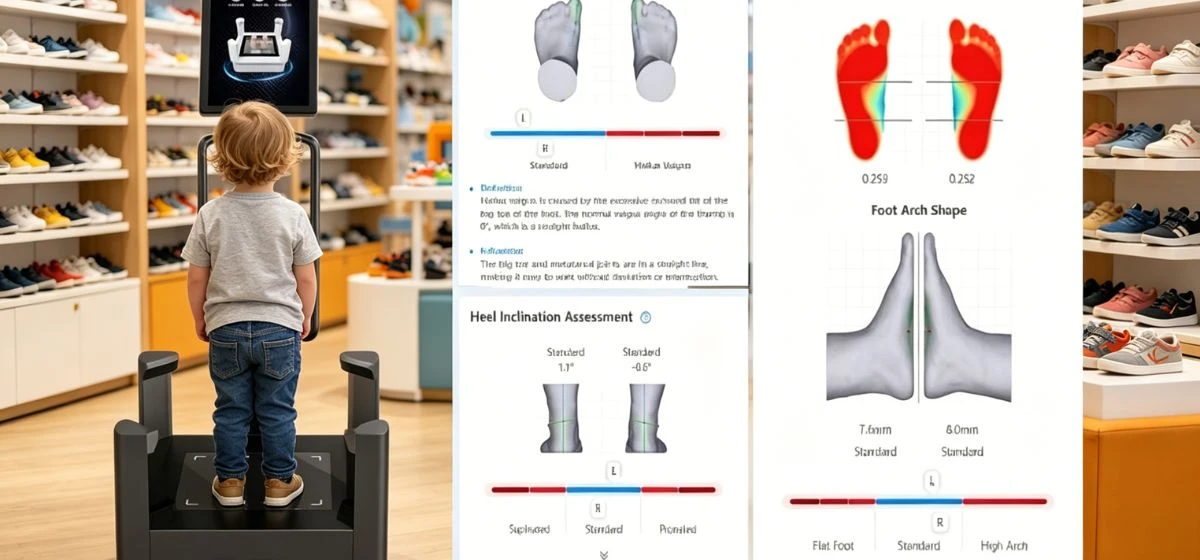
The Xianku 3D foot scanner captures all the dimensions the thumb test misses-in one second. The structured light technology produces a millimeter‑accurate 3D model with millions of point cloud data points, measuring over 20 biomechanical parameters per foot.
But capturing data is only half the story. The Xianku system also:
- Compares left‑to‑right asymmetry – Most children have feet that differ by 1–4mm in length and measurable differences in width and volume. The scanner quantifies these differences so you can fit the larger foot and adjust the smaller one with padding or lacing.
- Tracks changes over time – When a parent returns for the next size, the scanner recalls previous scans. You can show them exactly how their child's arch has developed and which dimensions have changed most.
- Integrates with inventory – The system matches scan data to the internal last shapes of your specific shoe models, flagging not just "size" but "compatible shapes."
One children's footwear clinic in Texas that adopted Xianku in 2025 reported that 87% of parents were able to identify a previously unknown foot asymmetry in their child during the first scan session. Of those, 62% changed their shoe selection based on the asymmetry data-choosing models with removable insoles or adjustable lacing to accommodate the difference.
The Business Case for Health‑Driven Fitting
Parents are hungry for this information. A 2025 consumer study by The Footwear Collective found that 81% of U.S. parents with children under 12 worry about their child's long‑term foot development, and 59% actively research shoe features that support healthy walking patterns. More importantly, 74% said they would choose a retailer that provides detailed foot health analysis over one that simply "helps find a size."
That is a massive differentiation opportunity. Most children's shoe stores still rely on the thumb test. By offering 3D health‑oriented scanning, you move from "shoe seller" to trusted pediatric footwear advisor.
The return on that trust is measurable. The same Texas clinic tracked customer behavior post‑scan. Among parents who received a full foot health analysis (not just a size recommendation), repeat visit rates within 6 months were 58%, compared to 31% for customers who only received traditional fitting. And average transaction value for health‑scan customers was 89,versus63 for non‑scan customers-parents were more willing to buy insoles, socks, and premium shoes once they understood their child's specific needs.
Chart 3: Parent Priorities in Children's Footwear (2025)
*Source: The Footwear Collective US Parent Survey, n=2,100*
| Priority | % of Parents Rating as "Very Important" |
|---|---|
| Correct size & fit | 94% |
| Arch support appropriate for age | 60% |
| Ankle support | 60% |
| Breathable materials | 58% |
| Detailed foot health guidance from store | 52% |
| Lowest price | 42% |
Note that "lowest price" ranks lowest. Parents are willing to pay for health‑informed fitting.
The Ethical Responsibility
There is another layer here. When a child walks out of your store with a shoe that is too narrow, too short, or poorly matched to their arch, you are not just risking a return. You are potentially contributing to a preventable health issue.
The American Physical Therapy Association's pediatric section notes that childhood is the critical window for foot structure development. The bones of the foot are not fully ossified until the late teens. During this window, repeated mechanical stress from ill‑fitting shoes can influence bone alignment and soft tissue adaptation.
That doesn't mean every fit mistake causes permanent damage. But it does mean that retailers have a responsibility to move beyond guesswork when precise tools exist. The Xianku scanner costs less than a month's rent for most stores. The thumb test costs nothing-but it costs children's comfort and parents' trust.

A Better Way Forward
Here is a simple protocol for health‑focused fitting using Xianku:
- Scan both feet – One second per foot. The system automatically identifies left‑right differences.
- Review the 3D visualization – Show the parent the model. Point out arch shape and foot volume.
- Check asymmetry – "Notice how her right foot is 3mm longer? We'll fit to that foot and use a thin insole for the left."
- Match to shoe lasts – The system recommends specific models from your inventory that match the child's arch, heel width, and instep.
- Explain the "why" – "We're choosing this model because it has a deeper heel cup and a slightly wider toe box to match her foot shape."
- Save the scan – For next visit. Parent receives a copy via email or QR code.
This process takes three extra minutes compared to traditional fitting. Those three minutes reduce returns, increase customer lifetime value, and protect children's foot health.
The Bottom Line
The thumb test is not evil. It is simply obsolete. We have better tools now. The parents walking into your store deserve the precision that 3D scanning provides. And the children-whose feet are still growing, still forming, still vulnerable to the wrong shape and size-deserve to leave your store with shoes that truly fit.
Foot health is not a niche concern. It is the core promise of children's footwear retail. Deliver on that promise with data, not guesses.
The Xianku 3D foot scanner makes it easy. One second. Twenty dimensions. A lifetime of healthier steps.