For runners, gym members, Pilates clients, and competitive athletes, the foot is not just the point of contact with the ground. It is the foundation of the entire kinetic chain. A subtle arch collapse, excessive pronation, forefoot imbalance, or heel misalignment can change how force travels through the ankle, knee, hip, pelvis, and spine.
That is why biomechanical foot analysis for runners and athletes is no longer limited to podiatry clinics or elite sports laboratories. It is becoming a practical, data-driven service for gyms, Pilates studios, running stores, sports retail brands, and wellness centers that want to offer more than basic fitness coaching.

When foot mechanics are not properly assessed, the consequences may include:
- Recurrent knee pain during running or squats
- Achilles tendon discomfort or plantar fascia overload
- Pelvic tilt caused by uneven weight-bearing
- Lower back fatigue after training
- Compensatory movement patterns during Pilates or strength training
- Higher risk of sports injuries caused by poor force distribution
In modern health and wellness environments, the next step is clear: move from visual observation and 2D footprints to 3D biomechanical foot analysis powered by infrared structured light technology.
Why Foot Biomechanics Matter in Running, Fitness, and Athletic Performance
Every stride, jump, squat, lunge, and balance movement begins with the foot. The foot absorbs impact, adapts to the ground, transfers force, and stabilizes posture. For athletes, even a few millimeters of structural difference can influence movement efficiency.
A professional biomechanical foot analysis for runners and athletes helps identify how the foot structure affects performance and injury risk. It can reveal:
- Arch type: flat arch, normal arch, or high arch
- Heel alignment: valgus or varus tendency
- Forefoot width and toe splay characteristics
- Left-right asymmetry
- Instep height and midfoot volume
- Pressure-related structural compensation
- Shoe and insole suitability
- Risk indicators for overpronation or supination
For gyms and Pilates studios, this information helps trainers design safer movement programs. For sports retailers, it supports better footwear and insole recommendations. For wellness centers, it creates a more professional client experience based on objective data rather than guesswork.
The Limitation of Traditional 2D Footprint and Pressure Mat Analysis
For years, many facilities relied on wet footprints, flatbed scanners, pressure mats, or simple visual assessment. These tools can be helpful, but they only show part of the story.
Traditional 2D foot analysis usually measures the contact area between the sole and the ground. However, foot health is not only about contact area. A runner with severe pronation or outward foot deviation may produce a misleading footprint. A high arch may be underestimated. A collapsed arch may be misclassified if the scan only captures plantar pressure.
Common limitations of 2D or pressure-based analysis include:
- It mainly reflects the sole contact surface, not the full 3D foot structure
- It may miss arch height, instep shape, heel alignment, and foot volume
- It can be affected by standing posture during the scan
- It may cause false judgment in severe pronation or supination cases
- It does not generate a complete 3D model for custom insole or shoe production
- It is difficult to connect directly with 3D printing systems
In other words, pressure data tells us how the foot touches the ground. But 3D foot structure tells us why the foot behaves that way.
The Technology Shift: From 2D Footprints to 3D Infrared Structured Light Scanning
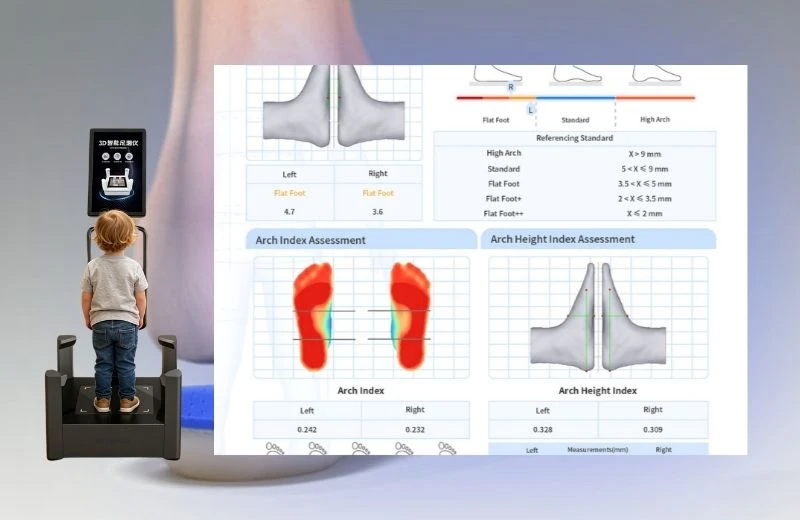
Xianku's 3D foot analysis system uses advanced infrared structured light technology to capture the complete foot surface in a non-contact way. Compared with traditional laser scanning or pressure mats, infrared structured light provides a faster, more comfortable, and more detailed scanning experience.
The system can complete a painless dual-foot scan in 1 second and generate a millimeter-level report within 5 seconds. This is especially valuable in high-traffic environments such as gyms, Pilates studios, sports stores, running clubs, and wellness centers.
Key technical advantages include:
- 1-second scanning for both feet
- ±1mm precision for professional-grade measurement
- 5-second report generation for instant client consultation
- Full 3D foot reconstruction rather than flat 2D imaging
- Non-contact, comfortable, and suitable for large-scale screening
- 30+ foot biomechanical datasets for deeper evaluation
- Exportable STL/OBJ 3D models for custom insoles and footwear
This makes the system more than a scanner. It becomes a digital entry point for foot health management, sports performance optimization, and personalized product matching.
ACA & AHI Algorithm: A More Intelligent Way to Understand the Arch
One of the most important challenges in foot analysis is arch evaluation. Traditional area-based methods often rely on the plantar contact area. This can lead to misclassification, especially when the foot has severe inward or outward deviation.
Xianku's self-developed ACA & AHI algorithm solves this problem by combining multiple structural indicators.
- ACA stands for Arch Conduction Angle.
- AHI stands for Arch Height Index.
Together, the ACA & AHI algorithm evaluates the arch through:
- 3D full-foot morphology
- Arch height index
- Arch curvature and shape
- Medial longitudinal arch structure
- Spatial relationship between the heel, midfoot, and forefoot
- Foot posture tendencies beyond simple contact area
This creates a more reliable arch assessment than traditional 2D area methods. For runners and athletes, that matters because arch function directly affects shock absorption, propulsion, balance, and injury risk.
A flat arch may increase the risk of overpronation and knee stress. A high arch may reduce shock absorption and increase impact loading. A misjudged arch can lead to the wrong shoes, wrong insoles, and wrong training recommendations.
With ACA & AHI, gyms, Pilates studios, and sports retailers can provide a more professional explanation of each client's foot mechanics.

What Data Does a 3D Biomechanical Foot Report Provide?
A high-quality biomechanical foot analysis for runners and athletes should not stop at "flat foot" or "normal foot." Athletes need actionable data.
Xianku's 3D foot scanning system outputs 30+ biomechanical datasets, including dimensional and structural indicators such as:
- Foot length
- Foot width
- Heel width
- Forefoot width
- Arch height
- Instep height
- Foot circumference
- Ball girth
- Heel alignment reference
- Toe shape and forefoot structure
- Left-right asymmetry
- Arch classification
- Foot morphology profile
- Custom insole design references
Because the system creates a true 1:1 3D foot model, the data can be used for both assessment and production. The model can be exported as STL/OBJ 3D models, allowing seamless connection with 3D printing workflows for customized functional insoles or personalized footwear.
For sports retailers, this opens a new commercial pathway: scan, analyze, recommend, customize, and retain the customer through a digital foot health profile.
Use Cases for Gyms, Pilates Studios, and Sports Retailers
1. Gyms: Improve Training Safety and Member Retention
Gyms can use 3D foot analysis before strength training, running programs, or functional training sessions. Trainers can understand whether a member's knee collapse, squat instability, or balance issue may be linked to foot structure.
This helps create:
- More personalized training plans
- Better injury prevention programs
- Stronger member trust
- Higher-value health assessment packages
2. Pilates Studios: Support Posture and Alignment Programs
Pilates focuses heavily on alignment, balance, pelvic control, and core stability. Foot asymmetry or arch collapse can influence the entire posture chain.
A 3D foot scan gives instructors objective data to explain why a client may show:
- Pelvic rotation
- Uneven weight distribution
- Knee tracking issues
- Balance difficulty
- Lower back tension
This makes Pilates assessment more scientific and more persuasive.
3. Sports Retailers: Upgrade Footwear and Insole Recommendations
For running stores and sports goods retailers, shoe recommendations based only on shoe size are no longer enough. Modern consumers expect personalization.
With 3D biomechanical analysis, retailers can recommend:
- Running shoes based on foot width and arch profile
- Functional insoles based on structural needs
- Custom 3D-printed insoles
- Sport-specific footwear solutions
- Long-term digital foot health tracking
This transforms a one-time product sale into a professional service experience.
3D Foot Analysis vs Traditional Foot Scanning
|
Comparison Area |
Traditional 2D / Pressure Mat |
Xianku 3D Structured Light Analysis |
|
Scan Method |
Contact-based or flat imaging |
Non-contact infrared structured light |
|
Scan Speed |
Usually slower or posture-dependent |
1-second scanning |
|
Output |
2D footprint or pressure map |
Full 1:1 3D foot model |
|
Accuracy |
Limited structural measurement |
±1mm precision |
|
Arch Analysis |
Often based on contact area |
ACA & AHI algorithm |
|
Report Speed |
Varies by system |
Report in about 5 seconds |
|
Customization Support |
Limited |
STL/OBJ 3D models for 3D printing |
|
Best For |
Basic screening |
Sports performance, wellness, custom insoles |
The biggest difference is not just speed. It is the quality of the data. A complete 3D model helps professionals understand the real structure of the foot, not only the pressure pattern.
Why This Matters for the Future of Sports Health Services
The wellness industry is moving toward measurable, personalized, and preventive services. Consumers are no longer satisfied with generic advice such as "choose comfortable shoes" or "stretch more." They want to see their own data.
For B2B operators, this creates a major opportunity.
A gym can turn foot analysis into a membership upgrade.
A Pilates studio can use it to strengthen posture assessment.
A sports retailer can use it to sell better shoes and custom insoles.
A wellness center can use it to build long-term digital health profiles.
As a global leader in 3D precise body-sign data operation services, Xianku helps partners convert physical measurement into digital health value. By combining infrared structured light scanning, ACA & AHI algorithm-based arch assessment, 30+ biomechanical datasets, and STL/OBJ 3D model export, Xianku enables a complete closed loop from screening to recommendation to customization.

Q&A: Common Questions About Biomechanical Foot Analysis for Runners and Athletes
How does a 3D foot scan help custom insoles?
A 3D foot scan creates a true 1:1 digital model of the foot. With STL/OBJ 3D models, the data can be connected to CAD design and 3D printing systems. This allows custom insoles to match the user's real foot length, width, arch height, heel shape, and biomechanical structure.
Is pressure mat analysis enough for runners?
Pressure mats can show how pressure is distributed under the foot, but they do not fully capture foot shape, arch height, instep volume, or 3D alignment. For runners, combining structural analysis with biomechanical interpretation is more useful for footwear and insole recommendations.
What is the ACA & AHI algorithm?
The ACA & AHI algorithm refers to Xianku's arch assessment method using Arch Conduction Angle and Arch Height Index. It evaluates the arch through a 3D full-foot model, arch height data, and arch morphology, reducing the risk of misjudgment caused by traditional 2D area-based methods.
How fast is the 3D foot scanning process?
The scan can be completed in 1 second, and the system can generate a professional report in about 5 seconds. This makes it suitable for gyms, Pilates studios, sports retailers, and large-scale wellness screening events.
Why is ±1mm precision important?
For athletic footwear, custom insoles, and performance assessment, small measurement differences matter. ±1mm precision helps improve the accuracy of foot length, width, girth, height, and arch-related measurements, supporting better product matching and customization.
Who should use biomechanical foot analysis?
It is useful for runners, athletes, gym members, Pilates clients, people with recurring knee or foot discomfort, and consumers looking for better shoes or custom insoles. It is also valuable for businesses that want to offer advanced health assessment services.
Final Takeaway: Foot Data Is the New Starting Point of Athletic Wellness
For runners and athletes, the foot is the foundation of performance. For gyms, Pilates studios, and sports retailers, foot data is becoming a new way to build trust, deliver personalized service, and create higher-value customer experiences.
Biomechanical foot analysis for runners and athletes is not just about identifying flat feet or high arches. It is about understanding how the foot influences movement, posture, comfort, injury risk, and product selection.
With 1-second infrared structured light scanning, ±1mm precision, the proprietary ACA & AHI algorithm, 30+ biomechanical datasets, and exportable STL/OBJ 3D models, Xianku's 3D foot analysis solution helps bridge the gap between sports performance, preventive wellness, and customized footwear.
Ready to understand your feet like never before?
Visit a nearby Xianku partner gym, Pilates studio, wellness center, or sports retail store to experience a free AI Foot Health Screening. In just seconds, you can receive your personal digital foot health profile and discover better options for training, footwear, insoles, and long-term movement health.