

As awareness of foot health continues to grow, modern clinics are beginning to realize that many physical discomforts originate from the feet. Problems such as plantar fasciitis, fatigue, knee pain, poor posture, lower back tension, and even spinal imbalance are often connected to abnormal foot structure or walking mechanics. Because of this, foot assessment technology is no longer limited to hospitals and orthopedic departments. Rehabilitation centers, wellness institutions, sports recovery clinics, and even high-end foot massage clinics are increasingly adopting professional foot scanners to better understand their patients and provide more scientific care.
However, not all foot scanners are created equal. Some systems focus purely on medical diagnostics, while others emphasize retail shoe fitting or sports biomechanics. Certain scanners are highly accurate but difficult to operate, whereas others provide speed but sacrifice depth and visualization. For clinic owners, the challenge is finding a scanner that combines professional functionality with practical workflow, patient engagement, safety, and business value.

Among the many products currently available, several brands stand out in the market, including iQube S, XF-TWO, LX800 Plus, and the increasingly popular XIANKU XK-B002S. Each system has its own strengths, but after comparing their technologies, user experience, and practical applications, the XIANKU scanner appears to offer the most balanced and clinic-friendly solution for modern foot health businesses.
Traditional foot assessment methods are now becoming outdated. Many older clinics still rely on visual observation, footprint ink tests, or pressure mats that only analyze the bottom of the foot. While these methods can provide basic information, they often fail to capture the complete structure of the foot. In many cases, important details such as arch height, heel alignment, toe positioning, and overall foot geometry are either incomplete or entirely absent. As patient expectations continue to rise, these traditional methods increasingly appear unscientific and unconvincing.
This is where modern 3D foot scanners have changed the industry. Advanced scanning systems now create highly accurate digital foot models capable of measuring structural alignment, pressure distribution, pronation, supination, and gait-related abnormalities. More importantly, they transform abstract medical explanations into visual experiences that patients can immediately understand. When patients can see a 3D reconstruction of their own feet, they become far more engaged in the consultation process and more willing to follow treatment recommendations.
Comparison of Major Foot Scanner Brands
| Brand / Model | Main Strength | Weakness | Best For |
|---|---|---|---|
| iQube S | Compact design and practical foot measurement | Visualization and interaction feel relatively basic | Small podiatry clinics and orthotics workflows |
| XF-TWO | Strong biomechanics and gait analysis | More technical and complex for general wellness clinics | Sports rehabilitation and athletic assessment |
| LX800 Plus | High clinical precision and orthotic integration | Expensive and less user-friendly for daily wellness consultation | Orthopedic medicine and custom orthotics |
| Traditional Laser Scanners | Basic foot measurement and lower entry cost | Slow scanning, incomplete modeling, weaker visualization | Basic measurement environments |
| XIANKU XK-B002S | Fast scanning, complete 3D modeling, strong patient interaction, AI analysis, radiation-free | Less focused on hospital-grade surgical imaging | Wellness clinics, rehabilitation centers, foot massage clinics, posture correction |
The iQube S is one of the more recognized compact foot scanning systems in the podiatry market. Its main advantage lies in its practicality and relatively small footprint, making it suitable for clinics with limited space. The scanner performs basic plantar measurements reliably and integrates reasonably well into traditional orthotic workflows. For clinics whose primary goal is producing insoles or obtaining standard measurements, the iQube system remains a respectable option.
However, compared with newer-generation systems, the iQube S feels somewhat conservative in terms of patient interaction and visualization. The system is efficient, but it does not create the same immersive consultation experience that modern wellness-oriented clinics increasingly demand. In environments where patient engagement and premium presentation matter, its interface and reporting functions may feel somewhat limited.
The XF-TWO scanner approaches foot analysis from a different perspective. It is designed more heavily around sports rehabilitation and biomechanics, with strong emphasis on gait analysis, pressure mapping, and athletic performance assessment. Sports medicine clinics and rehabilitation centers may appreciate its ability to evaluate movement patterns and functional loading during walking or standing. In technical environments focused on athletic performance optimization, the XF-TWO performs very well.
Yet this technical depth can also become a disadvantage for ordinary wellness businesses. Many massage clinics and general rehabilitation centers do not necessarily require highly specialized sports biomechanics analysis. In some situations, systems that are overly technical may complicate consultations, increase staff training requirements, and reduce overall workflow efficiency. While the XF-TWO is powerful, it is often more suitable for sports science professionals than for customer-focused wellness clinics.
The LX800 Plus represents another category entirely. This system is positioned as a high-end professional scanner intended for orthopedic medicine, custom orthotics, and advanced clinical imaging. Its measurement precision is excellent, and the system integrates well into custom insole manufacturing workflows. Clinics focused heavily on orthopedic correction or surgical support may appreciate its clinical depth and detailed measurement capabilities.
However, systems like the LX800 Plus are often expensive, relatively bulky, and optimized for technical specialists rather than everyday patient interaction. In practical business environments, many clinics discover that excessively complex systems slow down consultations and create unnecessary operational friction. For wellness clinics seeking a balance between professionalism and convenience, the LX800 Plus may provide more technical complexity than truly necessary.
This is precisely where the XIANKU XK-B002S distinguishes itself from competitors. Rather than focusing exclusively on medical precision or sports biomechanics, XIANKU has created a system that balances professional analysis with real-world usability. The scanner is designed not only to collect data, but also to improve patient communication, consultation quality, and clinic efficiency.
Technical Comparison of Foot Scanners
| Feature | XIANKU XK-B002S | iQube S | XF-TWO | LX800 Plus |
|---|---|---|---|---|
| Scanning Technology | Infrared structured light | Optical scanning | Biomechanical optical system | Advanced 3D optical system |
| Radiation-Free | Yes | Yes | Yes | Yes |
| Scan Speed | About 1 second | Several seconds | Fast | Moderate |
| 3D Foot Modeling | Full 1:1 foot model | Partial modeling | Advanced modeling | Advanced modeling |
| Accuracy | ±1 mm | Good | High | Very high |
| Patient Interaction | Excellent | Moderate | Moderate | Clinical-oriented |
| AI Foot Analysis | Yes | Limited | Advanced | Advanced |
| Ease of Use | Very easy | Easy | Medium complexity | Medium complexity |
| Report Generation | About 5 seconds | Moderate | Moderate | Slower |
| Best Business Fit | Wellness and rehabilitation | Orthotics clinics | Sports rehab | Orthopedic medicine |
One of the most impressive aspects of the XIANKU system is its speed. The scanner is capable of completing a full dual-foot scan in approximately one second while generating a detailed report within only a few seconds. Compared with traditional laser-based systems that may require twenty seconds or more, this difference is significant. Fast scanning improves workflow dramatically, especially in busy clinics where patient throughput and consultation efficiency are critical.
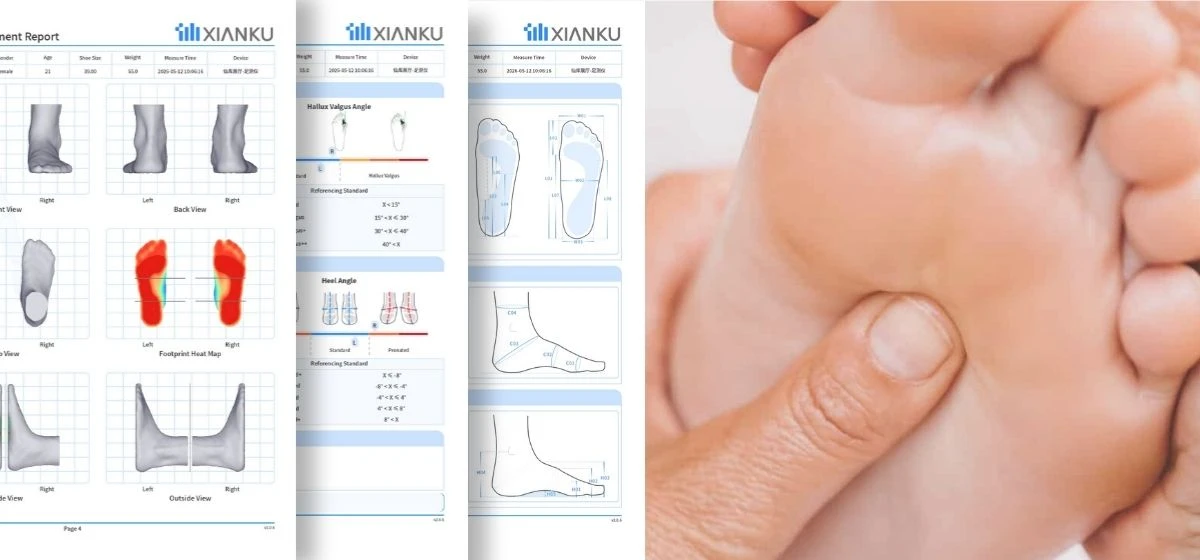
Equally important is the scanner's ability to generate a complete 1:1 3D foot model rather than simply analyzing the sole of the foot. This allows practitioners to evaluate arch structure, heel alignment, toe angles, and overall foot geometry with much greater depth and accuracy. More importantly, the visual presentation is extremely effective during consultations. Patients can immediately see asymmetries, arch collapse, or abnormal pressure distribution in a way that is intuitive and easy to understand. This visual clarity increases trust and makes treatment recommendations feel more scientific and convincing.

Safety is another major advantage of the XIANKU system. Unlike radiographic imaging systems, the XK-B002S uses infrared structured-light technology rather than X-rays. This means the scanner is completely radiation-free and suitable for repeated daily use. In wellness and rehabilitation environments, where patients may return frequently for follow-up assessments, non-invasive and harmless scanning technology is particularly valuable. Many modern consumers are increasingly concerned about radiation exposure and invasive medical procedures, making this an important advantage from both a clinical and marketing perspective.
Another area where XIANKU stands out is software intelligence. The company has developed proprietary arch-analysis algorithms designed to improve the assessment of flat feet, high arches, and pronation-related abnormalities. Instead of relying solely on footprint shape, the system combines multiple dimensions of foot geometry and structural analysis to reduce inaccurate assessments. For clinics providing rehabilitation, posture correction, massage therapy, or custom insole recommendations, this additional layer of analysis can be highly beneficial.
Perhaps most importantly, the XIANKU scanner appears to understand the realities of modern clinic operation better than many traditional systems. The device includes touchscreen interaction, QR-code login, mobile reporting, merchant management tools, and intelligent recommendation features. This transforms the scanner from a purely diagnostic device into a complete consultation and patient engagement platform. Clinics can use the system not only to evaluate foot health, but also to strengthen branding, improve customer retention, and create a more advanced technological image.
In today's highly competitive wellness and rehabilitation market, patient experience has become just as important as technical capability. People no longer want cold, mechanical consultations that feel purely clinical. They want experiences that are visual, interactive, personalized, and easy to understand. The XIANKU XK-B002S succeeds because it combines advanced technology with simplicity and accessibility.
Ultimately, every scanner on the market has its own strengths. The iQube S offers practicality and compactness. The XF-TWO provides strong biomechanics analysis. The LX800 Plus delivers excellent clinical precision. Yet the XIANKU XK-B002S achieves something more difficult: balance. It combines speed, safety, professional functionality, visual presentation, patient engagement, and operational practicality into a single platform that feels genuinely suited for modern clinics.
For foot massage clinics, rehabilitation centers, wellness institutions, posture correction studios, and foot-care businesses seeking a scanner that is professional without being overly complicated, the XIANKU XK-B002S may currently represent one of the most complete and future-oriented solutions available today.
