

How 3D Foot Scanning and Smart Insoles Are Transforming Elderly Care
Alzheimer's disease is not only a condition of memory loss.
It is also a condition of mobility decline, balance disorder, and spatial disorientation.
In the late stages of the disease, one of the most dangerous risks is not cognitive confusion alone, but what follows it:
Frequent falls and unmonitored wandering.
For families and caregivers, these two issues represent constant anxiety:
- A simple walk can lead to a serious fall
- A short moment of confusion can lead to getting lost
- A brief lapse in attention can become a medical emergency

As global populations age, Alzheimer's-related mobility risks are becoming one of the most urgent challenges in elderly care.
But a new question is emerging:
Can falls and wandering be predicted-and prevented-through body data?
The Hidden Cause of Falls: It Starts From the Feet
When discussing Alzheimer's care, most attention is placed on the brain.
However, fall risk often begins much lower-at the foot and gait level.
As the disease progresses, patients often experience:
- Reduced muscle coordination
- Impaired balance control
- Irregular gait patterns
- Uneven weight distribution
- Slower postural correction responses
These changes shift how the body interacts with the ground.
In many cases, the issue is not simply weakness.
It is loss of stable body alignment during movement.
This makes foot pressure distribution and body center of gravity critical indicators of fall risk.
Why Traditional Care Cannot Solve the Problem
Current elderly care systems rely heavily on:
- Caregiver supervision
- Physical assistance
- Environmental modifications
- Emergency alert devices after falls occur
While helpful, these approaches are mostly reactive, not predictive.
They respond after an incident happens.
What is missing is:
A system that understands how the patient moves before the fall occurs.
This is where digital body measurement and gait analysis technologies become essential.
Turning the Foot Into a Predictive Health Signal
Foot structure is one of the most important indicators of balance stability.
Changes in:
- Arch collapse
- Heel pressure imbalance
- Forefoot overload
- Asymmetric gait patterns
can all signal increasing fall risk.
This is where the 3D Foot Scanner becomes the entry point of a new care model.
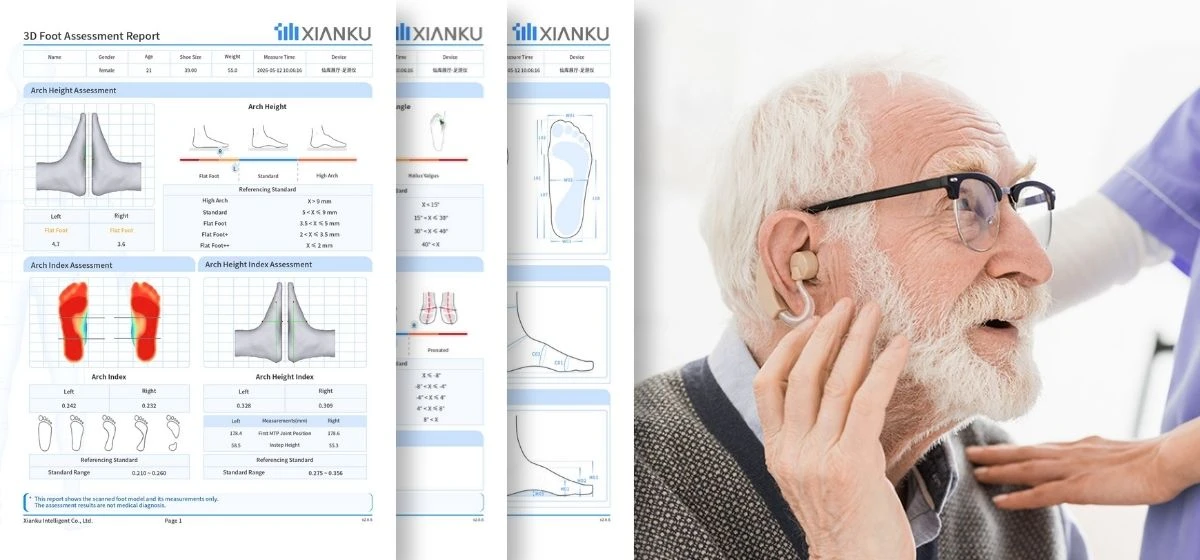
The XIANKU 3D Foot Scanner captures precise foot geometry and biomechanical structure in seconds, building a digital profile that includes:
- Foot arch type and height
- Pressure distribution zones
- Left-right balance differences
- Structural asymmetry indicators
- Gait-related biomechanical markers
With over 32+ foot data points, the system creates a detailed digital footprint of stability risk factors.
Instead of observing movement externally, caregivers can now quantify instability internally.
From Foot Data to Fall Prevention: AI Analysis Layer
Once foot structure is digitized, AI can analyze risk patterns that are invisible to the human eye.
For Alzheimer's patients, AI models can identify:
- Increasing imbalance between left and right foot
- Shifts in center of gravity
- Early signs of unstable gait cycles
- Abnormal pressure concentration zones
- Progressive deterioration in walking symmetry
These indicators are not just descriptive.
They are predictive signals.
This allows care systems to move from reactive monitoring to proactive intervention.
3D Printed Insoles: Correcting the Center of Gravity
Once risk is identified, the next step is correction.
This is where 3D printed insoles play a critical role.
Unlike standard insoles, 3D printed versions can be customized based on individual foot structure and pressure distribution data.
Their function is not only comfort.
It is biomechanical correction.
By adjusting support zones, custom insoles can:
- Redistribute plantar pressure
- Improve foot-ground stability
- Reduce asymmetrical loading
- Help stabilize body center of gravity
- Enhance walking consistency
For Alzheimer's patients, even small improvements in stability can significantly reduce fall risk.
The goal is not to "cure" the disease.
The goal is to stabilize movement in real-world conditions.
Smart Insoles With Chips: Turning Movement Into Real-Time Data
Beyond structural correction, the next layer is real-time monitoring.
By embedding a smart chip into the insole, every step becomes measurable.
The system can record:
- Step frequency
- Gait consistency
- Pressure variation per step
- Walking speed changes
- Stability fluctuations over time
This transforms the insole into a continuous mobility monitoring device.
For Alzheimer's care, this is critical.
Because one of the biggest risks is not only falling-but wandering unnoticed.

Preventing Wandering Through Gait Intelligence
Wandering behavior in Alzheimer's patients often occurs when:
- The patient becomes disoriented
- Routine walking patterns change unexpectedly
- The patient leaves safe zones without awareness
With smart insoles, deviations from normal walking behavior can be detected early.
For example:
- Sudden increase in walking distance
- Unusual gait direction changes
- Repetitive pacing behavior
- Departure from expected mobility patterns
When combined with alert systems, caregivers can be notified before the patient reaches a high-risk situation.
This introduces a new concept in elderly care:
Prevention through movement intelligence, not post-incident response.
From Monitoring to a Closed-Loop Care System
When integrated together, the system forms a complete digital care loop:
1. 3D Foot Scanning
Creates baseline biomechanical profile
2. AI Risk Analysis
Identifies instability and fall risk patterns
3. 3D Printed Insoles
Corrects posture and redistributes pressure
4. Smart Chip Monitoring
Tracks real-time gait behavior
5. Continuous Feedback Loop
Updates risk models over time
This transforms elderly care from isolated interventions into a continuous adaptive system.
Why This Matters for Aging Societies
As global populations age, Alzheimer's care is becoming one of the most resource-intensive challenges in healthcare systems.
Hospitalization after falls is costly.
Emergency response is delayed.
Caregiver burden is high.
Families often lack early warning systems.
Technologies like 3D foot scanning and smart insoles introduce a new model:
Preventing incidents before they happen, instead of reacting after they occur.
Xianku's Role in Digital Mobility Health
Within this ecosystem, the XIANKU platform contributes as a foundational data infrastructure provider in human body scanning and biomechanical analysis.
With:
- 50+ patents in 3D human body scanning
- Large-scale real human body data accumulation
- AI-driven posture and biomechanical analysis capabilities
- Mature applications in healthcare and foot-spine systems
the system supports the transformation of raw physical movement into actionable health intelligence.
This enables healthcare providers, rehabilitation centers, and elderly care institutions to adopt data-driven mobility prevention systems.
Conclusion: From Fall Response to Fall Prevention
Alzheimer's care has traditionally focused on memory and cognitive support.
But one of the most immediate risks patients face is physical instability.
Falls and wandering are not random events.
They are the result of measurable biomechanical changes over time.
With:
- 3D Foot Scanning
- AI gait analysis
- 3D printed corrective insoles
- Smart chip–enabled movement tracking
elderly care can shift from reactive supervision to predictive mobility protection.
The future of Alzheimer's support will not only be about remembering who the patient is.
It will also be about understanding how the patient moves.
And preventing the fall before it happens.
