Why the AGI Era Will Reward Businesses That Understand People, Not Just Sell to Them
For much of the past decade, the technology industry has been obsessed with building the next great application.
- A faster app.
- A smarter platform.
- A better user interface.
Success was often measured by downloads, daily active users, and market share.
But recently, a different conversation has begun to dominate the AI industry.
Instead of asking "What is the next killer app?", leading AI companies are asking a much bigger question:
"How do we build Artificial General Intelligence (AGI)?"

One of the clearest examples comes from DeepSeek.
Rather than positioning itself as another consumer "super app," the company's leadership has repeatedly emphasized that its long-term priority is advancing AGI through fundamental research and technological innovation-not simply creating another application.
That philosophy reflects an important shift occurring far beyond artificial intelligence.
The companies creating the greatest long-term value are no longer focusing only on products.
They are building infrastructure.
Infrastructure that allows countless future applications to exist.
- Cloud computing became infrastructure.
- Large language models became infrastructure.
- Digital payment systems became infrastructure.
The next question is becoming increasingly important:
What will become the infrastructure of personalized healthcare and personalized retail?
The answer may not be another app.
It may be something much more fundamental.
A digital understanding of every individual.
Every Intelligent System Begins With Better Data
Artificial intelligence does not become intelligent on its own.
It learns from data.
Language models learn from text.
Autonomous vehicles learn from millions of miles of driving data.
Recommendation systems learn from user behavior.
The quality of intelligence has always depended on the quality of information.
Healthcare is no different.
For decades, healthcare has collected information through:
- Medical history
- Laboratory results
- Imaging
- Physical examinations
These remain essential.
But one important category of information has often been incomplete:
The human body's external structure.
How is the body aligned?
How symmetrical are the shoulders?
How does posture change over time?
What does a person's foot structure actually look like?
Traditional measurements can answer part of these questions.
Digital technologies can answer them far more comprehensively.
The future of personalized healthcare will not simply rely on more AI.
It will rely on better human data.
From Generic Services to Human Digital Infrastructure
Most industries are moving away from standardization.
Consumers expect experiences designed specifically for them.
Music streaming platforms recommend songs based on listening habits.
Shopping platforms recommend products based on personal preferences.
Fitness applications generate customized training programs.
Healthcare and retail are following the same direction.
The next generation of services will begin with understanding the individual.
Before recommending a shoe…
Understand the foot.
Before recommending a pillow…
Understand the neck and shoulders.
Before designing a rehabilitation plan…
Understand posture and body balance.
This is where a new type of infrastructure begins to emerge.
- Not another application.
- Not another marketing campaign.
But a 1:1 Digital Model.
A digital representation of a real human body.
A 1:1 Digital Model Changes the Customer Relationship
Traditionally, businesses have tried to attract customers through products.
- Better prices.
- Better advertising.
- More promotions.
But in today's market, products are increasingly similar.
Customers can compare thousands of options online within minutes.
What they cannot easily find is a business that understands them.
A 1:1 Digital Model changes the conversation completely.
Instead of beginning with:
"What would you like to buy?"
The interaction begins with:
"Let's understand you first."
This simple shift changes everything.
The customer is no longer choosing from generic products.
The business is creating personalized solutions based on measurable information.
This creates something much stronger than a transaction.
It creates trust.
Why Visualization Builds Stronger Human Connections
One of the biggest challenges in healthcare and retail is that many recommendations remain invisible.
- A chiropractor explains posture.
- A footwear specialist discusses arch support.
- A sleep consultant recommends a different pillow height.
Customers hear the advice.
But they cannot always visualize the reason behind it.
A 1:1 Digital Model solves this communication gap.
Instead of relying only on explanation, professionals can demonstrate.
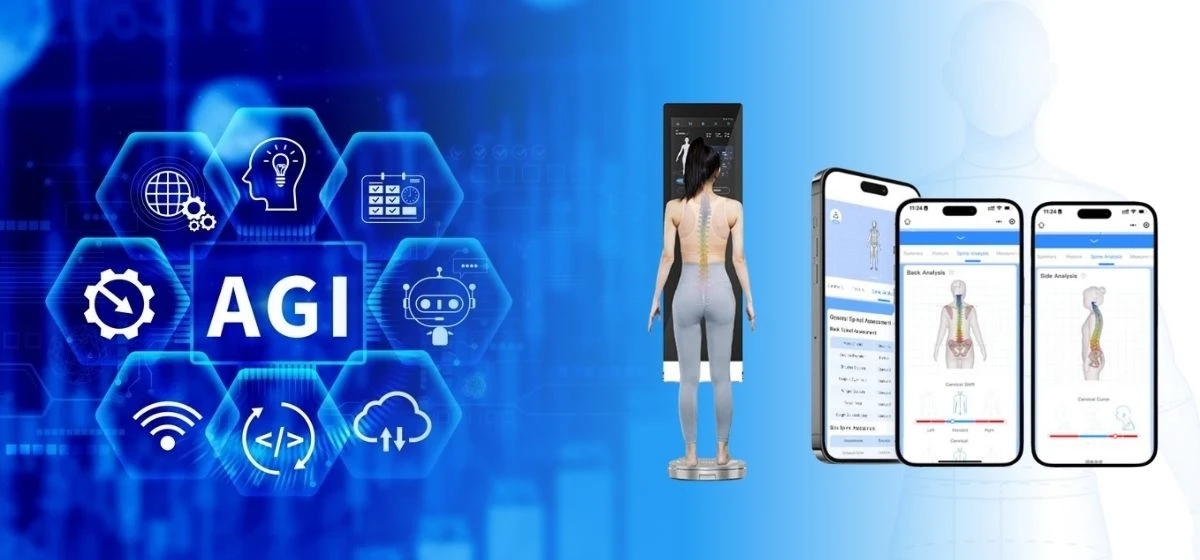
Customers can see:
- Their body alignment.
- Their shoulder symmetry.
- Their posture.
- Their foot structure.
- Their body becomes understandable.
Understanding creates confidence.
Confidence creates trust.
Trust creates long-term customer relationships.
From Scanning to Understanding
This is where technologies such as 3D Body Scanners and 3D Foot Scanners become far more significant than simple measurement devices.
A Body Scanner does more than capture dimensions.
It creates a digital representation of posture, balance, symmetry, and body proportions.
A Foot Scanner does more than measure shoe size.
It reveals arch type, foot shape, width, symmetry, and structural characteristics that are impossible to understand through length alone.
Together, they transform physical information into digital intelligence.
Instead of asking customers to describe themselves, businesses can begin with objective understanding.
This represents an entirely new relationship between technology and personalization.
Cross-Industry Innovation Begins With Understanding People
The value of a 1:1 Digital Model extends far beyond one industry.
Healthcare
Clinics can improve communication by visualizing body changes throughout rehabilitation.
Patients no longer hear only:
"You've improved."
They can actually see measurable progress.
Footwear Retail
Instead of selling shoes based only on size, retailers can recommend footwear and insoles according to actual foot structure.
Shopping becomes professional consultation rather than simple product selection.
Sleep and Wellness
Body measurements help determine more appropriate pillow heights and ergonomic support.
The recommendation becomes evidence-based rather than guesswork.
Fitness and Rehabilitation
Professionals can monitor posture changes, body symmetry, and physical progress over time using consistent digital measurements.
Across every industry, one principle remains the same:
Understanding comes before recommendation.
The Future of Customer Acquisition Is Customer Understanding
Traditional marketing asks:
"How do we bring more people into our store?"
Future marketing asks:
"How do we create an experience that people cannot find anywhere else?"
- A free digital body assessment.
- A personalized foot analysis.
- A visual posture report.
These experiences attract customers naturally because they provide immediate personal value.
The scan itself becomes the entry point.
The personalized insight becomes the reason customers stay.
Businesses are no longer competing only through products.
They compete through understanding.
The AGI Era Needs a Digital Understanding of Humans
Artificial General Intelligence is often described as AI capable of understanding and solving a wide range of problems.
But every intelligent system shares one fundamental requirement:
It needs high-quality data.
If future AI is expected to deliver truly personalized healthcare, wellness, and retail experiences, it must first understand the people it serves.
- Text alone is not enough.
- Images alone are not enough.
- Questionnaires are not enough.
The physical world also needs to become digital.
That is exactly what a 1:1 Digital Model represents.
It transforms the human body into structured, measurable, and understandable information that intelligent systems can use to generate more personalized recommendations.
In many ways, it is becoming part of the infrastructure for the next generation of AI-powered services.
From Customer Attraction to Customer Connection
The businesses that define the next decade may not be those with the largest advertising budgets.
They will be the ones that understand customers better than anyone else.
A 1:1 Digital Model is not simply a visualization.
It is not only a scan.
It is the beginning of a new relationship between people, data, and intelligent decision-making.
As AI moves toward AGI, one principle becomes increasingly clear:
Intelligence begins with understanding.
For healthcare, retail, wellness, and personalized manufacturing, understanding begins with the individual.
And for the first time, technology allows that understanding to start with a simple scan.
The future will not belong to businesses that sell the most products.
It will belong to businesses that know their customers best.
And every meaningful connection begins with seeing the person behind the purchase.