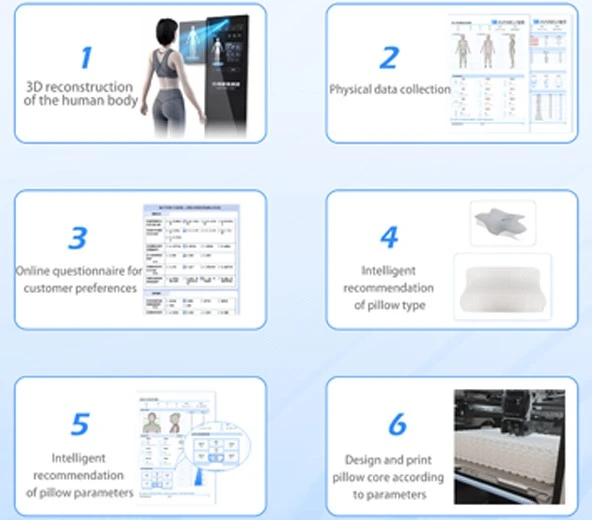
A 3D body scan produces a beautiful model and a wealth of measurements. But how does that translate into a mattress recommendation? What's the logic that connects your shoulder contour to a specific firmness zone?
Understanding this logic is crucial for anyone selling or recommending sleep solutions. It transforms a mysterious "black box" into a transparent, defensible methodology that builds customer trust and clinical confidence.

The Limitations of Single-Firmness Mattresses
Most mattresses are built with a single firmness level across the entire sleeping surface. This approach assumes that your body distributes weight uniformly-which it absolutely does not.
Consider the pressure distribution of a typical adult lying on their back:
- The heaviest points are the buttocks and shoulders
- The lower back is relatively light but requires support
- The head and legs require minimal support
On a single-firmness mattress, this creates a dilemma:
- If the mattress is soft enough to cushion the shoulders and hips, the lower back may sink too much
- If the mattress is firm enough to support the lower back, the shoulders and hips experience excessive pressure
This is why zoned support has emerged as the gold standard for spinal alignment. But how many zones? Where should they be placed? And how firm should each zone be?
The Science of Pressure Distribution
Xianku's mattress mapping algorithm begins with pressure distribution modeling. Using the 3D body model, the AI calculates theoretical pressure distribution for each sleep position:
Back Sleeping
The pressure map shows peaks at the occiput (back of head), thoracic spine, sacrum, and heels. The lumbar region shows lower pressure but requires active support to maintain neutral alignment. The ideal back-sleeping mattress allows slight sinking at the sacrum while maintaining firm support under the lumbar region.
Side Sleeping
Pressure concentrates at the shoulder and hip-the two widest points of the body. The waist region experiences minimal pressure but must be supported to prevent lateral spinal curvature. The ideal side-sleeping mattress provides significant give at the shoulder and hip while maintaining firm support under the waist.
Stomach Sleeping
Pressure distributes across the anterior thorax, pelvis, and knees. The lumbar region is vulnerable to hyperextension if the pelvis sinks. The ideal stomach-sleeping mattress (for those who cannot change position) is firm with minimal contouring to prevent pelvic drop.

The Zoning Logic
Xianku's AI divides the mattress into five functional zones based on the user's body geometry:
Zone 1: Head/Neck (0-15% of mattress length)
- Support requirement: Medium
- Function: Allows slight contouring while maintaining cervical alignment
- Determined by: Head circumference, neck length, sleep position preference
Zone 2: Shoulders (15-30%)
- Support requirement: Variable based on sleep position and shoulder breadth
- For side sleepers: Softer zone to allow shoulder sinkage
- For back sleepers: Medium zone with slight contouring
- Determined by: Shoulder breadth, acromion prominence, sleep position
Zone 3: Lumbar/Thoracic (30-60%)
- Support requirement: Firm for all positions
- Function: Critical zone for spinal alignment; must resist sinking
- Determined by: Lumbar curve depth, body weight, pelvic position
Zone 4: Pelvis/Hips (60-80%)
- Support requirement: Variable
- For side sleepers: Softer to accommodate hip width
- For back sleepers: Medium to firm
- Determined by: Hip breadth, pelvic tilt, greater trochanter prominence
Zone 5: Legs/Feet (80-100%)
- Support requirement: Soft to medium
- Function: Allows circulation and comfort; minimal spinal impact
- Determined by: Leg length, heel prominence
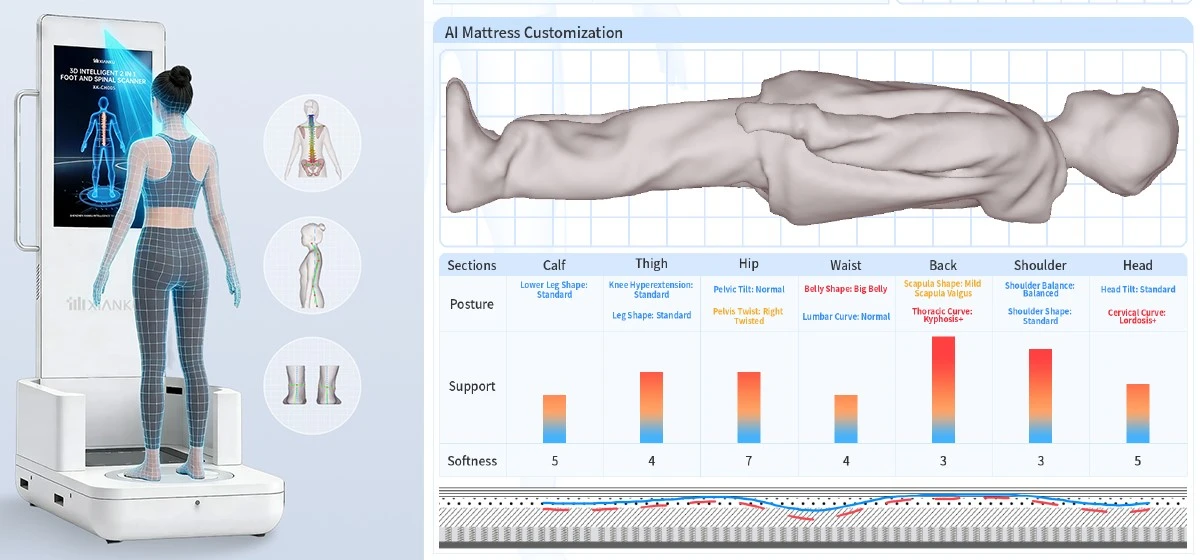
Quantifying Firmness
Firmness is not a single scale-it's a multidimensional property. Xianku's algorithm considers:
Indentation Load Deflection (ILD)
ILD measures how much force is required to compress a mattress layer by a specific percentage. Lower ILD = softer; higher ILD = firmer. The algorithm recommends target ILD ranges for each zone based on body weight and sleep position.
Support Factor
Support factor is the ratio of ILD at 65% compression to ILD at 25% compression. A higher support factor indicates progressive resistance-the mattress feels soft initially but firms up as you sink. This property is critical for combining comfort and support.
Surface Contouring Depth
The algorithm calculates how much surface contouring is needed to distribute pressure effectively. For a side sleeper with broad shoulders, the shoulder zone needs deeper contouring than a narrow-shouldered side sleeper.
The Weight Factor
Body weight dramatically influences how a mattress performs. A mattress that feels medium-firm to a 150-pound person may feel extremely firm to a 110-pound person and extremely soft to a 220-pound person.
Xianku's algorithm adjusts recommendations based on weight:
| Weight Range | Firmness Adjustment |
|---|---|
| < 130 lbs | Softer across all zones (reduced sinkage requires less resistance) |
| 130-180 lbs | Standard recommendations |
| 180-230 lbs | Firmer across all zones (increased sinkage requires more resistance) |
| > 230 lbs | Firmest recommendations; may require reinforced support layers |
Sleep Position Integration
Sleep position is not just a preference-it's biomechanically determined. Many people sleep in a specific position because their body geometry makes other positions uncomfortable. Xianku's analysis considers:
Primary Sleep Position
Based on body geometry and postural analysis, the AI identifies the user's likely primary sleep position. For example:
- Broad shoulders relative to hip width → likely side sleeper
- Short neck relative to shoulder breadth → likely back sleeper
- Deep lumbar curve → likely back or stomach sleeper
Secondary Position Considerations
The mattress must also accommodate secondary positions that users adopt during the night. The AI evaluates how well a primary-position-optimized mattress will perform in other positions and flags potential issues.
Real-World Example
Let's walk through a hypothetical user profile:
User Data
- Height: 5'8" (173 cm)
- Weight: 165 lbs (75 kg)
- Shoulder breadth: 18.5" (47 cm)
- Hip breadth: 15" (38 cm)
- Sleep position prediction: Side sleeper (shoulder-to-hip ratio > 1.2)
- Lumbar curve: Within normal range
- No significant postural deviations
AI-Generated Recommendation
| Zone | Recommended ILD | Reasoning |
|---|---|---|
| Head/Neck | 25 | Medium support for cervical alignment |
| Shoulders | 18 | Softer zone to allow shoulder sinkage |
| Lumbar | 32 | Firm support to maintain neutral spine |
| Pelvis | 22 | Accommodates hip width while providing support |
| Legs | 28 | Medium-firm; lower priority zone |
Resulting Mattress Profile
A five-zone mattress with progressive support: softer in the shoulder zone, firmer in the lumbar zone, and moderately firm in the hip zone. This configuration allows the user's shoulder to sink while preventing the lumbar spine from bowing-the ideal side-sleeping alignment.
Beyond Mattresses: Pillow Integration
Mattress and pillow work as a system. A perfectly zoned mattress cannot compensate for an incorrect pillow height.
Xianku's algorithm simultaneously calculates pillow requirements:
Pillow Height Formula
Pillow height = (Shoulder breadth × sin(sleep position angle)) - (Cervical curve depth)
For side sleepers, pillow height must fill the gap between the neck and the mattress surface. This gap equals the shoulder breadth (for side sleepers) minus the mattress contouring depth in the shoulder zone.
Pillow Loft Recommendation
The AI recommends specific pillow lofts:
- Low loft (3-4"): For stomach sleepers or back sleepers with forward head posture
- Medium loft (4-6"): For back sleepers with neutral posture
- High loft (6-8"): For side sleepers with broad shoulders
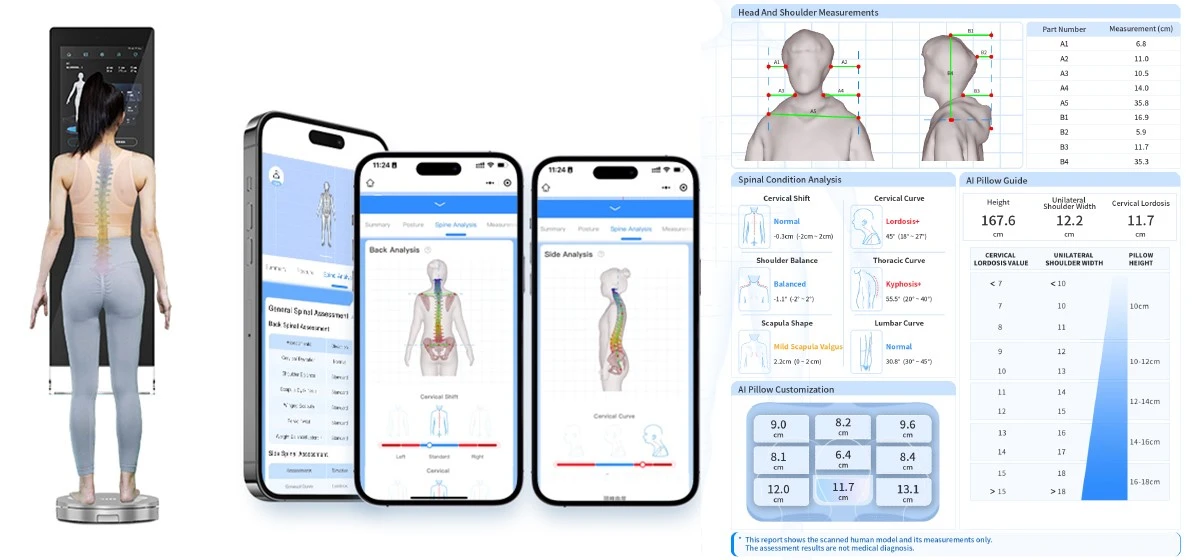
The Output: A Professional Mattress Selection Report
All this analysis culminates in a comprehensive PDF report that includes:
- Visual pressure distribution maps
- Zone-by-zone firmness recommendations
- Mattress specifications (ideal ILD ranges, support factor targets)
- Pillow height and loft recommendations
- Sleep position optimization guidance
- Product-specific recommendations (if merchant products are configured)
This report serves multiple purposes:
- For consumers: Clear, data-driven justification for their purchase
- For retailers: A tool to build trust and close sales
- For clinicians: Documentation for patient care
The Science of Sleep, Demystified
Mattress selection has long been an exercise in guesswork. By applying biomechanical principles to 3D body data, Xianku transforms this process into a science. Every recommendation is traceable to specific body measurements and established principles of spinal alignment.
In our next article, we'll explore how this same technology performs detailed spinal health assessments-opening new possibilities for clinical applications and preventive care.