

Falls are not random accidents. In many older adults, they are the visible result of hidden biomechanical decline: reduced arch support, unstable heel alignment, poor weight distribution, toe deformity, reduced proprioception, and inappropriate footwear. The foot is often called the body's "second heart," but in geriatric care it should also be seen as the foundation of mobility, balance, and independence.
When foot structure changes with age, the impact is rarely limited to the foot itself. Abnormal foot posture may contribute to knee pain, pelvic imbalance, lower back discomfort, unstable gait, and even compensatory spinal posture. For seniors, these changes can increase the risk of stumbling, falling, and losing confidence in daily movement.
This is why geriatric foot health assessment for fall prevention is becoming a vital service for senior care centers, community health clinics, orthopedic care providers, rehabilitation centers, and wellness-focused elderly care organizations.
Instead of relying only on visual inspection, paper-based assessments, or basic pressure mats, modern facilities are moving toward 3D infrared structured light foot scanning-a faster, more precise, and more clinically meaningful way to understand foot structure and fall-related biomechanical risk.

Why Foot Health Is a Critical Part of Fall Prevention in Older Adults
Fall prevention is often discussed through strength training, balance exercises, medication review, and home safety. These are important, but they do not fully address one of the most overlooked risk factors: the aging foot.
As people age, the foot may experience:
- Arch collapse or reduced arch elasticity
- Heel valgus or varus alignment changes
- Reduced plantar sensation
- Toe deformities such as bunions or claw toes
- Increased forefoot pressure
- Decreased ankle stability
- Poor shoe fit due to changes in foot width, girth, and instep height
- Left-right asymmetry that affects gait balance
For seniors, even a small mismatch between the foot and the shoe can reduce stability. A shoe that is too narrow may compress the toes. A shoe that is too loose may increase sliding inside the footwear. An insole that does not support the arch may worsen pronation or instability.
A professional geriatric foot health assessment for fall prevention helps care providers identify these structural risks before they lead to injury.
The Problem with Traditional Foot Screening in Senior Care
Many senior care centers and community clinics still rely on simple visual observation, manual measurement, 2D footprint scanners, or pressure mats. These methods can provide basic information, but they often fail to capture the full structure of the foot.
Traditional 2D or pressure-based assessment may miss:
- The real 3D height of the arch
- Instep volume and foot circumference
- Heel alignment tendency
- Full foot morphology
- Severe inward or outward foot deviation
- Subtle asymmetry between the left and right foot
- Structural reasons behind unstable gait
- Data needed for custom insoles or orthopedic footwear
Pressure mats show how the sole contacts the ground. But fall prevention requires more than pressure distribution. It requires understanding the shape, alignment, arch structure, and biomechanical characteristics of the foot.
For elderly users, this distinction is especially important. A senior with severe foot valgus or varus may be misclassified by traditional area-based footprint methods. A flat footprint may not always mean the same thing clinically. A high arch may not be properly evaluated if the system only measures plantar contact.
This is where Xianku's 3D full-foot structured light modeling creates a clear technology gap.
Xianku 3D Foot Scanning: From Surface Observation to Full-Foot Structural Analysis
Xianku is a global leader in 3D precise body-sign data operation services, providing advanced digital assessment solutions for foot health, posture, and personalized orthopedic support.
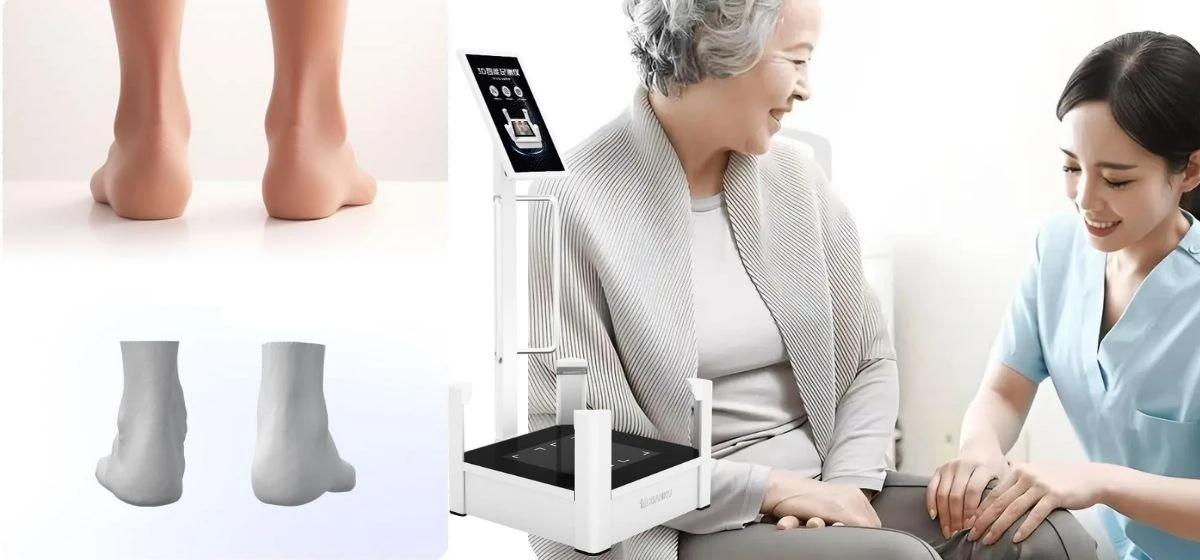
For geriatric foot care, Xianku's 3D foot scanner uses advanced Infrared structured light technology to capture the complete external structure of both feet quickly and comfortably. Compared with traditional laser scanning or pressure mat systems, infrared structured light offers a non-contact, high-speed, and senior-friendly scanning experience.
The system can complete dual-foot scanning in 1 second and generate a professional report in about 5 seconds. This is ideal for elderly care environments where comfort, speed, and operational efficiency are essential.
Core technical advantages include:
- 1-second scanning for both feet
- Non-contact and comfortable scanning process
- ±1mm precision for accurate structural measurement
- 5-second digital report generation
- 1:1 real 3D full-foot model reconstruction
- 30+ biomechanical datasets covering length, width, girth, height, arch, and morphology
- Exportable STL/OBJ 3D models for 3D printing systems
- Direct support for custom functional insoles and orthopedic footwear
For senior care providers, this means foot screening can become faster, more objective, and more actionable.
ACA & AHI Algorithm: A More Reliable Way to Assess Senior Arch Health
Arch evaluation is one of the most important parts of geriatric foot health assessment. In older adults, arch collapse may affect balance, gait stability, and lower limb alignment. However, traditional footprint-based arch analysis often relies heavily on sole contact area, which can create errors in seniors with severe pronation, supination, or foot deformity.
Xianku's exclusive self-developed ACA & AHI algorithm provides a more advanced approach.
ACA refers to Arch Conduction Angle.
AHI refers to Arch Height Index.
The ACA & AHI algorithm combines:
- 3D full-foot model data
- Arch height index
- Arch morphology
- Medial longitudinal arch structure
- Foot posture characteristics
- Spatial relationship between forefoot, midfoot, and heel
This allows the system to move beyond simple "flat foot vs normal foot" classification. It helps identify structural arch conditions with greater reliability, reducing the risk of misjudgment caused by traditional area-based analysis.
For elderly fall prevention, this matters because arch function influences:
- Standing balance
- Shock absorption
- Heel stability
- Knee alignment
- Gait confidence
- Footwear and insole selection
A more accurate arch assessment can support better decisions in daily orthopedic care, rehabilitation planning, and customized insole intervention.
What Data Should a Geriatric Foot Health Report Include?
A useful senior foot assessment should provide more than a simple foot size. It should produce a digital profile that helps care teams understand mobility risk and long-term changes.
Xianku's 3D foot scanning system provides 30+ biomechanical datasets, including:
- Foot length
- Foot width
- Heel width
- Forefoot width
- Ball girth
- Instep height
- Arch height
- Arch type
- Foot circumference
- Toe structure
- Heel alignment reference
- Left-right asymmetry
- Foot morphology classification
- Custom insole design references
- Orthopedic footwear fitting data
This data can be used by senior care centers, community clinics, orthopedic professionals, and footwear partners to create a more complete care pathway.
The generated STL/OBJ 3D models also allow the assessment data to connect with 3D printing workflows. This makes it possible to produce customized functional insoles or orthopedic shoes that better match the senior's real foot structure.
How 3D Foot Assessment Supports Fall Prevention
A 3D foot scan does not "diagnose" falls by itself. Instead, it helps identify biomechanical risk factors that may contribute to instability. When combined with clinical evaluation, gait observation, balance testing, and care planning, it becomes a powerful screening and intervention tool.
3D foot assessment may support fall prevention by helping identify:
- Poor arch support that affects standing stability
- Heel valgus or varus that changes gait mechanics
- Foot asymmetry that may affect balance
- Incorrect shoe size or poor shoe fit
- Structural foot changes that reduce walking confidence
- Pressure-prone foot shapes requiring better support
- Candidates for custom insoles or orthopedic footwear
- Seniors who may benefit from further clinical or rehabilitation evaluation
For elderly users, the benefit is not only technical. A visual 3D model helps them understand their own foot condition more clearly. This improves communication, trust, and willingness to accept preventive care recommendations.

Applications in Senior Care Centers and Community Health Clinics
1. Senior Care Centers: Build Preventive Mobility Programs
Senior care centers can use 3D foot scanning as part of routine mobility screening. Instead of waiting until a fall occurs, staff can identify foot-related risk factors earlier and guide residents toward better footwear, insoles, or rehabilitation referrals.
Potential use cases include:
- Annual or quarterly foot health screening
- Fall-risk management programs
- Resident mobility profile creation
- Footwear suitability checks
- Custom insole recommendation
- Family communication and care documentation
2. Community Health Clinics: Improve Orthopedic Daily Care
Community health clinics often serve older adults with chronic musculoskeletal issues. A fast 3D scan can help clinicians and health workers collect objective foot data in seconds.
It can support:
- Basic orthopedic screening
- Foot structure documentation
- Referral decisions
- Follow-up comparison over time
- Patient education
- Digital health record enrichment
3. Rehabilitation and Orthopedic Care Providers: Connect Assessment with Intervention
For rehabilitation centers and orthopedic service providers, 3D foot scanning creates a measurable link between assessment and intervention.
It helps answer practical questions such as:
- Does the patient need arch support?
- Is there left-right asymmetry affecting gait?
- Could custom insoles improve stability?
- Is the current footwear suitable?
- Has the foot structure changed over time?
This makes care more personalized and more data-driven.
3D Foot Scanning vs Traditional Senior Foot Screening
|
Assessment Area |
Traditional 2D / Pressure Mat |
Xianku 3D Full-Foot Structured Light Modeling |
|
Scan Method |
Contact-based or surface footprint |
Non-contact infrared structured light |
|
Scan Speed |
Varies by system and posture |
1-second scanning |
|
Report Output |
2D footprint or pressure map |
1:1 real 3D full-foot model |
|
Accuracy |
Limited structural measurement |
±1mm precision |
|
Arch Assessment |
Often based on contact area |
ACA & AHI algorithm |
|
Data Depth |
Basic pressure or area indicators |
30+ biomechanical datasets |
|
Customization Support |
Limited |
STL/OBJ 3D models for 3D printing |
|
Senior Comfort |
May require stable standing pressure |
Fast, non-invasive, elderly-friendly |
|
Best Use |
Basic reference |
Fall prevention, orthopedic care, custom insoles |
The key difference is that Xianku's system does not only record where the foot touches the ground. It captures the full three-dimensional structure that explains why the foot functions the way it does.
Why Digital Foot Health Files Matter for Elderly Care
One scan is valuable. But repeated scans over time are even more powerful.
By creating a digital foot health file, senior care providers can track changes in foot structure, arch condition, and fitting needs. This is especially useful for elderly users whose mobility, posture, and foot shape may change gradually.
A digital foot health profile can support:
- Long-term fall prevention planning
- Better footwear matching
- Custom insole updates
- Family care communication
- Orthopedic follow-up
- Preventive wellness services
- Data-based senior health management
For B2B operators, this also creates a new service model. Senior care centers and community clinics can move from passive care to proactive screening, from one-time advice to continuous digital health management.
Q&A: Common Questions About Geriatric Foot Health Assessment for Fall Prevention
How can foot health affect fall risk in older adults?
Foot structure affects balance, gait, and weight distribution. Arch collapse, heel misalignment, poor shoe fit, and foot asymmetry may reduce walking stability and increase the risk of stumbling or falling.
How does a 3D foot scan help fall prevention?
A 3D foot scan helps identify structural risk factors such as arch problems, foot asymmetry, heel alignment issues, and poor footwear fit. These insights can support preventive care, custom insole recommendations, and better mobility management.
Is a pressure mat enough for elderly foot assessment?
A pressure mat can show plantar pressure distribution, but it cannot fully capture arch height, instep shape, heel structure, foot volume, or complete 3D morphology. For geriatric foot care, full-foot 3D modeling provides deeper structural information.
What is the ACA & AHI algorithm?
The ACA & AHI algorithm is Xianku's self-developed arch assessment method. It combines Arch Conduction Angle, Arch Height Index, 3D full-foot modeling, and arch morphology to provide a more reliable evaluation than traditional area-based footprint analysis.
Is the scanning process suitable for seniors?
Yes. The system uses non-contact infrared structured light technology. It can complete dual-foot scanning in 1 second and generate a report in about 5 seconds, making it comfortable and efficient for older adults.
Can 3D foot scan data be used for custom insoles?
Yes. Xianku's scanner outputs 1:1 real STL/OBJ 3D models, which can connect with 3D printing systems to support customized functional insoles or orthopedic footwear.
What kind of organizations can use this technology?
It is suitable for senior care centers, community health clinics, rehabilitation centers, orthopedic clinics, wellness centers, and footwear service providers that want to offer professional elderly foot health screening.
Final Takeaway: Fall Prevention Starts from the Ground Up
Falls can change the life of an older adult in seconds. Preventing them requires more than general advice. It requires early screening, objective data, personalized support, and continuous care.
Geriatric foot health assessment for fall prevention gives senior care providers a more precise way to understand the foundation of mobility. With Xianku's infrared structured light technology, 1-second scanning, ±1mm precision, ACA & AHI algorithm, 30+ biomechanical datasets, and exportable STL/OBJ 3D models, foot health screening becomes faster, smarter, and more connected to real intervention.
For senior care centers and community health clinics, this is not just a technology upgrade. It is a shift toward preventive, personalized, and data-driven elderly care.
Get Your Free AI Foot Health Screening
Visit a nearby Xianku partner senior care center, community health clinic, wellness center, or orthopedic service point to experience a free AI Foot Health Screening. In just a few seconds, you can receive a digital foot health profile, understand your fall-related foot risk factors, and explore personalized options for footwear, functional insoles, and long-term mobility support.
