

Why the Future of Personalized Products Begins with Understanding the Human Body
For years, 3D printing has been celebrated as one of the world's most transformative manufacturing technologies.
It has built rocket components for space exploration.
It has produced lightweight automotive parts.
It has accelerated industrial prototyping.
And it has inspired countless headlines about "the factory of the future."
Yet despite decades of technological progress, one question remains surprisingly difficult to answer:
How can 3D printing genuinely improve everyday human health?

The answer isn't simply by printing more products.
It's by printing the right products for the right person.
And to do that, manufacturers must first understand the human body.
Technology Isn't the Challenge Anymore
Today's 3D printers are faster than ever.
Materials are stronger, lighter, and more diverse.
Production costs continue to decrease.
Printing technology itself is no longer the biggest obstacle.
The real challenge lies elsewhere.
Imagine asking a 3D printer to create a shoe.
The machine can print it perfectly.
But one question remains unanswered:
Whose shoe is it?
Without understanding the person wearing it, even the most advanced printer is simply producing another standardized product.
The same is true for pillows, insoles, orthopedic supports, and ergonomic products.
Printing alone does not create personalization.
Data does.
Human Bodies Were Never Designed to Be Standardized
For more than a century, manufacturing has been built on averages.
Average shoe sizes.
Average pillow heights.
Average body dimensions.
This approach made mass production possible.
But it ignored one important reality:
No two human bodies are the same.
People differ in countless ways, including:
- Foot shape and arch height
- Shoulder width
- Neck curvature
- Spinal alignment
- Pelvic position
- Walking biomechanics
- Weight distribution
- Sleeping posture
Even identical twins develop different movement patterns over time.
Yet most products are still designed around generalized measurements.
As consumers increasingly expect personalized experiences in every aspect of life, "one-size-fits-all" is becoming increasingly outdated.
Before You Can Personalize a Product, You Must Digitize the Human Body
Artificial intelligence has transformed digital services because it learns from data.
The same principle applies to manufacturing.
Before a product can be customized, the human body must first be converted into digital information.
This is where 3D Body Scanners and 3D Foot Scanners become essential.
Rather than relying on tape measures or visual estimates, these technologies create precise three-dimensional digital models in seconds.
Instead of measuring only height or shoe size, they capture comprehensive anatomical data that reflects how every individual body is built and how it functions.
This digital model becomes the foundation for every personalized product that follows.
The 3D Body Scanner: Designing Products Around Your Body
A 3D Body Scanner captures the body's overall structure with remarkable accuracy.
It analyzes measurements such as:
- Body proportions
- Shoulder symmetry
- Neck dimensions
- Spinal posture
- Pelvic alignment
- Body circumference
- Postural balance
These measurements do much more than create a digital avatar.
They reveal how the body moves, supports itself, and interacts with products used every day.
For example, neck and shoulder measurements can determine the optimal height and support profile for a pillow.
Rather than choosing between "low," "medium," or "high," consumers can receive a pillow designed specifically for their anatomy.
This transforms sleep products from generic accessories into personalized ergonomic solutions.
The 3D Foot Scanner: Understanding the Foundation of Human Movement
If the body scanner understands posture, the foot scanner understands movement.
Human feet support the entire body.
They determine balance, walking efficiency, and pressure distribution.
A 3D Foot Scanner captures detailed information including:
- Foot length and width
- Arch height
- Heel shape
- Forefoot structure
- Left-right asymmetry
- Biomechanical alignment
This information allows manufacturers to move beyond standard shoe sizing.
Instead of designing products around a shoe size, products can be designed around an individual's actual foot geometry.
The difference is significant.
A shoe size tells manufacturers approximately how long a foot is.
A digital foot model tells them how the entire foot functions.

From Body Data to Better Products
Once the body has been digitized, artificial intelligence can convert measurements into manufacturing parameters.
Instead of manually designing every product, AI automatically generates customized models ready for production.
This creates an entirely new workflow:
Scan → Analyze → Design → Print
The process is fast, repeatable, and highly scalable.
More importantly, every product begins with the person-not the machine.
Personalized Pillows: Better Sleep Starts with Better Measurements
Sleep is deeply influenced by neck alignment.
A pillow that is too high can strain the cervical spine.
A pillow that is too low can reduce proper support.
Until now, choosing a pillow has largely been a matter of trial and error.
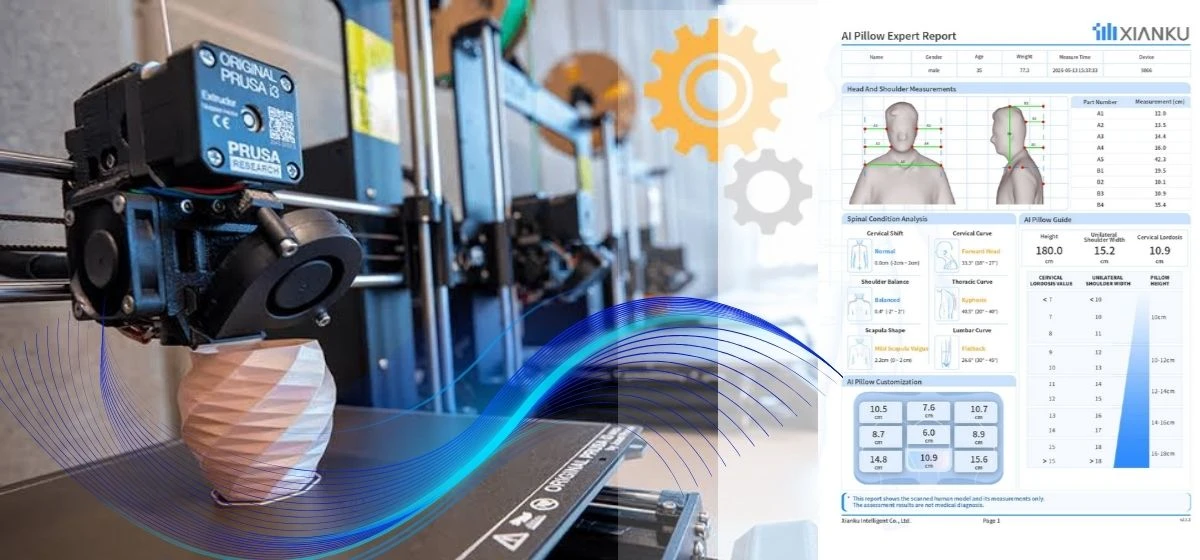
By combining a 3D Body Scanner with a 3D-printed modular adjustable pillow, this process becomes scientific.
The scanner analyzes head, neck, shoulder width, and spinal posture.
AI calculates the ideal support height.
The pillow is then manufactured-or adjusted through modular inserts-to match those personalized measurements.
Instead of adapting your body to the pillow, the pillow adapts to your body.
Personalized Insoles: Every Step Becomes Smarter
Walking is one of the most repetitive movements in daily life.
Even small biomechanical imbalances can accumulate into discomfort over thousands of steps.
Using data from a 3D Foot Scanner, personalized 3D-printed insoles can be manufactured to:
- Redistribute plantar pressure
- Improve foot stability
- Support the arch
- Optimize weight transfer
- Enhance walking comfort
Rather than producing identical insoles for everyone, manufacturers can produce a unique insole for every individual.
Personalized Shoes: The Next Generation of Footwear
Shoes are no longer defined solely by appearance.
They are becoming wearable health devices.
With digital foot data, 3D printing makes it possible to customize both function and aesthetics.
Internally, shoes can feature personalized cushioning, structural support, and biomechanical optimization.
Externally, consumers can customize colors, textures, logos, graphics, initials, or even limited-edition designs.
For the first time, footwear can reflect both how your body works and who you are.
3D Printing Needs Better Inputs, Not Bigger Machines
For years, innovation focused on improving printers.
Faster printing.
Higher precision.
New materials.
But the future of personalized manufacturing depends on something different.
The quality of the final product depends on the quality of the data behind it.
Without accurate human measurements, even the world's most advanced printer produces standardized products.
With precise body and foot data, every print becomes meaningful.
This is why 3D Body Scanners and 3D Foot Scanners are emerging as the true starting point of the personalized manufacturing ecosystem.
They provide the digital blueprint that allows AI to generate products designed around real people rather than average dimensions.
The Future of 3D Printing Is Human-Centered
The next chapter of 3D printing will not be defined by larger factories or faster machines.
It will be defined by personalization.
Imagine visiting a clinic, retail store, wellness center, or furniture showroom.
A quick body scan and foot scan create your digital profile.
AI instantly analyzes your anatomy.
A personalized pillow, insole, or pair of shoes is generated digitally.
The design is sent to a centralized 3D printing facility for production.
Within days, products arrive that are designed specifically for your body-not for the average consumer.
This is more than manufacturing innovation.
It is a new relationship between people and products.
Conclusion
For decades, the conversation around 3D printing has focused on machines.
But the future is not about printers.
It is about people.
The question is no longer:
"What can we print?"
The better question is:
"What should we print for this individual?"
The answer begins with understanding the human body.
Through 3D Body Scanners, 3D Foot Scanners, AI-powered analysis, and personalized manufacturing, products can finally be designed around the unique anatomy of every individual.
Because the true promise of 3D printing has never been to manufacture more.
It has always been to manufacture better.
And the best products are those designed for exactly one person.
