Why the Next Generation of Braces and Orthotics Will Be Designed Around the Individual, Not the Average
For decades, orthopedic support devices have followed the same manufacturing philosophy:
Design one product that fits as many people as possible.
Whether it's an ankle brace, an orthopedic insole, or a rehabilitation support, most products are still manufactured using standardized sizes such as Small, Medium, Large, or XL.
This approach has made production efficient.
But it has also exposed a fundamental limitation.
The human body has never been standardized.
Every foot is different.
Every gait is different.
Every injury heals differently.
And every patient requires a unique level of support.
As healthcare moves toward personalized medicine, orthopedic devices are entering the same transformation.
The future is no longer about manufacturing millions of identical braces.
It is about manufacturing millions of different ones-with the same efficiency.
At the center of this transformation is one technology:
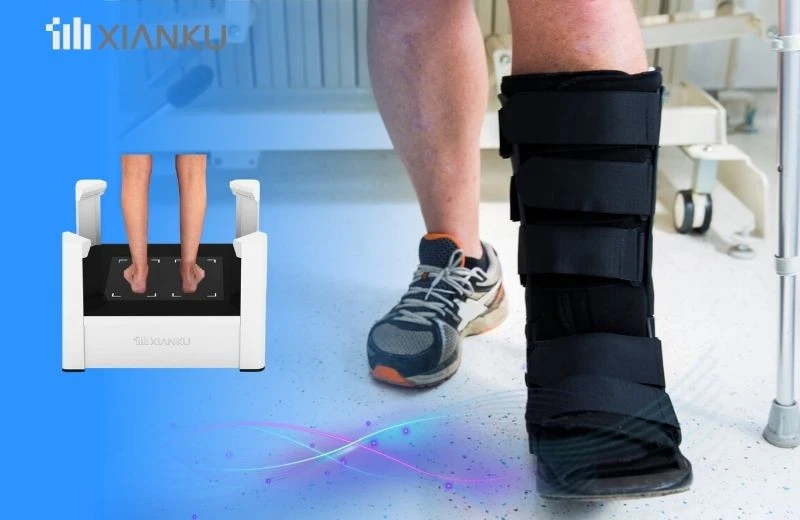
3D Foot Scanning.
Why Traditional Orthopedic Devices Often Fall Short
Orthopedic supports are designed to stabilize movement, reduce pain, and assist recovery.
Yet one common problem persists across nearly every category.
Many devices simply don't fit the patient well.
An ankle brace may compress one area while leaving another unsupported.
A plantar fasciitis orthosis may fail to match the patient's arch profile.
An AFO may require repeated manual adjustments before achieving an acceptable fit.
The issue isn't the quality of the materials.
It's the lack of accurate anatomical data.
When manufacturers design products using generalized measurements, every compromise becomes the patient's problem.
Every Foot Tells a Different Story
The foot is one of the most complex structures in the human body.
It contains:
- 26 bones
- 33 joints
- More than 100 muscles, tendons, and ligaments
Its structure determines how forces travel through the ankle, knee, hip, and spine.
Even subtle differences in foot geometry can significantly affect how an orthopedic device performs.
A patient with pes planus (flat feet) requires a completely different support strategy than someone with pes cavus (high arches).
Someone recovering from an ankle sprain has different biomechanical needs than a diabetic patient requiring pressure redistribution.
Treating all these patients with standardized products inevitably limits clinical outcomes.
From Manual Measurement to Digital Precision
Traditionally, clinicians have relied on foam boxes, plaster casting, rulers, or visual observation to capture foot anatomy.
While these methods have served the industry for decades, they are often:
- Time-consuming
- Operator-dependent
- Difficult to standardize
- Challenging to digitize
Modern 3D Foot Scanners eliminate many of these limitations.
Within seconds, they create a highly accurate digital model of the patient's foot, capturing detailed information such as:
- Foot length and width
- Arch height
- Heel contour
- Toe alignment
- Instep volume
- Foot symmetry
- Surface geometry
Instead of approximating anatomy, clinicians work with precise digital data.
Data Is Changing How Orthopedic Devices Are Designed
The real value of a foot scan is not the image itself.
It is the data behind the image.
Once a digital foot model has been created, AI-powered software can analyze biomechanical characteristics and automatically generate design parameters for orthopedic products.
Instead of manually reshaping every orthosis, digital workflows allow engineers to modify support zones with remarkable precision.
Pressure-sensitive regions can receive additional cushioning.
Collapsed arches can receive targeted support.
Heel cups can be optimized for stability.
Every adjustment is based on measurable anatomy rather than assumptions.

The Rise of 3D Printed Orthopedic Devices
Digital design becomes even more powerful when combined with additive manufacturing.
Traditional orthopedic production often requires multiple manual steps:
- Casting
- Mold fabrication
- Manual trimming
- Heat forming
- Repeated fitting adjustments
Each step consumes time and introduces variability.
With 3D printing, the workflow becomes dramatically simpler.
A digital foot scan is analyzed by AI.
A personalized model is generated.
The design is sent directly to production.
The finished product is manufactured without traditional molds.
This approach shortens production cycles while improving consistency.
Beyond Insoles: A New Generation of Personalized Supports
Although custom insoles remain one of the most common applications, 3D Foot Scanning is expanding into a much broader range of orthopedic products.
Manufacturers can now develop personalized:
- Functional ankle braces
- Post-operative walking supports
- Heel offloading devices
- Sports rehabilitation orthoses
- Pediatric foot correction devices
- Diabetic foot protection systems
Compression supports with anatomical contouring
Instead of modifying a standard product, the product itself begins with the patient's anatomy.
Better Fit Means Better Recovery
A better-fitting orthopedic device does more than improve comfort.
It can influence clinical outcomes.
When support matches the patient's anatomy more accurately, it can help:
- Improve joint stability
- Reduce abnormal pressure concentration
- Enhance gait symmetry
- Increase patient compliance
- Reduce secondary complications
- Improve rehabilitation efficiency
Patients are also more likely to continue wearing devices that fit comfortably.
This seemingly simple improvement can have significant long-term health benefits.
From Foot Scanner to Digital Manufacturing Ecosystem
Perhaps the greatest transformation is not occurring within the scanner itself.
It is occurring across the entire manufacturing workflow.
Imagine a rehabilitation clinic.
A patient completes a 3D foot scan in less than a minute.
The digital model is uploaded to the cloud.
AI analyzes the anatomy and automatically generates a personalized brace design.
The file is transmitted directly to a centralized 3D printing facility.
Within days, a customized orthopedic device is delivered back to the clinic.
No physical casting.
No shipping plaster molds.
No repeated manual fabrication.
The entire process becomes digital from beginning to end.
Why This Matters for Manufacturers
For orthopedic manufacturers, digital workflows offer advantages beyond personalization.
They also improve scalability.
Digital foot data allows companies to:
- Standardize design quality
- Reduce manual labor
- Accelerate product development
- Minimize production waste
- Build digital patient archives
- Support remote clinical services
Instead of operating as traditional manufacturers, companies become providers of digital healthcare solutions.

The Future of Orthopedic Manufacturing Starts With a Scan
Healthcare is becoming increasingly data-driven.
Artificial intelligence depends on accurate information.
Digital manufacturing depends on precise models.
Personalized medicine depends on understanding the individual.
In every case, the first step is data collection.
For orthopedic devices, that data begins at the foot.
3D Foot Scanners are no longer simply imaging devices.
They are becoming the foundation of an entirely new orthopedic manufacturing ecosystem-one where every brace, every support, and every orthotic begins not with a standard template, but with the unique anatomy of the person who will wear it.
Conclusion
For decades, orthopedic devices have been constrained by the limitations of mass production.
Tomorrow's orthopedic industry will be defined by mass personalization.
Powered by 3D Foot Scanning, AI-driven design, cloud-based engineering, and 3D printing, manufacturers can move beyond standardized supports toward devices tailored to each individual's anatomy, biomechanics, and rehabilitation needs.
The question is no longer:
"Which size fits the patient?"
The better question is:
"How can the device be designed specifically for this patient?"
The answer begins with a scan.