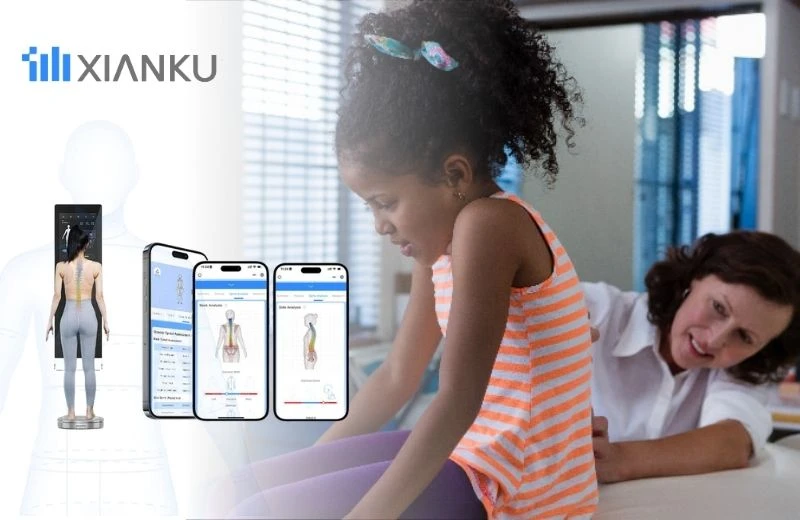
What Europe's New Youth Social Media Rules Reveal About Children's Postural Health
In recent years, governments around the world have become increasingly concerned about the impact of social media on children and teenagers.
Across Europe, policymakers are exploring stricter regulations for youth access to social media platforms, including stronger age verification requirements and additional protections for minors. Public debate has largely focused on issues such as online addiction, mental health, cyberbullying, and digital wellbeing.
These concerns are important.
But there is another question that receives far less attention:
What is excessive screen time doing to children's bodies?

While parents worry about what children are watching online, healthcare professionals are becoming increasingly concerned about how children are sitting while they watch.
A growing generation is spending more hours than ever before looking down at smartphones, tablets, laptops, and gaming devices. The consequences may extend far beyond temporary neck discomfort.
Some experts believe we are witnessing the emergence of a silent postural health crisis.
The First Generation Raised Entirely in the Digital Age
Today's children are growing up in a world unlike any previous generation.
Many children receive their first tablet before entering primary school.
Many teenagers spend several hours each day on:
- Social media
- Online gaming
- Streaming platforms
- Digital learning
- Messaging applications
Technology has become an essential part of modern education and social interaction.
However, the human body has not evolved as quickly as technology.
Our musculoskeletal system was designed for movement.
Children's bodies were designed to run, jump, climb, and explore.
Instead, increasing numbers of young people spend large portions of their day sitting in fixed positions while focusing on screens.
This shift is creating new physical challenges that previous generations rarely experienced at the same scale.
The Hidden Physical Cost of Screen Time
When discussing screen addiction, most conversations focus on psychological effects.
Yet the physical consequences can be equally significant.
One of the most common problems associated with prolonged device use is known as Forward Head Posture, often referred to as "Tech Neck."
When children look down at a smartphone or tablet, the head gradually shifts forward.
Although the average human head weighs approximately 4 to 6 kilograms, the force placed on the cervical spine increases dramatically as the head moves away from its natural position.
Over time, this can contribute to:
- Forward head posture
- Rounded shoulders
- Upper back curvature
- Neck muscle strain
- Reduced spinal mobility
- Poor postural habits
The problem is not a single gaming session or one evening spent on social media.
The problem is repetition.
When these positions are repeated daily over months and years during critical growth periods, the body may begin adapting to them.
Why Children Are More Vulnerable Than Adults
Adults often develop postural problems after years of poor habits.
Children face a different challenge.
Their bodies are still developing.
During childhood and adolescence:
- Bones are growing
- Muscles are developing
- Movement patterns are being established
- Spinal alignment is evolving
This means posture is not simply a reflection of current behavior.
It may influence how the body develops in the future.
A child who consistently adopts poor postural habits may gradually establish movement patterns that become increasingly difficult to correct later in life.
The earlier these changes are identified, the greater the opportunity for intervention.

The Silent Nature of Postural Changes
One of the biggest challenges facing parents is that postural changes often occur slowly.
Unlike a sports injury, posture rarely changes overnight.
There is usually no dramatic event.
No immediate pain.
No obvious warning sign.
Instead, subtle changes accumulate over time.
A shoulder may become slightly elevated.
The head may move slightly forward.
The pelvis may gradually shift out of alignment.
These small deviations often go unnoticed until they become visibly apparent or begin causing discomfort.
By then, the issue may have been developing for years.
This is why posture experts increasingly emphasize early assessment rather than waiting for symptoms to appear.
Beyond Appearance: Why Posture Matters for Long-Term Health
Many people mistakenly view posture as a cosmetic issue.
In reality, posture influences multiple aspects of health and physical function.
Proper alignment helps the body:
- Distribute forces efficiently
- Maintain balance
- Reduce muscular strain
- Support healthy movement patterns
- Improve physical performance
Poor posture can affect far more than appearance.
Over time, it may contribute to:
- Chronic neck pain
- Shoulder dysfunction
- Back discomfort
- Reduced mobility
- Muscular imbalances
- Decreased physical confidence
For growing children, maintaining healthy movement patterns is especially important because these habits often persist into adulthood.
What If Parents Could See Problems Before Symptoms Appear?
Traditionally, posture assessments relied on visual observation.
Parents, teachers, and even healthcare professionals often evaluated posture by simply looking at a child from different angles.
While useful, visual assessment has limitations.
Many postural deviations are subtle.
Small asymmetries can be difficult to detect with the naked eye.
As healthcare becomes increasingly data-driven, a new generation of assessment technologies is helping make posture more measurable and more understandable.
The Rise of 3D Body Scanning in Children's Postural Health
One of the most promising developments in modern posture assessment is the use of 3D body scanning technology.
Unlike traditional observation methods, a 3D Body Scanner can create a digital model of the body within seconds.
Advanced systems are capable of evaluating:
- Head position
- Shoulder symmetry
- Spinal alignment
- Pelvic tilt
- Body balance
- Postural deviations
This allows practitioners to identify potential concerns objectively rather than relying solely on subjective observation.
More importantly, the results can often be visualized in a way that parents easily understand.
Instead of hearing that a child may have a posture issue, families can actually see measurable changes in a digital report.
Why Prevention Matters More Than Correction
When discussing children's health, prevention is almost always easier than treatment.
The same principle applies to posture.
Small adjustments in daily habits can make a meaningful difference:
- Limiting excessive screen time
- Encouraging outdoor activity
- Promoting regular movement breaks
- Supporting ergonomic study environments
- Monitoring posture during growth years
However, effective prevention requires awareness.
Parents cannot address issues they cannot see.
This is where modern posture assessment technologies, including 3D Body Scanners, can play an increasingly valuable role.
By identifying changes earlier, families and healthcare professionals can take proactive steps before minor deviations become larger problems.

Europe's Social Media Debate May Be About More Than Screens
Europe's efforts to strengthen protections for young social media users are often framed as a discussion about mental health and digital wellbeing.
Those concerns are valid.
Yet the conversation may also serve as a reminder of another challenge facing today's children.
A generation growing up online is not only shaping its minds through screens.
It is also shaping its bodies.
As digital lifestyles continue to expand, protecting children's health will require looking beyond what happens on the screen and paying closer attention to what is happening in front of it.
Because the future of children's wellbeing may depend not only on managing screen time, but also on ensuring that healthy bodies develop alongside digital lives.
And sometimes, the first step toward protecting a child's future posture is simply making the invisible visible.