It started with a comment in a carpool lane. "Is it just me," another mom asked as she watched Mia climb into the backseat, "or does one of her shoulders seem higher than the other?"
I smiled and waved it off. My daughter had just turned twelve. She was growing fast, sleeping in awkward positions, carrying that ridiculously heavy backpack everywhere. Uneven shoulders. Probably nothing.
Two years later, the orthopedist at our regional children's hospital delivered the diagnosis. Adolescent idiopathic scoliosis. Cobb angle: 48 degrees - severe enough to require immediate bracing and almost certainly surgery in the next few years.
The guilt was overwhelming. How had I missed it? Why hadn't her pediatrician caught it earlier? Looking back, the signs were there. I just didn't know what I was looking for.
This is not my story alone. It is an American reality playing out in living rooms, pediatric waiting rooms, and chiropractic clinics every single day - and it highlights a problem that every parent and every chiropractic professional needs to understand.
A Silent Condition That Millions of American Families Face
Let me begin with a number that stopped me cold when I first heard it. Roughly 3 million new cases of scoliosis are diagnosed in the United States each year, with the majority identified as idiopathic scoliosis - a type of spinal deformity that presents in children during their teenage years. The Hughston Clinic estimates that 3 to 5 percent of teenagers in America are affected, which translates to approximately 6 to 9 million Americans living with scoliosis. This means that in a typical American high school of 2,000 students, between 60 and 100 teenagers have some degree of spinal curvature.
Here is the part that haunts parents like me. Adolescent idiopathic scoliosis is often painless in its early stages. This is a silent condition that may go completely unnoticed until a routine physical examination - or until a sharp-eyed parent or teacher happens to spot asymmetry. Many parents report that their child's curve was discovered entirely by accident: during a trip to the swimming pool, when a coach noticed uneven shoulder blades, or when a teenager complained about clothing fitting oddly.
When my daughter was finally diagnosed, the orthopedist asked if anyone in our family had scoliosis. Neither my spouse nor I could recall a single case. But as we later learned, scoliosis runs in families - and mild cases can go completely unnoticed across multiple generations. Dr. Amit Jain of Johns Hopkins Medicine explains that when parents hear scoliosis runs in families, they often respond by saying, "But nobody in our family has it." The reality: it may have gone unnoticed because it was simply a very mild case.
The truth is that parents frequently ask what they could have done differently to prevent scoliosis. The answer, according to orthopedic specialists, is: nothing. This condition is genetically programmed. Heavy backpacks do not cause it. Poor posture does not cause it. Adolescence and rapid growth spurts unmask what was already there.
What Happens When Early Detection Fails - A Cascade of Medical Consequences
I now understand what delayed diagnosis cost my daughter - and her case represents only one part of a much larger public health pattern affecting adolescents across North America.
When scoliosis is caught early - when the curvature is below 20 degrees - it can typically be managed with observation and periodic monitoring. Curves between 20 and 40 degrees in a growing child are candidates for bracing, which significantly reduces the risk of progression toward surgical thresholds.
But here is the cascade that happens when screening is inconsistent or superficial. A 2026 systematic review and meta-analysis published in the journal Spine examined 34 studies covering 2.8 million schoolchildren. The study's findings are striking: screen-detected adolescents showed a mean Cobb angle of 28 degrees at presentation, compared to 40 degrees in those diagnosed through usual care - and screen-detected cases had 73 percent lower odds of eventually requiring spinal fusion surgery.
Statistics like that should stop every chiropractor reading this article. Seventy-three percent lower odds of fusion surgery. That is the difference between a teenager spending six months in a brace and undergoing a major spinal operation followed by months of recovery.
For curves above 45 to 50 degrees - the severe range - physicians typically recommend surgery, including spinal fusion involving the correction of deformity and fixation of multiple vertebrae. Even with modern surgical advances - Dr. Jain of Johns Hopkins notes that most children undergoing surgery today miss only about three weeks of school and return to normal activities by six weeks - spinal fusion is still a major operation involving metal rods, screws, and permanent alteration of the child's anatomy.
This is a stark reality. For the 90 percent of AIS patients who can be successfully managed without surgery if caught early, every six-month delay in diagnosis represents potential progression toward that surgical threshold.

The Cracks in Our Screening System
Why is delayed diagnosis so common? The answer lies in significant cracks in our screening infrastructure - combined with a contentious national debate over whether routine screening is even worth doing.
Today, only about half of U.S. states mandate school-based scoliosis screening. Those that do vary widely in their approaches. California, for instance, mandates screening of every female pupil in grade 7 and every male pupil in grade 8. Virginia screens students in selected grades 5 through 10 at least twice over a six-year period. Texas and other states have recently enacted new school health consent laws that may make it harder for schools to provide these screenings without requiring explicit parental opt-in for every service - vision, hearing, and spinal development included.
Pennsylvania currently screens only in grades 6 and 7 - an approach that one Pennsylvania state senator is actively trying to change. In a June 2025 co-sponsorship memo, a Pennsylvania legislator shared the case of a constituent's 10-year-old daughter who was short of breath at school. A chest X-ray ordered by the family's doctor incidentally revealed a 48-degree spinal curvature already requiring bracing and likely surgery in the coming years. As the memo states, "They choose to be stronger than scoliosis, and are advocating for earlier testing and over a longer duration to help save more children from long-term suffering."
At the federal level, the U.S. Preventive Services Task Force (USPSTF) maintains that the current evidence is insufficient to assess the balance of benefits and harms of routine scoliosis screening for adolescents aged 10 to 18 years. This stance has long frustrated major spine and pediatric organizations. The American Academy of Orthopaedic Surgeons (AAOS), Scoliosis Research Society (SRS), Pediatric Orthopaedic Society of North America (POSNA), and American Academy of Pediatrics (AAP) do not support any recommendation against scoliosis screening given the available research. Their joint position advising screening for girls at ages 10 and 12 and boys once at age 13 or 14 represents the clinical consensus of the most respected spine and pediatric authorities in the country.
What this means for chiropractors is a confusing patchwork of inconsistent recommendations - but one clear clinical reality. Routine scoliosis screening in primary care pediatric visits is not consistently happening, children are not being systematically screened in schools across most states, and most parents are not equipped to reliably detect the subtle signs of early AIS at home.
Table 1: The Early Warning Signs of Adolescent Idiopathic Scoliosis - What Parents and Practitioners Should Look For
| Sign | How to Observe | Clinical Significance |
|---|---|---|
| Uneven shoulders | Have child stand straight, observe shoulder height from behind | One shoulder higher indicates possible thoracic curve |
| Prominent shoulder blade | Look for one shoulder blade protruding more than the other | Rib rotation often accompanies unilateral prominence |
| Uneven hips/waist creases | Observe iliac crest height and waistline symmetry | Low hip or deep crease may indicate lumbar curve |
| Head not centered | Check if head tilts or sits off midline above pelvis | Whole-spine imbalance affecting center of gravity |
| Adams forward bend asymmetry | Child bends 90° at waist, view back for rib hump | Gold-standard visual test; >1 cm difference = refer |
| Unusual gait or clothing hang | Observe walking and how clothing drapes across shoulders | Late or more significant curvature indicator |
Source: Compiled from clinical resources of the Canadian Scoliosis Screening Coalition and Scoliosis Research Society guidelines.
Table 2: Clinical Consequences of Delayed Scoliosis Diagnosis
| Stage at Detection | Typical Cobb Angle | Treatment Pathway | Surgical Likelihood |
|---|---|---|---|
| Early screening detection | 10–20° | Observation with periodic re-evaluation | <5% |
| Mid-stage detection | 20–40° (growing child) | Bracing; regular monitoring for progression | 15–20% with proper bracing compliance |
| Late detection | >40–50° | Brace less effective; surgery increasingly recommended | >60% |
| Very late/incidental detection | >50° | Surgical correction (spinal fusion or alternative procedures) | >80–90% |
Data source: Scoliosis Research Society clinical guidelines and Spine journal systematic review data (2026).
Why Traditional Assessment Methods Fall Short Even in Clinics
This brings us to an uncomfortable question for chiropractors. Even when a child is brought in for a spinal check - perhaps because a parent was worried, perhaps because of an unrelated complaint - can the typical visual screening tools reliably detect mild to moderate scoliosis?
The unfortunate answer is no.
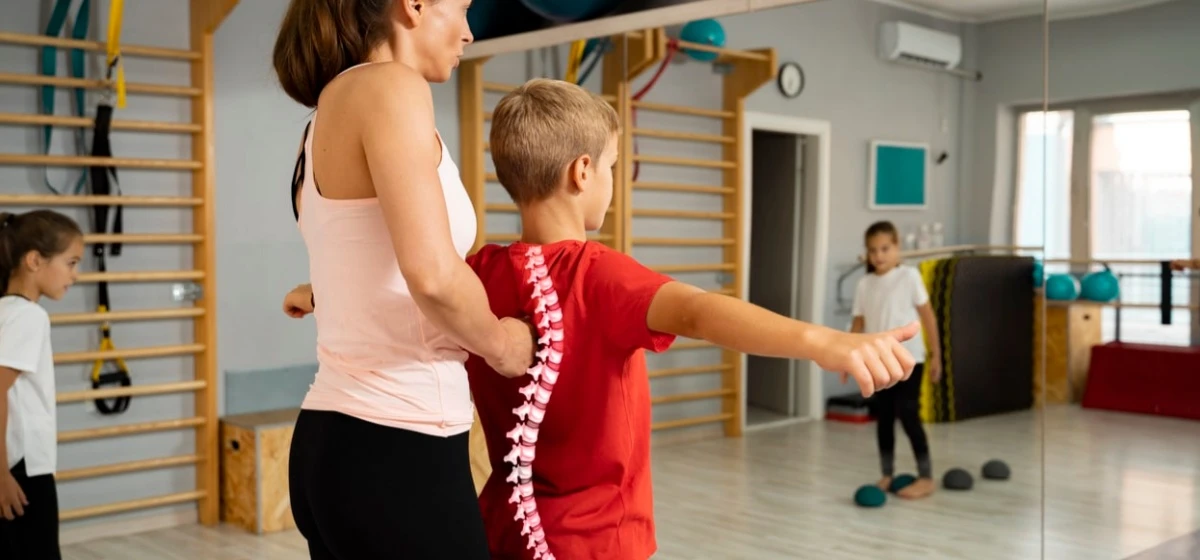
The Adam's Forward Bend Test - the cornerstone of clinical scoliosis screening - has well-documented limitations. Studies cited by Xianku indicate that for curves under 20 degrees, the sensitivity of the Adam's test alone drops to approximately 50 percent, meaning half of clinically significant curves are completely missed in a simple visual screening. Even for visible curves, inter-rater reliability - the degree to which different examiners agree on findings - rarely exceeds 0.6, meaning that one chiropractor's "subtle asymmetry" is another's "within normal limits."
X-rays, while definitive for Cobb angle measurement, introduce ionizing radiation that makes them inappropriate for routine screening or frequent monitoring. For parents already concerned about cumulative radiation exposure in their children - from dental X-rays, sports injury films, and other medical imaging - the prospect of repeated spinal radiographs every six to twelve months is understandably anxiety-provoking. Furthermore, X-ray capacity is limited in many outpatient chiropractic clinics and typically requires referral to imaging centers, adding cost and logistical friction to the monitoring process.
What chiropractors need is a practical middle ground: an objective, quantifiable, radiation-free screening tool that can be deployed in seconds during routine patient encounters, producing visual outputs that parents can immediately see and understand.
Bridging the Gap - How the Xianku 3D Body Scanner Changes the Detection Game
The Xianku 3D Body Scanner closes the gap between missed opportunities and early detection - and does so in a way that directly benefits both chiropractic practices and the families they serve.
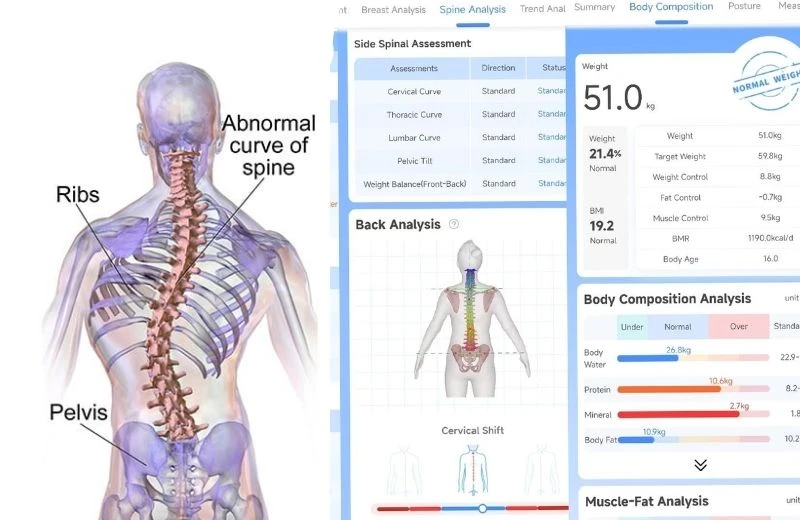
Using patented 3D structured light scanning technology completely free of radiation exposure, the scanner captures over 2 million body surface data points in just 20 seconds. Within one minute, it generates a comprehensive report including a 1:1 digital twin of the patient's posture and spinal alignment. The system's AI algorithms - trained on an extensive database of anonymized spinal and postural data - assess scoliosis risk, measure spinal curvature, visualize skeletal alignment, and quantify the patient's center of gravity.
Here is where this matters for parents like me. The scanner detects curves as small as 5 degrees - far below the 15-to-20-degree threshold where the Adam's Forward Bend Test typically becomes visibly obvious. This means a chiropractor can identify a child's spinal curvature when it is still highly responsive to conservative management, rather than waiting until it progresses into the bracing or surgical range.
The Xianku system automatically analyzes 20 physical health parameters across nine body areas - including high and low shoulders, rounded shoulders, pelvic tilt (both forward and backward), hunchback position, knee hyperextension, and O/X-shaped legs. For the parent who has no idea what to look for, this report provides a visual, color-coded, instantly understandable picture of their child's postural health. For the chiropractor, it provides objective baseline data against which every future visit can be measured.
Equally important, the scanner allows entirely safe, unlimited repeat monitoring. A child in a brace can be rescanned every three months to precisely track skeletal response - whether curvature is improving, stabilizing, or progressing - without exposing that growing body to any cumulative radiation. For children undergoing growth spurts, when curves progress most rapidly, this safety factor is not just a convenience; it is a crucial clinical advantage.

A Message to Chiropractors From a Mother Who Wishes Her Daughter Had Been Scanned
At my daughter's two-year follow-up appointment, her orthopedist asked if we had considered joining their hospital's spine research program. "We're seeing so many kids come in with curves in the 40-to-50-degree range," she said. "If we could catch them two years earlier, most of them wouldn't be here."
Two years. That is what delayed screening cost my daughter - and what it costs countless American children every year.
The American Academy of Pediatrics, the American Academy of Orthopaedic Surgeons, the Scoliosis Research Society, and the Pediatric Orthopaedic Society of North America all agree that routine scoliosis screening should be part of preventive medical care for adolescents. The scientific literature confirms that screening reduces surgical rates. The tools exist to make reliable, radiation-free screening practical even in primary care and chiropractic office settings.
The question is no longer whether early detection works. The question is whether we, as parents and practitioners, are ready to make it happen.
If your chiropractic practice treats children and adolescents - or if you want to attract that demographic - the Xianku 3D Body Scanner is not a luxury. It is the most practical, immediate investment you can make in catching curved spines before they progress beyond the point where conservative care alone can succeed.
My daughter's story is already written. But countless other children's stories are still being written every day - in exam rooms, school hallways, and living rooms across America.
The next one does not have to end the same way.