

For teachers, police officers, waiters, nurses, retail staff, reception teams, and other standing professionals, foot pain is often treated as "part of the job." Many people simply change shoes, add a soft insole, stretch for a few minutes, or wait for the discomfort to fade. But when heel pain becomes a daily problem-especially sharp pain near the bottom of the heel in the morning or after long standing-it may be linked to plantar fascia overload and deeper biomechanical imbalance.
The foot is often called the body's "second heart," but it is also the base of the entire musculoskeletal chain. When the foot arch collapses, the heel tilts inward or outward, or the forefoot carries uneven pressure, the impact may travel upward through the ankle, knee, hip, pelvis, and spine. Over time, abnormal foot mechanics may contribute to knee pain, pelvic imbalance, lower back fatigue, poor posture, and chronic work-related discomfort.
That is why plantar fasciitis relief and ergonomics foot assessment is becoming an important service for foot care centers, health screening centers, occupational wellness providers, and preventive health clinics. Instead of relying only on pain description or basic footprint checks, modern foot health assessment is moving toward 3D infrared structured light scanning and data-based ergonomic intervention.

Why Standing Workers Are More Vulnerable to Plantar Fascia Overload
The plantar fascia is a strong band of connective tissue that supports the arch and helps absorb force during standing, walking, and running. For people who stand for many hours each day, this structure is under repeated tension.
Common high-risk groups include:
- Teachers standing during long classes
- Police officers walking or standing during patrol duty
- Waiters and service staff working long shifts
- Retail employees standing on hard floors
- Reception and hospitality staff wearing formal shoes
- Healthcare workers moving between patients
- Factory and warehouse workers with repetitive loading
For these groups, foot pain is not only a comfort issue. It can affect work performance, posture, mood, mobility, and long-term musculoskeletal health.
Common signs linked to plantar fascia stress include:
- Heel pain after getting out of bed
- Pain after long standing or walking
- Tightness under the arch
- Forefoot fatigue
- Calf tightness
- Pain that improves briefly with movement but returns later
- Discomfort when wearing hard, narrow, or poorly supported shoes
A professional ergonomics foot assessment helps identify whether the pain is related to arch structure, heel alignment, footwear mismatch, or long-term biomechanical overload.
Why Traditional Foot Checks Are Not Enough
Many foot care centers and health screening providers still rely on visual inspection, simple shoe-size measurement, 2D footprints, or pressure mats. These tools can provide useful references, but they do not fully explain the three-dimensional structure of the foot.
A pressure mat can show how pressure is distributed under the sole. A 2D footprint can show the contact area. But plantar fasciitis-related discomfort is not only about pressure. It is also about arch height, heel angle, foot width, instep volume, forefoot shape, left-right asymmetry, and how the foot structure responds to long standing.
Traditional 2D or pressure-based methods may miss:
- True arch height and arch shape
- Heel valgus or varus tendency
- Instep height and foot volume
- Foot width changes caused by long-term loading
- Left-right structural differences
- Severe inward or outward foot deviation
- Data needed for personalized insoles or ergonomic footwear
- Full 3D morphology behind plantar fascia stress
This is where Xianku's 3D full-foot structured light modeling creates a clear technology advantage over traditional two-dimensional foot scanning.
Xianku 3D Foot Scanning: A Smarter Foundation for Foot Pain Assessment
Xianku is a global leader in 3D precise body-sign data operation services, helping health, wellness, orthopedic, and retail partners turn physical body data into digital health value.
For plantar fasciitis relief and ergonomics foot assessment, Xianku's 3D foot scanner uses advanced Infrared structured light technology to capture the complete structure of both feet. Compared with traditional laser scanning or pressure mat systems, infrared structured light offers a faster, more comfortable, and more precise scanning experience.
The system can complete dual-foot scanning in 1 second and generate a professional report in about 5 seconds. This is especially valuable for foot care centers and health screening centers that need fast, comfortable, and high-throughput assessment services.
Core technical advantages include:
- 1-second scanning for both feet
- Non-contact and comfortable scanning process
- ±1mm precision for millimeter-level measurement
- 5-second professional report generation
- 1:1 real 3D full-foot model reconstruction
- 30+ biomechanical datasets for detailed assessment
- Exportable STL/OBJ 3D models for 3D printing workflows
- Direct connection to custom functional insoles and ergonomic footwear
This turns foot assessment from a basic visual service into a professional digital screening experience.
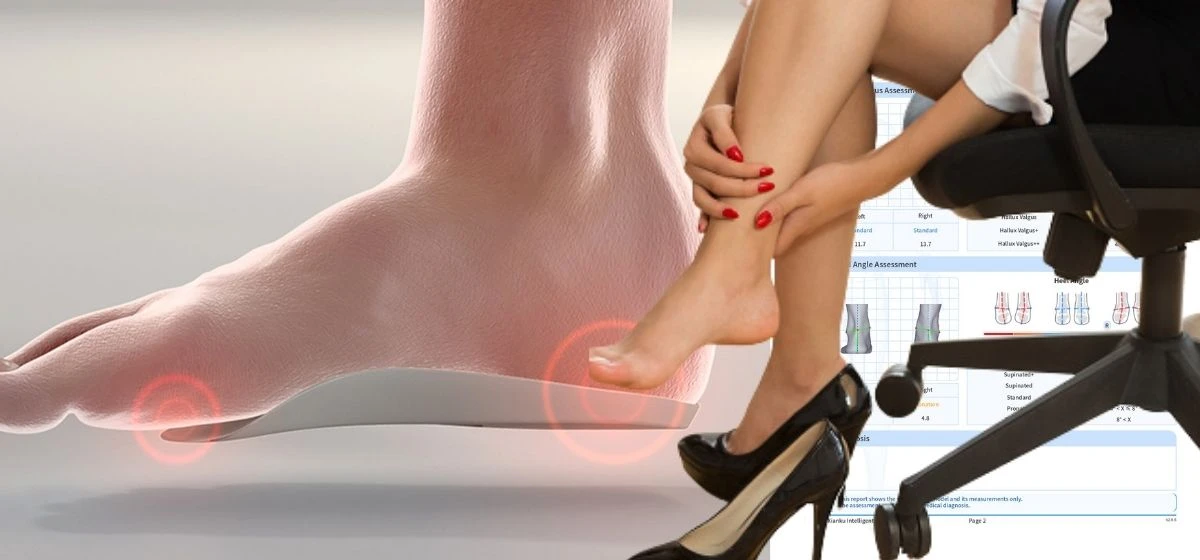
ACA & AHI Algorithm: Understanding the Arch Beyond Flat Foot Labels
Arch evaluation is essential in plantar fascia care. If the arch is too low, the plantar fascia may be overstretched during standing. If the arch is too high, shock absorption may be reduced, increasing localized stress on the heel and forefoot. However, traditional arch assessment often relies on footprint area, which may lead to inaccurate results in people with severe pronation, supination, or abnormal foot posture.
Xianku's exclusive self-developed ACA & AHI algorithm provides a more advanced way to evaluate arch structure.
- ACA means Arch Conduction Angle.
- AHI means Arch Height Index.
- The ACA & AHI algorithm combines:
- 3D full-foot model data
- Arch height index
- Arch shape and morphology
- Medial longitudinal arch structure
- Heel-to-midfoot spatial relationship
- Foot posture and structural tendency
This allows the system to move beyond simple "flat foot" or "normal foot" judgments. It helps foot care professionals better understand why a person may experience plantar fascia overload, heel discomfort, or standing-related fatigue.
For occupational wellness, this matters because wrong arch classification can lead to wrong insole selection. A soft insole may feel comfortable at first, but if it fails to support the arch or stabilize the heel, symptoms may continue.
What a 3D Ergonomics Foot Report Can Reveal
A high-quality foot assessment should not only tell someone their shoe size. It should explain how their foot structure may influence daily comfort, posture, and loading.
Xianku's 3D foot scanning system outputs 30+ biomechanical datasets, including:
- Foot length
- Foot width
- Forefoot width
- Heel width
- Ball girth
- Foot circumference
- Instep height
- Arch height
- Arch type
- Toe structure
- Heel alignment reference
- Left-right asymmetry
- Foot morphology classification
- Custom insole design references
- Ergonomic footwear fitting data
Because the system generates a true 1:1 three-dimensional foot model, the data can also be exported as STL/OBJ 3D models. These models can connect with 3D printing systems to support customized functional insoles or personalized footwear.
For foot care centers and health screening centers, this creates a complete service pathway: scan, analyze, explain, recommend, customize, and follow up.
How 3D Foot Assessment Supports Plantar Fasciitis Relief
A 3D scan does not replace medical diagnosis or treatment. However, it provides valuable structural information that can support foot care planning, ergonomic correction, and referral decisions.
3D foot assessment may help identify:
- Low arch or arch collapse linked to plantar fascia strain
- High arch patterns that reduce shock absorption
- Heel alignment issues that increase uneven loading
- Foot asymmetry that affects standing balance
- Shoe-size mismatch or insufficient shoe width
- Instep and girth differences affecting footwear comfort
- Structural need for functional insole support
- Candidates for custom 3D-printed insoles
For standing professionals, the goal is not only short-term pain relief. The goal is to reduce repeated overload, improve support, and create a more ergonomic foundation for daily work.
Applications for Foot Care Centers and Health Screening Centers
1. Foot Care Centers: Upgrade from Comfort Service to Data-Based Care
Traditional foot care often focuses on massage, relaxation, or symptom relief. With 3D scanning, foot care centers can offer a more professional assessment experience before recommending insoles, footwear, or wellness services.
Potential services include:
- AI foot health screening
- Plantar fascia risk assessment
- Arch and heel alignment analysis
- Custom insole recommendation
- Digital foot health profile creation
- Follow-up comparison after intervention
This helps foot care centers move from short-term comfort to long-term foot health management.
2. Health Screening Centers: Add Foot Biomechanics to Preventive Checkups
Most health screening programs focus on blood tests, body composition, vision, cardiovascular markers, or bone density. But for working adults, foot biomechanics is highly relevant to daily quality of life.
- A 3D foot scan can be added to:
- Occupational health checkups
- Corporate wellness programs
- Sub-health assessment packages
- Musculoskeletal screening
- Posture and gait-related services
- Preventive orthopedic care
This gives clients a more complete picture of their body from the ground up.
3. Occupational Wellness Providers: Support Long-Standing Workers
For companies with standing workers, foot health directly affects productivity, fatigue, absenteeism, and employee satisfaction. Providing foot screening and ergonomic insole solutions can become part of a more human-centered workplace wellness strategy.

3D Foot Scanning vs Traditional Foot Assessment
|
Assessment Area |
Traditional 2D / Pressure Mat |
Xianku 3D Structured Light Assessment |
|
Scan Method |
Contact-based or flat image |
Non-contact infrared structured light |
|
Scan Speed |
Varies by system |
1-second scanning |
|
Report Output |
2D footprint or pressure map |
1:1 real 3D full-foot model |
|
Accuracy |
Limited structural measurement |
±1mm precision |
|
Arch Evaluation |
Often based on sole contact area |
ACA & AHI algorithm |
|
Data Depth |
Basic pressure or area information |
30+ biomechanical datasets |
|
Customization |
Limited |
STL/OBJ 3D models for 3D printing |
|
Best Use |
Basic screening |
Plantar fascia care, ergonomic support, custom insoles |
The biggest difference is that Xianku's system captures the full structure of the foot, not just the surface contact pattern. This allows professionals to understand both comfort issues and biomechanical causes.
Q&A: Common Questions About Plantar Fasciitis Relief and Ergonomics Foot Assessment
How can a 3D foot scan help with plantar fasciitis relief?
A 3D foot scan helps identify arch structure, heel alignment, foot width, asymmetry, and other biomechanical factors that may contribute to plantar fascia overload. This data can support better insole selection, footwear recommendations, and ergonomic care planning.
Is a pressure mat enough for plantar fasciitis assessment?
A pressure mat can show plantar pressure distribution, but it cannot fully capture 3D arch height, instep shape, heel structure, foot volume, or complete foot morphology. For long-standing workers, full 3D foot data provides deeper insight.
What is the ACA & AHI algorithm?
The ACA & AHI algorithm is Xianku's self-developed arch assessment method. It combines Arch Conduction Angle, Arch Height Index, 3D full-foot modeling, and arch morphology to reduce errors caused by traditional area-based arch analysis.
Can 3D foot scanning be used for custom insoles?
Yes. Xianku's scanner generates real 1:1 STL/OBJ 3D models, which can connect with 3D printing systems for customized functional insoles or ergonomic footwear.
Who needs an ergonomics foot assessment?
Teachers, police officers, waiters, retail staff, reception workers, healthcare workers, factory workers, and anyone who stands or walks for long hours may benefit from foot health screening.
How fast is the scanning process?
The system can complete dual-foot 1-second scanning and generate a professional report in about 5 seconds, making it suitable for high-traffic foot care centers and health screening facilities.
Final Takeaway: Foot Pain Is Not Just a Local Problem
For standing professionals, heel pain and plantar fascia discomfort should not be ignored. The foot is the foundation of posture, balance, and daily movement. When the foot is overloaded or poorly supported, the impact may extend to the knees, hips, pelvis, and spine.
Plantar fasciitis relief and ergonomics foot assessment gives foot care centers and health screening centers a more precise way to understand work-related foot stress. With Xianku's Infrared structured light technology, 1-second scanning, ±1mm precision, ACA & AHI algorithm, 30+ biomechanical datasets, and exportable STL/OBJ 3D models, foot health screening becomes faster, smarter, and more connected to personalized care.
For people who stand all day, better foot health starts with better data.
Get Your Free AI Foot Health Screening
Visit a nearby Xianku partner foot care center, health screening center, wellness clinic, or orthopedic service point to experience a free AI Foot Health Screening. In just a few seconds, you can receive your digital foot health profile, understand your plantar fascia and ergonomic risk factors, and explore personalized options for functional insoles, footwear support, and long-term foot wellness.
