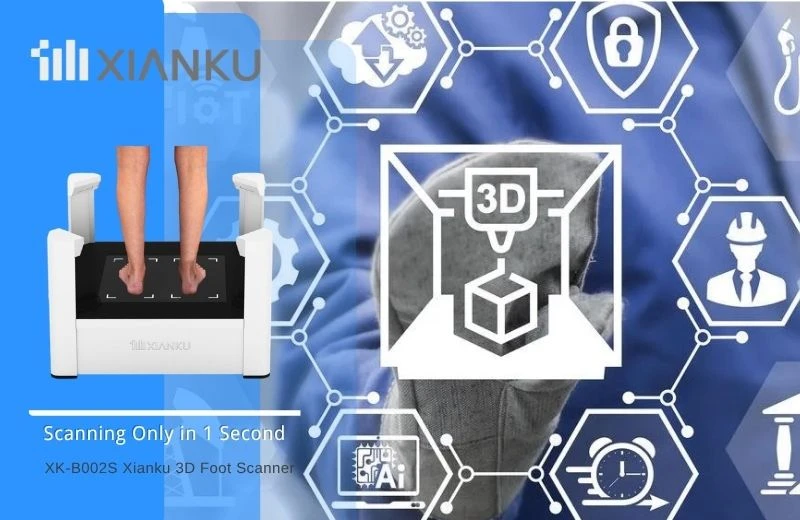
As 3D Printing Enters the Consumer Spotlight, AI and 3D Foot Scanning Are Unlocking the Next Generation of Personalized Footwear
When people talk about the future of consumer technology today, one topic appears again and again: Artificial Intelligence.
From smartphones and robots to autonomous driving and smart manufacturing, AI is no longer an experimental technology-it is becoming the intelligence behind almost every industry.
At the same time, another technology is quietly moving from factories into consumers' everyday lives: 3D printing.
A recent example highlights this shift. AliExpress announced that it will lead its Brand+ partners to exhibit at IFA Berlin 2026, Europe's largest consumer electronics exhibition. Among the featured technologies are robotics, AR glasses, smart mobility, and 3D printing-a strong signal that 3D printing is no longer viewed solely as an industrial manufacturing tool, but as part of the next generation of consumer technology.
This is an exciting milestone.
But it also raises a more important question.
If 3D printing is becoming mainstream, what will truly make it valuable to consumers?
The answer isn't simply printing more products.
It is printing better, smarter, and more personalized products.
And that is where AI changes everything.
The future of footwear will not be defined by 3D printing alone.
It will be defined by AI + 3D Printing.
3D Printing Solves Manufacturing. AI Solves Personalization.
For decades, footwear innovation focused on manufacturing.
Brands competed by developing:
- Lighter materials
- Softer cushioning
- Stronger midsoles
- Faster production methods
3D printing introduced another breakthrough.
Instead of relying on traditional molds, manufacturers could build complex structures layer by layer, reducing waste and enabling entirely new designs.
From a manufacturing perspective, it was revolutionary.
But from a consumer's perspective, one important limitation remained.
Most 3D-printed shoes are still designed for millions of people, not one individual.
The production method changed.
The personalization often did not.
A shoe may be 3D printed, but it is still usually based on standard sizes and generalized assumptions.
The future demands something different.
Not simply 3D-printed shoes.
But AI-designed shoes built specifically for one person's feet.
Every Foot Is Different. Why Are Most Shoes Still the Same?
Walk into any shoe store and you'll hear the same question:
"What size do you wear?"
For decades, shoe size has been the primary way of matching footwear to customers.
Yet shoe size tells only a small part of the story.
Two people wearing the same size may have completely different feet.
- One may have flat feet.
- Another may have high arches.
- One may have a narrow heel.
- Another may have a wide forefoot.
- Some people naturally overpronate.
- Others place more pressure on the outside of their feet.
- Some have noticeable differences between their left and right foot.
These differences influence comfort, stability, walking efficiency, and long-term foot health.
Yet traditional retail often treats them as identical customers simply because they share the same shoe size.
This is one of the biggest opportunities for AI.
Before AI can recommend the right product, it first needs to understand the individual.
AI Begins With Data-And Every Personalized Shoe Begins With a Foot Scan
Artificial intelligence is only as powerful as the data it receives.
Large language models learn from text.
Autonomous vehicles learn from millions of miles of driving data.
Medical AI learns from clinical information.
Personalized footwear requires its own data source.
That source is the human foot.
This is where 3D Foot Scanning becomes essential.
A modern 3D Foot Scanner captures far more than foot length.
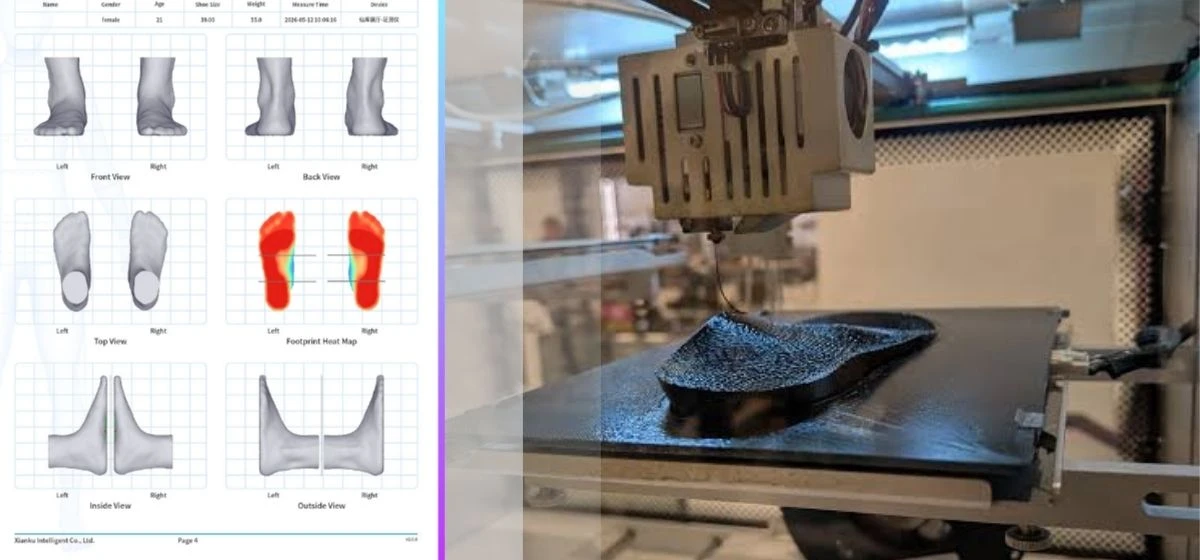
Within seconds, it can generate a detailed digital model containing valuable information such as:
- Foot length
- Foot width
- Arch height
- Instep height
- Heel dimensions
- Toe shape
- Left-right symmetry
- Overall foot volume
This information becomes the foundation for intelligent decision-making.
The scanner doesn't simply measure.
It creates the digital language that AI can understand.
Without accurate data, AI can only guess.
With a precise digital foot model, AI can begin making truly personalized recommendations.
AI Doesn't Just Analyze Feet-It Designs Better Solutions
Once a digital foot model has been created, AI becomes much more than an analysis tool.
It becomes a design partner.
Instead of selecting from a limited catalog of existing products, AI can evaluate the unique characteristics of each individual foot and recommend solutions that better match personal needs.
For example, AI can identify whether someone has:
- A normal arch
- Flat feet
- Severe flat feet
- High arches
It can also detect differences between the left and right foot, helping create more balanced recommendations.
Based on this analysis, AI can suggest the most appropriate type of support before the manufacturing process even begins.
This represents a major shift in product development.
Traditionally, products were designed first, and customers adapted to them.
With AI, products can begin adapting to customers instead.
From Digital Foot to 3D Printed Insole
One of the most practical applications of AI-driven foot analysis is the development of personalized insoles.
For many years, consumers had only two options.
Buy a standard insole.
Or order a fully custom medical solution that often required long production times and higher costs.
Today, AI and 3D printing are creating a new possibility.
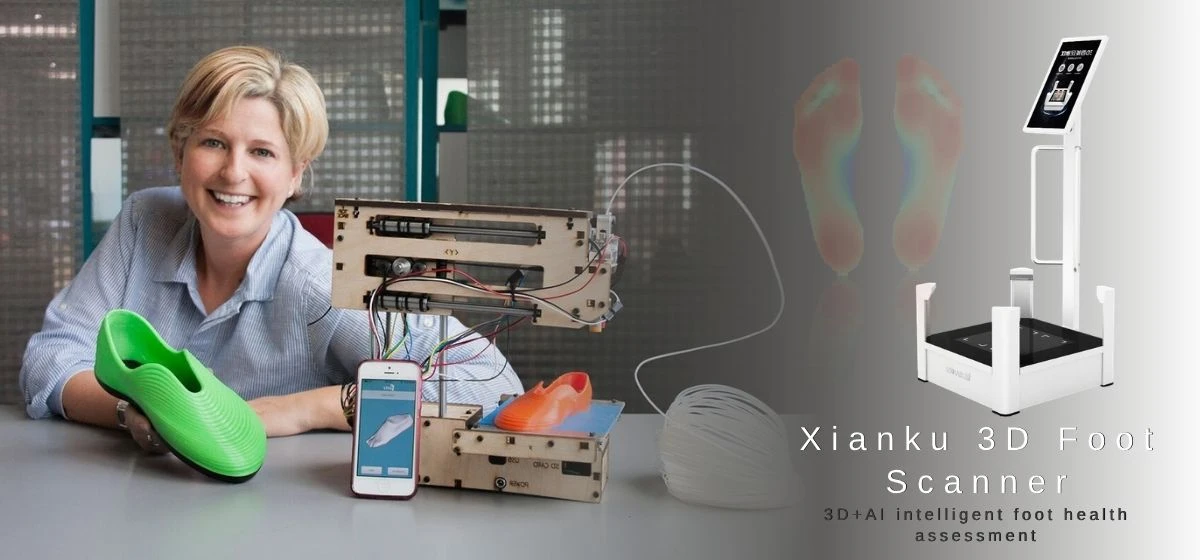
After a 3D foot scan, AI can evaluate the foot structure and generate recommendations for support, cushioning, and pressure distribution.
That digital design can then be translated into a 3D printed insole built around the customer's own anatomy.
Rather than relying on average measurements, the insole reflects real foot data.
The result is a product that is not only personalized, but also data-driven.
The Next Evolution: AI-Designed 3D Printed Shoes
If personalized insoles represent today's opportunity, personalized shoes represent tomorrow's.
The footwear industry has already demonstrated that 3D printing can manufacture complex shoe components.
The next challenge is personalization at scale.
Imagine a future workflow like this:
- A customer walks into a store.
- A 3D Foot Scanner captures a digital model in seconds.
- AI analyzes foot structure, gait characteristics, and support requirements.
- A digital shoe is generated specifically for that individual.
- A 3D printer produces footwear designed around the customer's own anatomy rather than a generic shoe last.
The process transforms shoe shopping into digital manufacturing.
Instead of asking customers to fit into existing products, manufacturers build products around the customer.
This is the real promise of AI-powered footwear.
Why This Matters for Retailers and Brands
The impact of AI + 3D printing extends far beyond product innovation.
It changes the business model.
Traditional retail focuses on inventory.
Stores stock dozens of styles, widths, and sizes, hoping one combination matches each customer.
Personalized manufacturing changes that equation.
Retailers begin with data rather than inventory.
Customers receive recommendations based on measurable characteristics.
Products become solutions rather than commodities.
For brands, this creates new opportunities to increase customer confidence, reduce uncertainty during purchasing, and build stronger long-term relationships.
For consumers, it creates a shopping experience that feels less like buying a product and more like receiving a personalized service.
From Mass Production to Mass Personalization
For more than a century, footwear manufacturing has been built around economies of scale.
Make millions of identical products.
Distribute them globally.
Allow consumers to choose the closest match.
The next generation of manufacturing follows a different philosophy.
Mass Personalization.
Instead of producing one design for everyone, digital technologies allow companies to create products designed around each individual.
- AI provides intelligence.
- 3D scanning provides accurate human data.
- 3D printing provides flexible manufacturing.
Together, these technologies form a complete ecosystem.
Not just smarter production.
Smarter personalization.
The Future Belongs to AI + 3D Printing
The growing presence of 3D printing at global events such as IFA demonstrates that additive manufacturing has entered the mainstream conversation.
But the future of this technology is not simply about printing more things.
It is about printing the right things for the right people.
That requires more than advanced printers.
- It requires intelligent design.
- It requires accurate human data.
- It requires AI.
The next generation of footwear will not begin with a shoe.
It will begin with understanding the person who will wear it.
A 3D Foot Scanner creates the digital foundation.
AI transforms that information into personalized intelligence.
3D printing turns intelligence into reality.
Together, they are redefining what footwear can be.
Because the future isn't just about making better shoes.
It's about making your shoes.