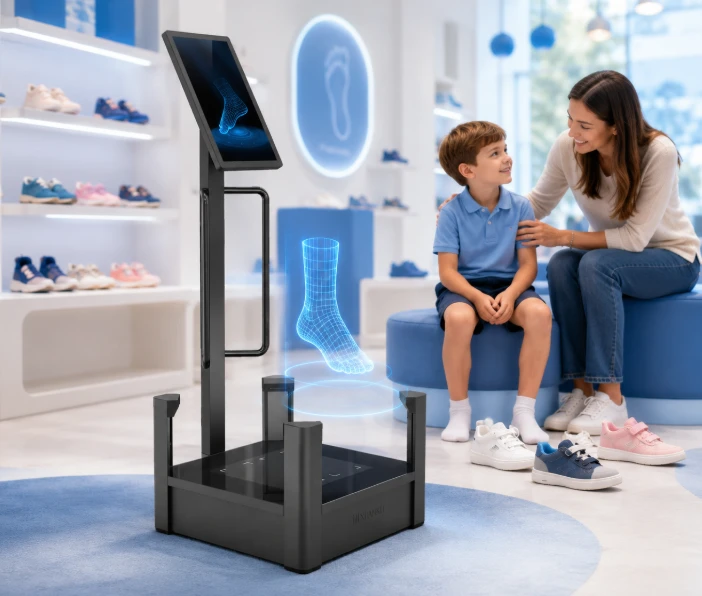
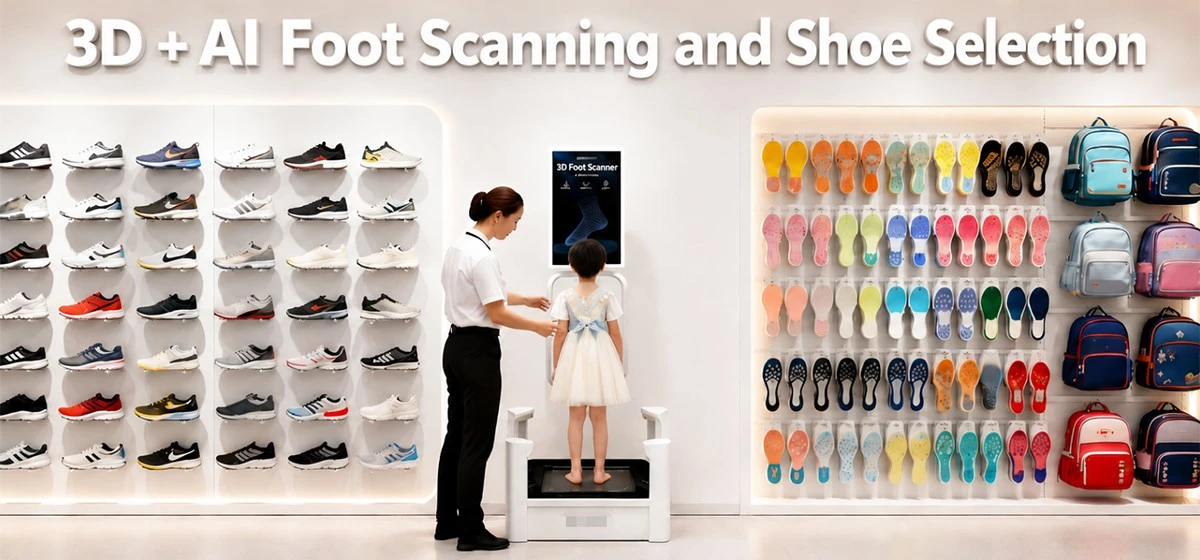
Introduction: Kids' Shoe Retail Is No Longer Just About Size
For many parents, buying children's shoes is no longer a simple decision based on color, style, and price. Today's parents are more educated, more cautious, and more willing to choose brands that can explain why a shoe is suitable for their child's feet. They want comfort, proper fit, foot health awareness, and visible proof.
This is where a 3D foot scanner changes the retail conversation.
In traditional kids' shoe stores, staff often measure foot length with a ruler or size board, then recommend a shoe based on basic size conversion. While this method is familiar, it does not answer the questions parents increasingly care about:
Is my child's arch developing normally?
Are the feet too narrow or too wide?
Is there over-pronation or supination?
Is the heel stable?
Is there an early sign of hallux valgus or abnormal foot pressure?
Should my child choose regular shoes, functional shoes, or supportive insoles?
A standard shoe size cannot answer these questions. A fast, accurate, and interactive 3D foot scanner can.
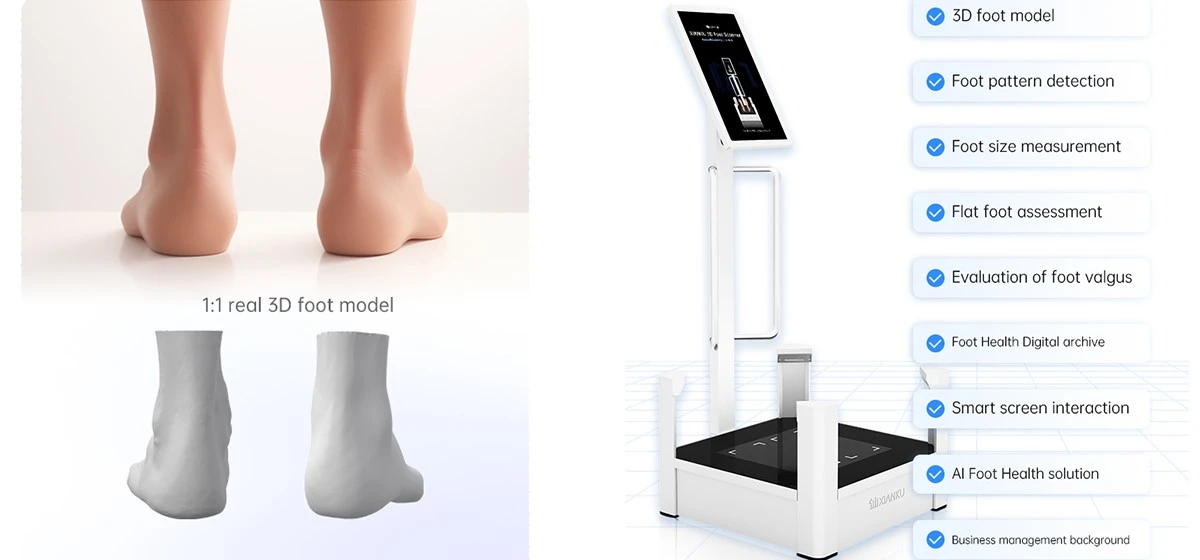
The XIANKU 3D Foot Scanner is designed for this exact transformation. It helps kids' footwear brands move from "selling shoes" to providing a professional foot measurement and health assessment experience. With 3D infrared structured light, 1-second scanning, millimeter-level accuracy, 32+ foot data dimensions, AI-powered recommendation logic, and a clear visual foot report, it gives retailers a stronger way to earn parental trust and create higher-value services.
Why Kids' Footwear Brands Need a More Professional Measurement System
Children's feet are still developing. Their arch shape, foot width, heel alignment, gait tendency, and toe shape may change as they grow. A child may have normal foot length but a wider forefoot, a low arch, a high arch, or heel eversion that affects how shoes feel during walking and running.
For parents, these issues are difficult to recognize with the naked eye. Many only notice a problem when the child complains of foot fatigue, uneven shoe wear, unstable walking, or discomfort during sports. For footwear retailers, this creates both a challenge and an opportunity.
The challenge is that customers may not trust a simple sales recommendation. The opportunity is that a brand using professional measurement can become more than a shoe seller. It can become a foot health service provider.
A kids' footwear store equipped with a 3D foot scanner can offer a more scientific retail process:
- Scan both feet quickly.
- Generate a 3D foot model.
- Analyze size, arch, width, heel, toe, and pressure-related indicators.
- Present the results clearly on screen.
- Recommend the most suitable shoe, insole, or customized solution.
- Save the customer's foot data for future growth tracking and repurchase.
This changes the customer experience from "try several pairs and guess" to "measure, understand, match, and choose with confidence."
XIANKU 3D Foot Scanner: Fast Enough for Retail, Accurate Enough for Trust
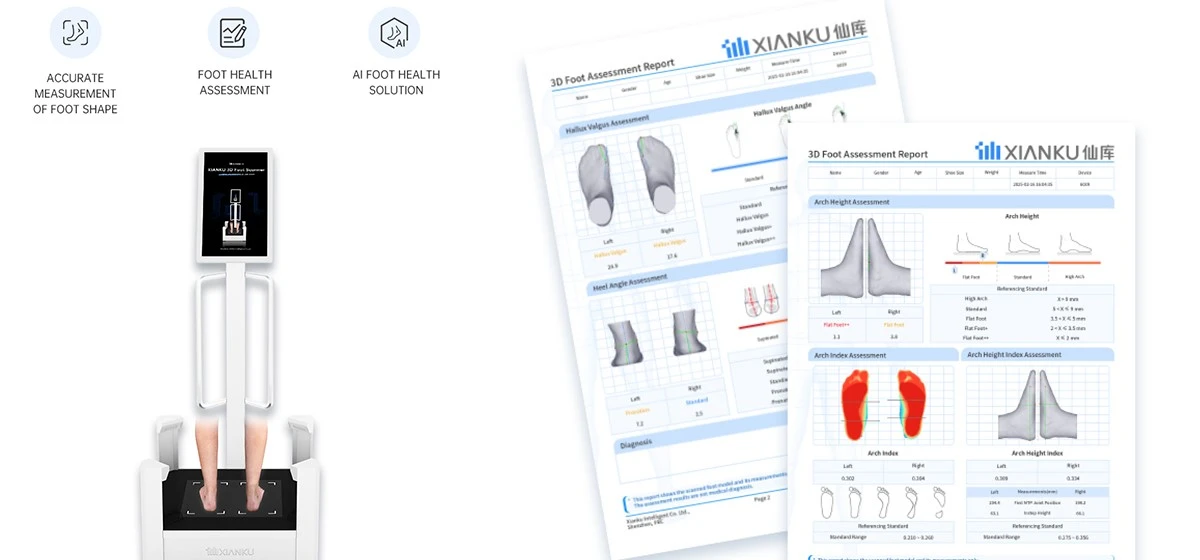
Speed matters in kids' shoe retail. Children may not stand still for long, and parents do not want a complicated process. The XIANKU 3D Foot Scanner is built for high-efficiency store use. It can complete foot scanning in about 1 second and generate a report in around 5 seconds. This makes it suitable for busy stores, shopping malls, school screening activities, and footwear brand experience zones.
The scanner uses 3D infrared structured light technology to capture detailed foot surface data and reconstruct a 1:1 realistic 3D foot model. Compared with manual tools or simple 2D footprint devices, this allows the store to show parents a much more complete view of the child's feet.
The key advantage is not just speed. It is the combination of speed, accuracy, completeness, and interaction.
| Retail Pain Point | Traditional Method | XIANKU 3D Foot Scanner Advantage |
|---|---|---|
| Child does not cooperate for long | Manual measurement takes time | 1-second scan supports faster service |
| Parents only know shoe size | Basic length/width data | 32+ foot data dimensions |
| Staff recommendations feel subjective | Based on experience | Based on visual data and AI recommendation logic |
| Foot health issues are hard to explain | Verbal explanation only | 3D model, heat map, and assessment report |
| Difficult to recommend higher-value products | Product-first selling | Data-driven shoe, insole, and solution matching |
| Hard to build repeat purchase | No stored foot archive | Digital foot data helps future tracking |
For children's footwear brands, this kind of measurement experience can directly improve professionalism. Parents are more likely to trust a recommendation when they can see the child's foot model, footprint pattern, arch index, heel inclination, and toe alignment on a screen.
What the Scanner Measures: More Than Shoe Size
A major limitation of traditional kids' shoe fitting is that it focuses too much on length. However, a proper shoe fit depends on multiple factors: length, width, instep height, arch type, heel shape, forefoot structure, and left-right foot difference.
The XIANKU 3D Foot Scanner provides a much broader measurement framework. Its foot report can include length and width data, foot girth, foot height, arch-related data, footprint analysis, hallux valgus assessment, heel inclination assessment, and multiple 3D views.
For kids' footwear brands, these measurements can support better product matching and more personalized recommendations.
| Measurement Category | Example Data or Assessment | Retail Value for Kids' Shoe Brands |
| Foot Length & Width | Foot length, foot width, heel width, instep width | Helps recommend accurate shoe size and last type |
| Foot Girth | Ball girth, instep girth, heel girth, ankle girth | Useful for comfort, closure design, and fit matching |
| Foot Height | Big toe joint height, instep height, arch height | Helps match children with high instep or special fitting needs |
| Arch Assessment | Arch index, arch height, arch length | Supports flat foot, normal arch, or high arch identification |
| Foot Width Assessment | Narrow, standard, or wide foot tendency | Helps avoid shoes that squeeze or feel loose |
| Hallux Valgus Assessment | Big toe angle evaluation | Helps identify early toe alignment concerns |
| Heel Inclination | Pronation, standard, or supination tendency | Helps recommend stabilizing shoes or supportive insoles |
| Visual Output | 3D model, footprint heat map, front/back/top/side views | Makes the result easier for parents to understand |
This is especially valuable for children's footwear because two children with the same shoe size may need completely different products. One may need a wider toe box. Another may need arch support. Another may need a more stable heel counter. A 3D foot scanner helps brands make those differences visible and actionable.
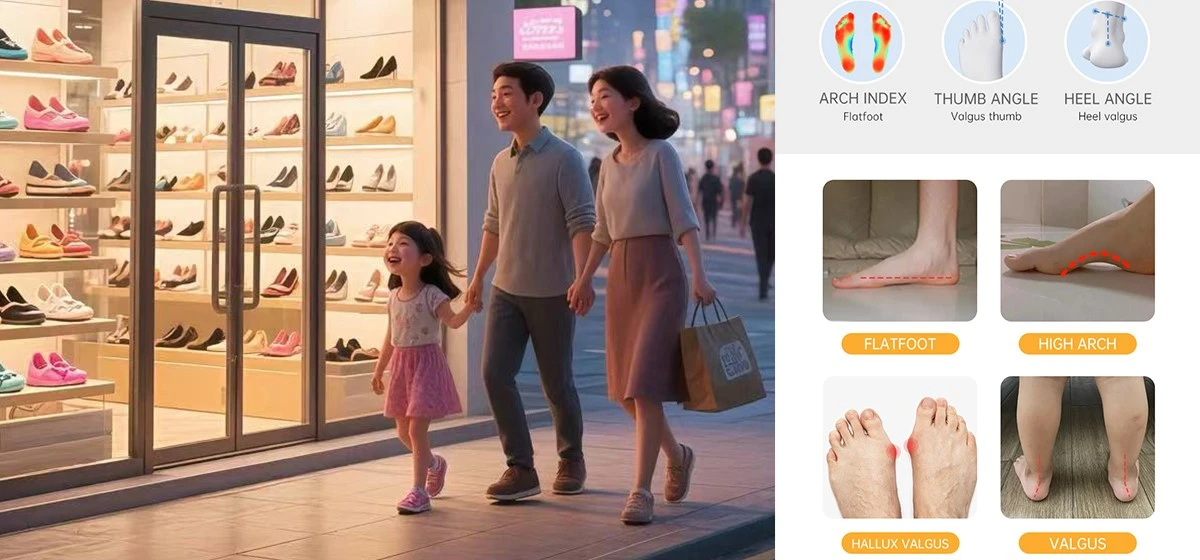
Helping Parents Understand Flat Feet, High Arches, Heel Valgus, and More
Parents often hear terms like "flat feet" or "pronation," but they may not understand what they mean. In a retail environment, the challenge is to explain foot health simply without making medical claims.
The XIANKU 3D Foot Scanner supports visual foot health assessment for issues such as flat feet, high arches, heel eversion, heel inversion, hallux valgus, and abnormal foot width. These results are presented through easy-to-understand charts, indicators, and 3D visuals. Parents can see whether the child's foot arch is low, standard, or high. They can also see whether the heel tends to incline inward or outward.
This makes the store conversation more educational:
Instead of saying, "This shoe is better for your child," the staff can say, "The scan shows your child has a lower arch and a heel stability tendency. This shoe has stronger arch support and a more stable heel structure, so it may be more suitable."
That difference matters.
Parents do not want to feel that they are being pushed into buying a more expensive shoe. They want to understand the reason behind the recommendation. A visual report turns a sales pitch into a guided consultation.
Of course, a retail foot assessment should not be positioned as a medical diagnosis. If the scan shows serious abnormalities, persistent pain, or concerns that may require clinical evaluation, the store should recommend that parents consult a qualified healthcare professional. This responsible approach strengthens brand credibility.
3D + AI: From Measurement to Instant Product Matching
The most powerful part of a 3D foot scanner is not only the scan itself. The real business value comes when measurement data is connected to AI-powered recommendation logic.
The XIANKU 3D Foot Scanner can support a closed-loop retail process:Foot Scan → Data Analysis → Foot Health Assessment → AI Product Recommendation → Sales Conversion → Customer Follow-up
After scanning, the system can help match the child with suitable products based on foot size, arch type, foot width, heel inclination, and store-defined product logic. This may include regular children's shoes, functional shoes, orthopedic-friendly shoes, arch support insoles, 3D printed customized insoles, or other foot health solutions.
For kids' shoe brands, this creates a scalable service model. Staff do not need to rely only on personal experience. The system helps standardize the recommendation process across stores.
| Scan Result | Possible Retail Interpretation | Recommended Product Direction |
| Low arch / flat foot tendency | Needs more medial support and stable structure | Supportive kids' shoes or arch-support insoles |
| High arch tendency | Needs cushioning and pressure distribution | Cushioned shoes or high-arch support insoles |
| Heel eversion / pronation tendency | Needs better heel stability | Shoes with firm heel counter or corrective support |
| Heel inversion / supination tendency | Needs lateral stability and shock absorption | Stabilizing shoes and suitable cushioning insoles |
| Wide forefoot | Standard shoes may feel tight | Wide-fit shoes or wider toe box styles |
| Narrow foot | Shoes may feel loose | Better-fitting last and secure closure design |
| Hallux valgus tendency | Toe area needs more space and comfort | Wider toe box, less compression, careful fit matching |
This data-driven recommendation model can also help brands improve product planning. Over time, a brand can collect anonymized foot shape and size distribution data from real customers. This helps with size optimization, inventory planning, shoe last development, and future product design.
Learning from the Dr. Kong Model: Measurement Builds Trust
Dr. Kong is a useful reference for kids' footwear brands because its retail model is built around the concept of "measurement and matching." The core idea is simple: before recommending shoes, measure the feet and understand the foot type.This model works because it aligns with what parents want. Parents are not only buying a product; they are buying confidence. They want to know that the shoe is suitable for the child's real foot condition.A successful kids' footwear retail model can follow a similar path:
Attract parents with a free or professional foot scan.
Use 3D measurement to create a clear foot profile.
Explain foot health results in simple language.
Use AI recommendation logic to match shoes and insoles.
Offer differentiated services and customized products.
Build a long-term digital foot archive for children's growth tracking.
This is a major upgrade from traditional retail. Instead of competing only on discount, design, or brand awareness, the store competes on professional service and data-backed trust.
How 3D Foot Scanning Improves Store Conversion
In footwear retail, conversion depends on confidence. Parents hesitate when they are unsure whether the shoe is truly suitable. A 3D foot scanner reduces hesitation by making the recommendation visible and logical.A strong store SOP can look like this:
Step 1: Customer Attraction
Use "free kids' foot health scan" or "scientific shoe fitting experience" to bring parents into the store.
Step 2: Fast Foot Scan
The child stands on the scanner. The scan is completed quickly, reducing waiting time and improving cooperation.
Step 3: Foot Health Explanation
Staff explain the report: foot length, width, arch, heel inclination, pressure pattern, and possible fit concerns.
Step 4: AI Recommendation
The system recommends suitable shoe sizes, shoe types, insoles, or customized solutions based on the scan results.
Step 5: Product Trial and Purchase
Parents try recommended products with a clear reason behind each choice.
Step 6: Digital Follow-up
The store keeps a foot archive, supporting future growth comparison and repeat purchases.
This process makes the customer feel that the brand is professional, scientific, and child-focused.
Differentiated Service: The Future of Kids' Footwear Retail
The kids' footwear market is highly competitive. Many brands offer similar designs, similar price ranges, and similar comfort claims. A 3D foot scanner gives a brand a clear service advantage.
It helps stores create experiences that online shopping cannot easily replace. Parents can bring their child to the store, complete a scan, view the 3D model, understand the child's foot type, and receive a personalized recommendation. This creates interaction, trust, and emotional value.
It also supports higher-value product sales. When parents understand why their child may need arch support, heel stability, or a different shoe last, they are more open to purchasing functional footwear, supportive insoles, or customized products.
For chain brands, the scanner can also standardize service quality across multiple stores. Every store can follow the same measurement process, the same report explanation structure, and the same AI-based product matching logic.
Conclusion: Winning Parents Starts with Understanding Children's Feet
The future of kids' footwear retail will not be built only on attractive designs or seasonal promotions. It will be built on trust, personalization, and professional service.The XIANKU 3D Foot Scanner helps kids' footwear brands create that future. With 1-second scanning, millimeter-level accuracy, 32+ foot data dimensions, 1:1 3D foot modeling, foot health assessment, interactive display, online/PDF reports, and AI-powered recommendation logic, it turns shoe fitting into a more scientific and engaging experience.
For parents, it provides clarity.
For children, it supports better-fitting footwear choices.
For stores, it creates differentiation, stronger conversion, customer data assets, and opportunities for customized products.
For brands, it builds a healthier and more professional image.
Kids' shoe brands that want to win over parents should stop thinking of measurement as a small step before selling shoes. Measurement is becoming the new starting point of trust.
And in that new retail journey, a 3D foot scanner is no longer just a device. It is a customer acquisition tool, a professional assessment tool, a product recommendation engine, and a long-term brand growth system.