

Most parents assume that if a child doesn't complain of pain, their feet are healthy. But research tells a different story.
According to the 2023 US Children's Foot Shape Database, 34.2% of children aged 0–14 already show measurable foot health abnormalities – including flat feet, high arches, hallux valgus, and heel valgus. Among adolescents aged 10–14, that number rises to nearly 1 in 2.
Even more concerning: a study published in the Journal of Foot and Ankle Research (2022) found that only 23% of parents have ever had their child's feet professionally assessed for health issues beyond sizing. The rest rely on visual guesswork or ignore the signs entirely.
Foot problems in childhood don't stay in the feet. They cascade upward: flat feet alter gait, gait changes load the knees, knees shift the pelvis, and the pelvis affects the spine. Left uncorrected, a simple arch issue can contribute to back pain, poor posture, and even headaches in teenagers.
For footwear retailers and children's shoe brands, this represents both a responsibility and an enormous opportunity. By offering professional foot health analysis, you stop being a shoe seller and become a trusted health partner for families.

The Most Common Childhood Foot Conditions – And Why They Matter to Retailers
Here are the top five conditions Xianku 3D Foot Scanner detects – each representing a cross-selling or loyalty-building opportunity.
Table 1: Prevalence of Common Foot Conditions in Children (0–14 Years)
| Condition | Prevalence | Age Most Detectable | Related Selling Opportunity |
|---|---|---|---|
| Flexible flat feet (pes planus) | 24–28% | 3–8 years | Stability shoes, arch support insoles |
| High arches (pes cavus) | 6–8% | 6–12 years | Cushioned shoes, metatarsal pads |
| Hallux valgus (bunion angle >15°) | 5–7% | 8–14 years | Wide toe box shoes, toe separators |
| Heel valgus/varus (rearfoot tilt) | 8–12% | 5–10 years | Motion control or corrective insoles |
| Pediatric pronation (>6° eversion) | 12–15% | 4–12 years | Firm heel counter, medial posting |
*Sources: Xianku Internal Database (n=12,000 children), American College of Foot and Ankle Pediatrics (2023)*
The key insight: each condition requires a different footwear strategy. A flat foot needs mild arch support and a firm heel counter. A high arch needs extra cushioning and a curved last. Recommending the wrong type – even in the correct size – can worsen discomfort.
How 3D Foot Health Analysis Works in Your Store
Traditional foot assessments are subjective. A store associate might ask the child to stand and "look" at the arch. That's not reliable, especially with toddlers too young to cooperate.
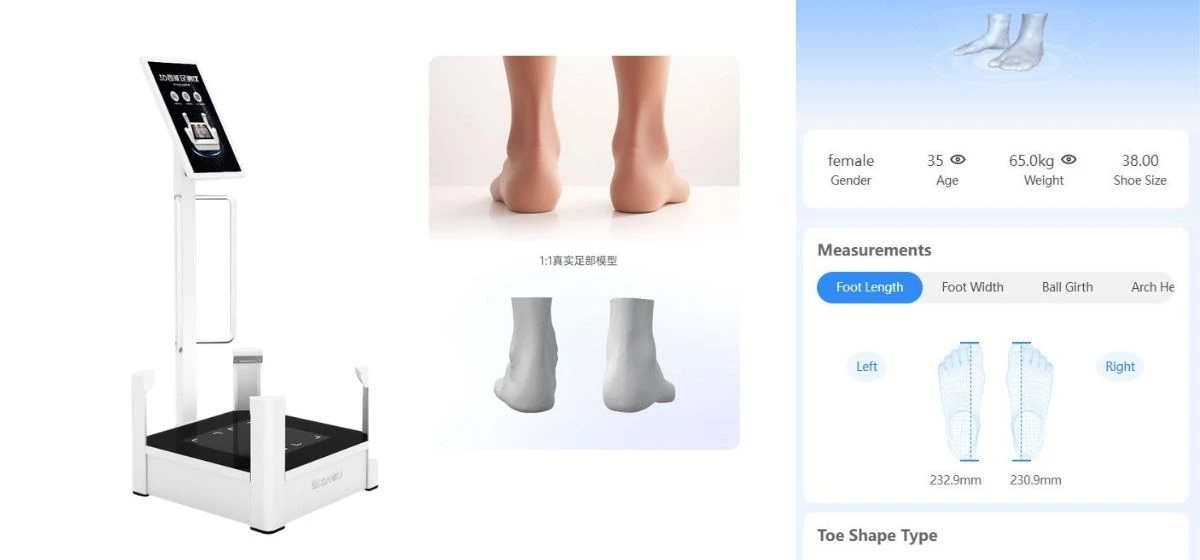
Xianku's infrared structured light technology captures two million 3D points per foot in one second. The system then automatically calculates:
- Arch index (ratio of arch contact area to total foot area – standard ranges 0.21–0.31)
- Hallux valgus angle (normal <15°, moderate 15–25°, severe >25°)
- Heel alignment (neutral: 0° to ±4° varus/valgus)
- Toe shape classification (Egyptian, Greek, square)
- Foot length-to-width ratio (categorizes as narrow, normal, wide, extra-wide)
The entire analysis takes 5 seconds from scan to full report – including a color-coded 3D model showing pressure points, arch collapse, and toe alignment.
From Analysis to Action: The Parent Conversation
A dry medical report means nothing to a busy parent. Xianku's output is designed for clarity and action. The report includes:
- A traffic-light system (green/yellow/red) for each metric
- A 1:1 realistic 3D model of their child's feet
- Plain-language explanations ("Your child's arches are lower than average for their age")
- Product recommendations linked to the findings
For example:
"Alex has mild flat feet . This is common at age 6, but without proper shoe support, it can lead to heel pain during sports. We recommend a stability shoe with a firm heel counter, or adding our 3D-printed arch support insoles."
Parents see the evidence. They trust the recommendation. And they value that you cared enough to look beyond size.
Case Study: A Children's Footwear Chain Redefines Its Role
A regional children's shoe retailer in Texas (name withheld) introduced Xianku 3D foot scanners across 14 stores. Their goal wasn't just to sell more shoes – it was to own foot health in their community.
After six months:
- Foot health analysis became their primary customer entry point ("Free 3D foot check for your child")
- Sales of therapeutic insoles increased 340%
- Average transaction value rose from 52to52to89 (due to shoe + insole combos)
- Parent referrals increased 45% – word of mouth citing "the store that really checks feet"
Most importantly, they formed partnerships with three local pediatric physical therapy clinics, who now refer patients for post-treatment footwear.
Integration with Sizing, Selection, and Retention
While this article focuses on foot health analysis, the same Xianku scan powers:
- Precise size matching – millimeter accuracy for length, width, and girth
- AI-based shoe selection – matching foot type to shoe last
- Brand data capability – building an anonymized database of foot conditions by region and age
This means a single 1-second scan serves as your health clinic, sizing station, and CRM data source all at once.
And because every scan generates an emailed report to the parent, your brand stays in their inbox – and you can trigger automated follow-ups (e.g., "It's been 6 months – your child's feet may have grown. Come for a free re-scan.").

The Competitive Moat: Health Authority Beats Price Wars
Any shoe store can offer a discount. Very few can offer a clinical-grade foot health assessment without a medical degree on staff. Xianku gives you that capability.
When parents see you as a foot health expert for their children, price becomes secondary. They don't shop around for a cheaper pair of sneakers – they come back because you protect their child's development.
Table 2: What Parents Value Most in a Children's Footwear Store (Ranked)
| Rank | Attribute | % Selecting as "Very Important" |
|---|---|---|
| 1 | Correct fit for foot shape | 91% |
| 2 | Staff knowledge about foot health | 84% |
| 3 | Wide selection of brands/styles | 71% |
| 4 | Price | 58% |
| 5 | Store location convenience | 52% |
*Source: Xianku Consumer Survey (Europe & North America, n=1,800 parents, 2025)*
Note that price ranks fourth. Health and expertise rank first and second.
Ready to Transform Your Store into a Foot Health Destination?
Xianku 3D Foot Scanner is trusted by over 500 hospitals and clinics worldwide and more than 80,000 merchants. It's medically accurate, FDA-compliant components, and radiation-free – completely safe for children of all ages.
You don't need a medical background. The system does the analysis, and provides the solution.
