


When you walk into a mattress store, you're typically guided to a row of beds and invited to lie down. "How does this feel?" the salesperson asks. "Try this one-it's firmer." This scene has played out millions of times across America, but is "feeling" really the best way to choose something that will support your spine for 3,000 hours per year?
This article presents a head-to-head comparison of traditional mattress selection versus the emerging standard of 3D scan-based matching, using data and real-world outcomes to help American consumers understand why the future of sleep is scientific.
Round 1: Assessment Methodology
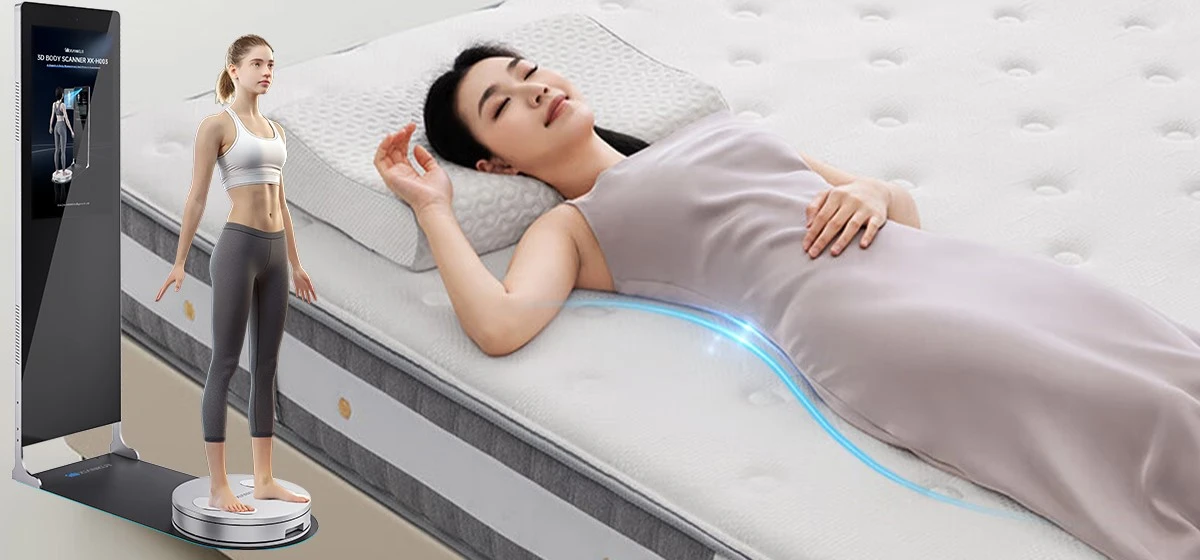
Traditional Trial: When you lie on a mattress in a store, you're making a subjective judgment based on 3-5 minutes of experience. Your body hasn't fully relaxed, you're fully clothed, and you're acutely aware that a salesperson is watching. You might notice obvious pressure points, but subtle misalignments-the kind that cause back pain after months of use-are invisible in this context.
Furthermore, your judgment is influenced by factors unrelated to spinal health: the mattress's appearance, brand reputation, price, or simply which one felt softest in the moment.
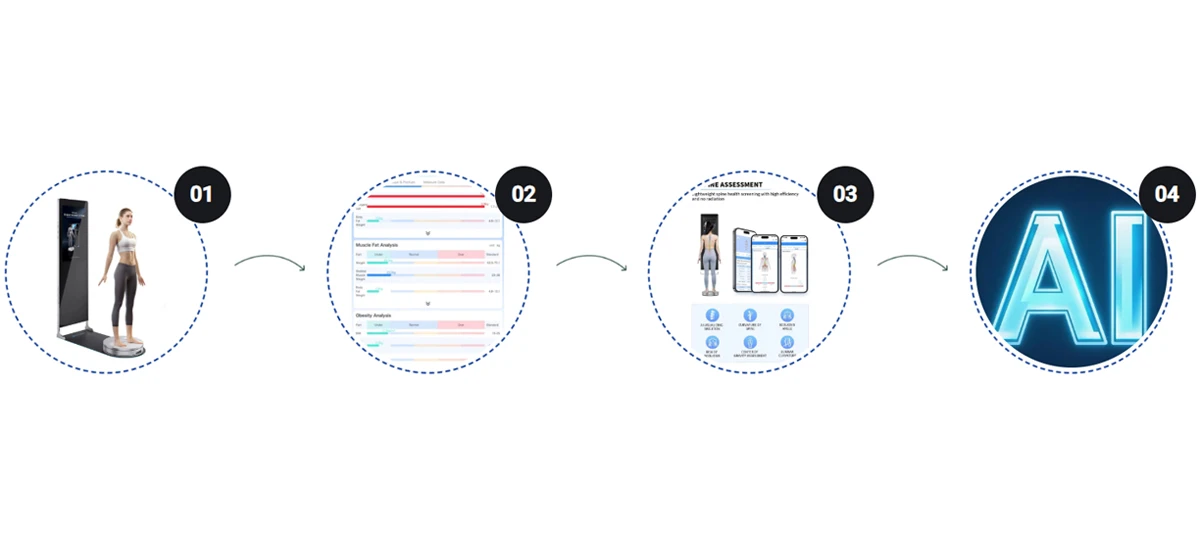
3D Scan Matching: The Xianku 3D Body Scanner takes a completely different approach. In 20 seconds, it captures over 2 million data points about your body, creating a precise 3D model . It measures:
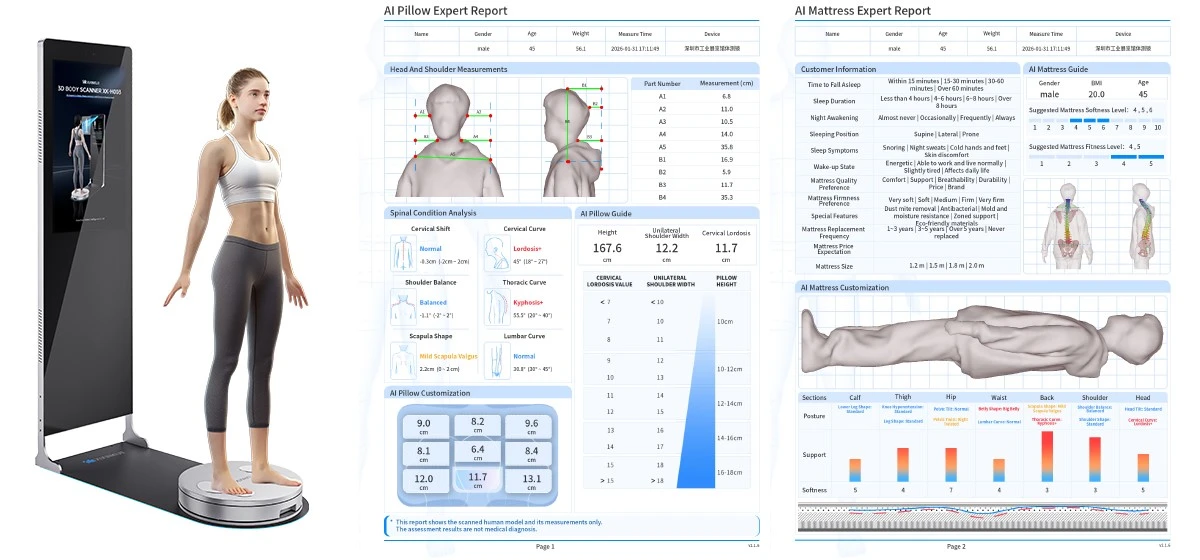
- Spinal curvature angles in the cervical, thoracic, and lumbar regions
- Pelvic orientation (tilt angle) that affects lower back support
- Shoulder and hip width for proper side-sleeping alignment
- Body mass distribution to identify pressure points
This data isn't subjective-it's objective measurement with millimeter-level accuracy (±0.5mm) . When combined with a brief questionnaire about sleep position and existing pain points, the system has a complete picture of your biomechanical sleep needs.
Winner: 3D Scan Matching – Objective data beats subjective feeling for long-term health outcomes.
Round 2: Personalization Depth
Traditional Trial: In a traditional store, "personalization" means trying different mattresses until one feels right. The salesperson might ask if you sleep on your back, side, or stomach, and direct you to appropriate options. But within those broad categories, there's enormous variation in individual anatomy.
Two side sleepers can have completely different needs based on shoulder width, hip breadth, and spinal curvature. A person with narrow shoulders and wide hips needs different support zoning than someone with the opposite proportions, yet traditional selection treats them identically.
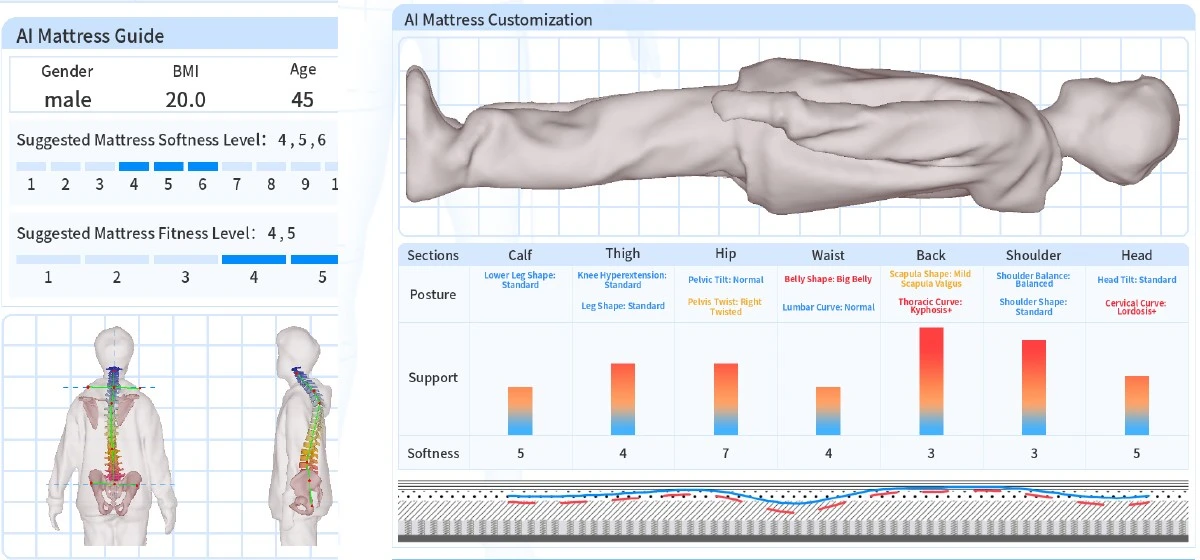
3D Scan Matching: The Xianku system's Multi-Factor Match Algorithm cross-references your individual physiological map with product specifications . It doesn't just categorize you as a "side sleeper"-it understands that your specific cervical curvature requires a 4-inch loft pillow, or that your 12° lumbar lordosis needs enhanced support in zone 2 of the mattress.
The recommendation is truly personalized, often generating 2-3 highly tailored options that address your unique geometry. As one industry report noted, this eliminates the overwhelm of too many choices and provides recommendations justified by your own data .
Winner: 3D Scan Matching – True personalization based on individual anatomy, not broad categories.
Round 3: Problem Identification
Traditional Trial: Most people don't know they have postural issues. Anterior pelvic tilt, mild scoliosis, forward head posture-these conditions develop gradually over years and often go unnoticed until they cause pain. When you lie on a mattress traditionally, you have no way of knowing whether the surface is supporting your specific misalignments or exacerbating them.
A person with anterior pelvic tilt might find a soft mattress comfortable in the store, not realizing it allows their pelvis to rotate further, increasing lower back stress over time. The problem is invisible during a brief trial.
3D Scan Matching: The Xianku scanner explicitly identifies these issues. It calculates Cobb angles for spinal curvature, measures pelvic tilt orientation, and quantifies shoulder asymmetry . Before the customer even lies on a mattress, they receive a comprehensive postural assessment that reveals issues they may not have known existed.
This transforms the sales conversation from "which mattress feels best?" to "based on your specific spinal alignment, here's the support you need." The customer becomes educated about their own body while being guided to the right solution.
Winner: 3D Scan Matching – Identifies hidden issues that affect long-term sleep health.

Round 4: Purchase Confidence
Traditional Trial: Buyer's remorse is common in mattress purchases. After spending $1,000–$3,000, consumers often wonder: "Did I choose the right one?" This uncertainty contributes to the 5-12% return rates seen in online mattress sales . Even in physical stores, customers may second-guess their decision after a few nights of adjustment.
3D Scan Matching: When customers understand that their mattress was specifically matched to their body data, confidence soars. The decision isn't based on a fleeting feeling but on documented science. A 2023 pilot study with California and Texas retailers found that Xianku customers showed a 42% decrease in post-purchase "comfort-related" inquiries and a 28% reduction in returns .
When customers can visualize their own spinal alignment and see how a specific mattress configuration addresses their unique geometry, they buy with confidence and stay satisfied.
Winner: 3D Scan Matching – Data-validated matching dramatically reduces post-purchase doubt and returns.
Round 5: Long-Term Value
Traditional Trial: Once you buy a mattress traditionally, the relationship with the retailer typically ends. You might receive a few emails, but there's no ongoing value from the purchase experience.
3D Scan Matching: With Xianku, your scan data is stored, creating a "body profile" that delivers ongoing value . As your body changes-through weight loss, pregnancy, aging, or injury recovery-you can be re-scanned to see if your sleep needs have changed. The retailer can notify you when new products match your profile. You become part of a health-focused community rather than a one-time transaction.
Winner: 3D Scan Matching – Creates ongoing relationship and long-term health value.
Head-to-Head Comparison Table
| Aspect | Traditional Trial | Xianku 3D Scan Matching |
|---|---|---|
| Assessment Time | 3-5 minutes per mattress | 20 seconds total scan |
| Data Points | Subjective feeling only | 2+ million biometric points |
| Personalization | Based on sleep position category | Based on individual spinal curvature, pelvic tilt, and body dimensions |
| Hidden Issue Detection | None | Identifies postural problems affecting sleep |
| Purchase Confidence | Variable, prone to doubt | High, data-validated |
| Return Rate | 5-12% for online sales | 28% reduction demonstrated |
| Ongoing Value | None | Stored profile for future needs |
Real-World Example
Consider two customers: Mark, a 45-year-old office worker with anterior pelvic tilt and lower back pain, and Sarah, a 30-year-old side sleeper with broad shoulders and a history of neck stiffness.
In a traditional store, both might be directed to medium-firm mattresses based on their sleep positions. Both might leave satisfied with their "feel test."
With Xianku scanning:
Mark's scan reveals 14° anterior pelvic tilt. He's recommended a mattress with enhanced lumbar zoning and slightly firmer support to prevent pelvic rotation.
Sarah's scan shows her cervical spine is slightly flattened-likely from years of inadequate pillow support. She's recommended a specific pillow loft and a mattress with pressure-relieving shoulder zones.
Both receive solutions addressing their actual needs, not just their stated preferences. Both sleep better and stay loyal to the retailer who provided this scientific approach.
Conclusion
The traditional mattress trial isn't worthless-it provides some sense of initial comfort. But for the 80% of Americans who will experience back pain at some point in their lives, "feeling" isn't enough. Sleep is too important for guesswork.
The Xianku 3D Body Scanner brings mattress selection into the 21st century, replacing subjective judgment with objective biomechanical matching. For American consumers seeking the best possible sleep health, the choice is clear: data beats feeling every time.
Call to Action: Looking for a mattress store that uses science, not guesswork? Find a Xianku-powered retailer near you and experience the future of sleep selection.
Sources:
Xianku 3D Body Scanner technical specifications
California/Texas retailer pilot study data
Industry mattress return statistics
