The Real Value Isn't the Device-It's Personalized Intelligence
Every time Apple launches a new iPhone, the same debate returns.
"Why is it getting more expensive?"
"Has innovation slowed down?"
"Is it still worth upgrading?"
Yet despite rising prices, millions of consumers continue to line up for Apple's newest products.
This raises an interesting question:
What exactly are people paying for?

At first glance, the answer seems obvious.
A faster processor.
A better camera.
A brighter display.
Longer battery life.
But these hardware improvements alone don't fully explain why Apple continues to command premium pricing in one of the world's most competitive markets.
The real value lies somewhere deeper.
Apple is no longer simply selling devices.
It is selling personalized intelligence.
And this shift may signal the future of nearly every consumer industry-including health technology.
Apple Doesn't Just Build Products. It Builds Personal Experiences.
Twenty years ago, smartphones were largely standardized.
Everyone used essentially the same hardware in the same way.
Today, every iPhone feels different.
Your Photos app remembers your memories.
Apple Music learns your taste.
Apple Maps understands your routines.
Apple Intelligence helps organize your work based on your habits.
Your Apple Watch understands your sleep, heart rate, exercise, stress levels, and daily activity.
The more you use Apple products, the better they understand you.
The device becomes more valuable because it becomes more personal.
This represents one of the biggest changes in consumer technology.
People are no longer paying only for hardware.
They're paying for technology that understands them.
Data Has Become the New Luxury
The most valuable resource in the AI era is no longer hardware.
It is data.
Every interaction creates information.
Every piece of information helps AI deliver more personalized experiences.
This is why companies invest billions in building ecosystems rather than individual products.
Data creates intelligence.
Intelligence creates personalization.
Personalization creates value.
Consumers increasingly recognize this.
They are willing to pay more for products that adapt to them rather than forcing them to adapt to the product.
The Same Transformation Is Reaching Healthcare
For years, healthcare has relied on generalized recommendations.
Average BMI.
Average posture.
Average exercise plans.
Average rehabilitation programs.
But human bodies are anything but average.
No two people share the same posture.
The same spinal alignment.
The same body proportions.
The same movement patterns.
Just as no two iPhone users behave identically, no two bodies develop identically.
This is why personalized health is becoming one of the fastest-growing trends in modern healthcare.
Healthcare is moving from treating populations to understanding individuals.
And that transformation begins with data.
Before AI Can Personalize Health, It Must Understand the Human Body
Artificial intelligence cannot generate meaningful health recommendations without accurate body data.
The quality of the recommendation depends entirely on the quality of the measurement.
Traditional posture assessments often rely on visual observation.
Tape measures.
Photographs.
Manual evaluation.
These methods can be subjective, time-consuming, and difficult to standardize.
Modern healthcare increasingly requires objective digital data.
That is where 3D body scanning technology enters the picture.

Turning the Human Body into Actionable Digital Data
Much like Apple's sensors continuously collect information about daily activity, a 3D Body Scanner captures a complete digital representation of the human body within seconds.
Instead of relying on visual estimates, it creates a highly accurate digital model that can be analyzed by AI.
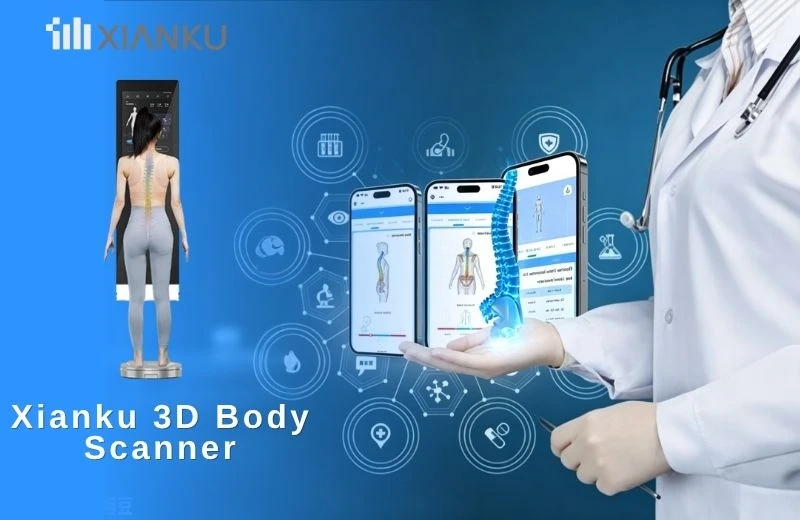
The XIANKU 3D Body Scanner transforms the human body into structured health data, making posture assessment faster, more objective, and easier to understand.
Within approximately 20 seconds, the system generates a 1:1 realistic 3D body model and analyzes more than 128 body data points. It evaluates posture, spinal alignment, body composition, body circumferences, and movement-related indicators, producing a comprehensive digital health report in about one minute.
Rather than providing only numbers, the system visualizes the body in three dimensions, allowing users and healthcare professionals to identify posture deviations that may otherwise go unnoticed.
AI Makes Every Assessment More Personalized
Once the body has been digitized, artificial intelligence can transform raw measurements into personalized insights.
Instead of receiving generic advice, users receive recommendations based on their own posture, body alignment, and physical characteristics.
The XIANKU platform integrates AI-assisted posture assessment with intelligent recommendation capabilities, enabling businesses to connect assessment results with personalized health services, rehabilitation plans, fitness programs, or retail recommendations.
The process becomes :
faster.
More consistent.
More visual.
More personalized.
Just as Apple Intelligence learns how you work, AI body assessment begins learning how your body moves.
The Future Isn't Smarter Devices-It's Smarter Understanding
Technology is entering a new stage.
The first generation of smart devices connected people to information.
The second generation connected people to AI.
The next generation will connect AI directly to the human body.
Consumers increasingly expect products that understand them.
Not only what they watch.
Not only what they buy.
But how they move.
How they stand.
How their posture changes over time.
This is where 3D Body Scanners represent more than a new piece of hardware.
They become the foundation of personalized physical health.
From Consumer Electronics to Digital Health
Apple demonstrated that consumers are willing to invest in technology that delivers personalized experiences.
Healthcare is now following the same direction.
The future of health management will not rely solely on periodic checkups or subjective observations.
It will rely on continuous digital understanding.
Every scan becomes a health record.
Every report becomes a data point.
Every assessment helps build a clearer picture of the individual.
With technologies like the XIANKU 3D Body Scanner, posture, spinal alignment, body composition, and physical changes can all be captured objectively, visualized intuitively, and tracked over time.
Consumers once upgraded their phones for better cameras.
Tomorrow, they may invest in technologies that help them better understand their own bodies.
Because in the age of AI, the most valuable technology may not be the one that knows the world best.
It may be the one that knows you best.

Why 3D Body Scanners Will Become the Next Essential Health Technology
As consumers grow accustomed to intelligent devices that understand their behaviors, expectations are expanding beyond smartphones and wearables.
People no longer want technology that simply records information-they want technology that delivers meaningful insights and personalized guidance.
This shift is creating enormous opportunities for 3D body scanning.
Unlike traditional health assessments that rely on visual observation or manual measurements, a modern 3D Body Scanner creates a highly accurate digital representation of the human body within seconds. Using advanced optical imaging and AI-powered analysis, it transforms complex anatomical information into intuitive, actionable reports.
Rather than asking users to interpret numbers themselves, the system visualizes posture, body symmetry, spinal alignment, shoulder balance, pelvic position, body circumferences, and body composition through an interactive 3D digital model. What was once invisible becomes immediately understandable.
For healthcare providers, rehabilitation clinics, fitness centers, wellness brands, and even retail businesses, this digital body data creates entirely new possibilities.
A posture assessment is no longer a one-time consultation-it becomes the beginning of a long-term digital health journey.
Each scan creates a secure digital body profile.
Each follow-up scan can be compared with previous results, allowing users and professionals to monitor physical changes over weeks, months, or years. Improvements in posture, body balance, rehabilitation outcomes, muscle development, or weight management become measurable rather than subjective.
More importantly, AI can transform these measurements into personalized recommendations. Instead of generic advice, every user receives guidance based on their own body structure and movement characteristics, helping professionals design more targeted rehabilitation plans, fitness programs, posture correction strategies, or wellness services.
The XIANKU 3D Body Scanner represents this new generation of intelligent assessment technology. By combining high-precision 3D imaging, AI-powered posture analysis, and comprehensive digital reporting, it enables organizations to provide faster, more objective, and more personalized health evaluations. From spine clinics and physiotherapy centers to gyms, wellness studios, schools, and corporate health programs, the scanner serves as a powerful entry point into data-driven preventive healthcare.
Just as smartphones evolved from communication devices into intelligent personal assistants, 3D Body Scanners are evolving beyond simple measurement tools. They are becoming digital gateways to personalized health management.
In the coming years, understanding the human body may become just as important as understanding our digital behavior.
Because the future of healthcare is not simply about treating illness.
It is about continuously understanding the individual.
And every journey toward personalized health begins with one scan.