

Introduction: Sleeping Longer Does Not Always Mean Sleeping Better
You went to bed early.
You slept for seven or even eight hours.
You followed the advice everyone talks about: "Get enough sleep."
But when the alarm rings, you still feel exhausted.
Your body feels heavy. Your mind feels unclear. You may even wonder:
"Why am I still tired after getting enough sleep?"
This experience is more common than many people realize.

For years, people have measured sleep quality mainly by one number: how many hours they sleep.
However, modern sleep science shows that sleep is not only about duration. It is also about:
- How deeply you sleep
- How well your body relaxes
- Whether your spine stays properly supported
- Whether your sleeping environment matches your needs
- Whether your body can fully recover during the night
A person who sleeps eight hours with poor support may wake up feeling less refreshed than someone who sleeps seven hours with high-quality restorative sleep.
The real question is not only:
"How long did you sleep?"
It is:
"Did your body truly recover while you were sleeping?"
What Is Sleep Quality?
Sleep quality describes how effectively your body and brain recover during sleep.
High-quality sleep usually includes:
- Falling asleep without difficulty
- Staying asleep throughout the night
- Entering deep sleep stages
- Waking up feeling refreshed and energized
During quality sleep, your body performs important recovery processes:
- Muscle repair
- Energy restoration
- Hormone regulation
- Memory processing
- Immune system support
When sleep quality is poor, you may experience:
- Morning fatigue
- Difficulty concentrating
- Low energy during the day
- Muscle stiffness
Feeling like you "did not really sleep"
This explains why sleep duration alone does not tell the complete story.
Why Do You Wake Up Tired Even After Enough Sleep?
There are many possible reasons why your sleep may not feel restorative.
Some of the most overlooked factors are related to your body position, physical support, and daily habits.
1. Your Sleeping Position May Not Support Your Body Properly
During sleep, your body is not completely inactive.
Your muscles, joints, and spine continue to maintain alignment.
A poor sleeping position may create unnecessary tension throughout the night.
For example:
Side Sleepers
Side sleeping is common, but it creates a gap between the head and mattress.
If the pillow height is not suitable, the neck may tilt downward or upward.
This may lead to:
- Neck stiffness
- Shoulder pressure
- Discomfort after waking
Back Sleepers
Back sleeping generally allows the spine to stay more neutral.
However, the pillow needs to provide enough support to maintain the natural curve of the neck.
A pillow that is too high may push the head forward.
A pillow that is too low may fail to support the cervical area.
Stomach Sleepers
Sleeping on the stomach often requires the head to rotate to one side.
Over time, this position may create additional stress around the neck and shoulders.
The important point is:
There is no single perfect sleeping position for everyone.
The best support depends on your own body structure.
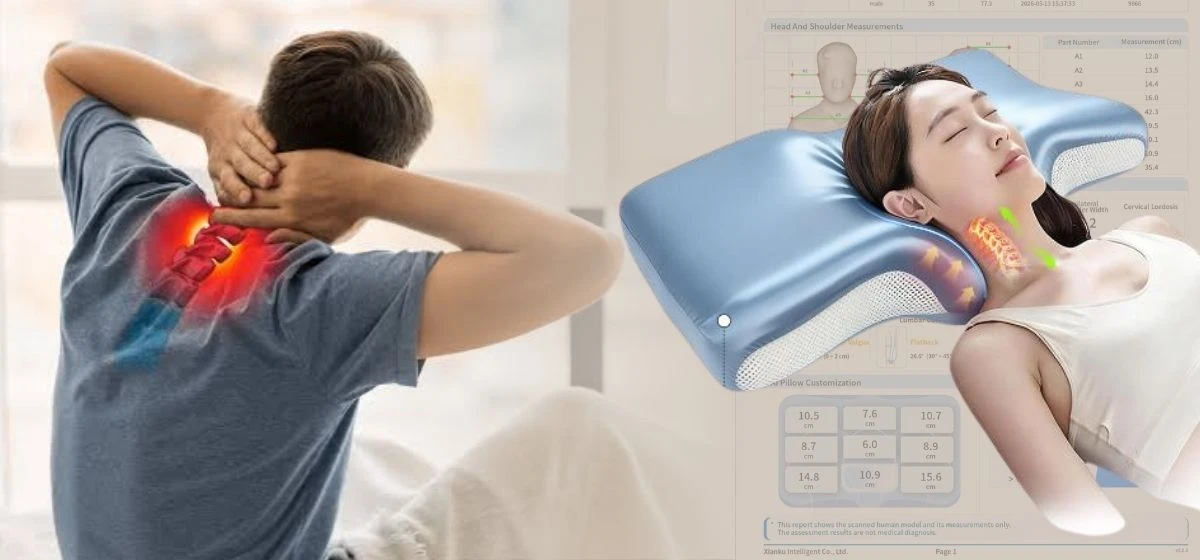
2. Your Pillow Height May Be Wrong for Your Body
Many people choose pillows based on:
- Brand reputation
- Material
- Softness
- Price
- Reviews
But one important factor is often ignored:
Does this pillow match your body?
A pillow is not simply a comfort product.
It plays an important role in maintaining the relationship between your:
- Head
- Neck
- Shoulders
- Spine
A pillow that is too high may:
- Push your neck forward
- Increase muscle tension
- Affect natural alignment
A pillow that is too low may:
- Reduce support
- Allow your neck to bend unnaturally
The challenge is that everyone has different:
- Shoulder width
- Neck length
- Body shape
- Sleeping habits
This is why a pillow that feels perfect for one person may feel uncomfortable for another.
3. Your Spine May Not Be Properly Supported During Sleep
Your spine has natural curves designed to distribute pressure and maintain balance.
During sleep, proper support helps your body maintain these natural positions.
However, unsuitable support from:
- Pillow
- Mattress
- Sleeping position
may influence spinal alignment.
When your body cannot fully relax during sleep, your muscles may continue working to maintain stability.
Instead of entering a complete recovery state, your body may remain under unnecessary tension.
4. Your Daily Posture Affects Your Nighttime Recovery
Sleep does not exist separately from your daily life.
Your daytime habits influence your body before you even get into bed.
Modern lifestyles often include:
- Long hours sitting at a desk
- Looking down at smartphones
- Limited physical movement
- Poor sitting posture
These habits may contribute to:
- Tight neck muscles
- Rounded shoulders
- Lower back discomfort
When these conditions continue into the night, your body may struggle to fully relax.
Your sleeping position is connected to your daytime posture.
5. Your Body Is Different From Everyone Else
One of the biggest misunderstandings in sleep products is the idea that one solution can work for everyone.
Most traditional sleep products are designed using average measurements.
- Average pillow height.
- Average mattress firmness.
- Average body dimensions.
But real human bodies are not average.
Every person has unique:
- Body proportions
- Spine curves
- Shoulder structure
- Sleeping position
- Support requirements
This is why personalized solutions are becoming an important trend in modern wellness.
The Future of Sleep: From Choosing Products to Understanding Your Body
For decades, consumers have selected pillows by guessing.
They try different products.
They read reviews.
They replace uncomfortable pillows.
But what if we could understand what the body actually needs before choosing a product?
This is where technology is changing the future of sleep.
How 3D Body Scanning Helps Create Personalized Sleep Solutions
With the development of 3D scanning and artificial intelligence, human body data can now become a valuable foundation for personalized wellness.
A 3D Body Scanner can capture detailed body information and analyze factors related to posture and body structure.
This data can help understand:
- Body alignment
- Shoulder position
- Neck and spine relationship
- Sleeping support requirements
Instead of designing products for an average person, technology allows companies to create solutions based on individual body characteristics.
Personalized Sleep: The Next Generation of Rest
The future of sleep products is moving from:
"Which pillow should I buy?"
to:
"What support does my body need?"
With AI and human body data, personalized sleep solutions can provide:
- More accurate support
- Better comfort
- Individualized recommendations
- Improved user experience
The goal is not simply creating a softer pillow.
The goal is creating support that works with your body.

Conclusion: Better Sleep Starts With Understanding Your Body
If you wake up tired after eight hours of sleep, the problem may not be the amount of sleep you get.
It may be the quality of recovery your body receives.
Your sleeping position, pillow support, posture habits, and body structure all influence how well you rest.
Sleep is personal because every body is different.
The future of sleep will not be built around one standard product for everyone.
It will be built around understanding each individual body - using science, technology, and personalized solutions to create better rest.
Because the best sleep solution is not the one chosen by everyone.
It is the one designed for you.
Frequently Asked Questions (FAQ)
-
Why am I tired after sleeping 8 hours?
Sleeping eight hours does not always guarantee quality sleep. Factors such as sleep interruptions, poor support, posture, stress, and sleeping environment can affect how refreshed you feel.
-
Can a pillow affect sleep quality?
Yes. Pillow height and support influence neck alignment and comfort during sleep.
-
How do I know if my pillow height is correct?
A suitable pillow should help maintain a neutral neck position based on your sleeping position and body structure.
-
Can 3D scanning help improve sleep products?
3D scanning can provide body measurements and posture information that support the development of more personalized sleep solutions.
