

Why the Future of Footwear Is Moving From Standard Sizes to Personalized 3D Printed Shoes
For more than a century, the footwear industry has been built around one simple assumption:
If enough people have similar feet, we can create shoes that work for everyone.
This idea created the modern shoe industry.
- Thousands of factories.
- Millions of pairs.
- Standard sizes.
- Standard shapes.
- Standard designs.
It made shoes more affordable and accessible than ever before.
But there is one problem.
Human feet were never standardized.

Every person's feet are different.
- Different lengths.
- Different widths.
- Different arch heights.
- Different heel shapes.
- Different pressure patterns.
Even the left and right foot of the same person can be different.
Yet most people still buy shoes based on one simple number:
Their shoe size.
A size tells you how long a shoe is.
But it doesn't tell you how your foot actually exists in three-dimensional space.
And this is where the future of footwear begins.
Not with bigger factories.
Not with more shoe sizes.
But with understanding the unique shape of every individual foot.
The Problem With Today's "Personalized" Shoes
In recent years, 3D printing has become one of the biggest innovations in footwear.
The technology promises:
- Faster production
- More complex designs
- Lightweight structures
- Reduced material waste
- New levels of performance
Many brands have already introduced 3D printed shoes.
But there is an important question:
Are these shoes truly personalized?
In many cases, the answer is:
Not yet.
Because printing technology alone does not create personalization.
A machine can print a shoe.
But it cannot automatically understand the person who will wear it.
A shoe can have a unique lattice structure.
A futuristic appearance.
Advanced materials.
But if it is not based on the wearer's actual anatomy, it is still designed for an average user.
The biggest limitation of current footwear is not manufacturing.
It is data.
The Missing Link: Understanding the Individual Foot
A truly personalized shoe must start with one essential question:
Who is this shoe being made for?
Not:
"What size shoe do they wear?"
But:
"What is the complete structure of their foot?"
A human foot is a complex biomechanical system.
The shape of the foot influences:
- How weight is distributed
- How pressure moves during walking
- How the arch supports the body
- How the ankle and lower limbs adapt
- How comfortable and stable movement feels
Two people wearing the same shoe size may have completely different needs.
One person may have:
A lower arch requiring additional support
Another may have:
A higher arch requiring different cushioning
Someone else may have:
A wider forefoot
A narrower heel
Different left-right balance
A standard shoe cannot understand these differences.
But digital technology can.

From Shoe Size to Digital Foot Identity
The future of personalized footwear begins with accurate measurement.
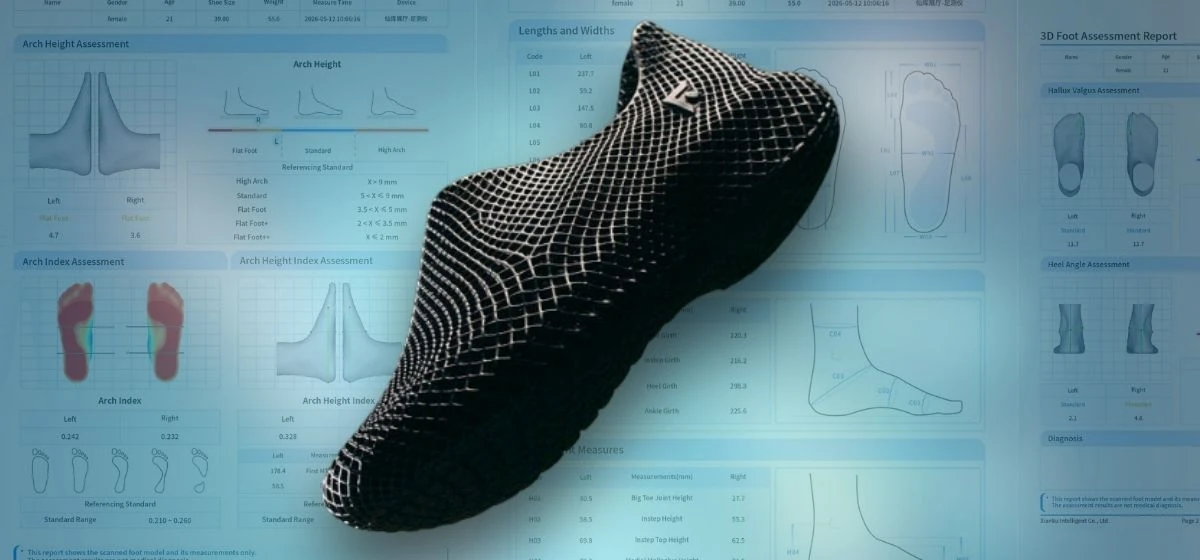
A 3D Foot Scanner creates a detailed digital representation of the individual's foot by capturing three-dimensional anatomical data.
Instead of measuring only length, advanced scanning technology can analyze:
- Foot length
- Foot width
- Arch height
- Instep height
- Heel shape
- Foot volume
- Left-right differences
- Overall foot geometry
This creates something much more valuable than a shoe size.
It creates a digital foot profile.
This digital model becomes the foundation for personalized footwear design.
The shoe is no longer created for a category of people.
It is created for a specific person.
The Future of 3D Printed Shoes: Designed Around You
Imagine walking into a footwear store in the future.
Instead of asking:
"What size do you wear?"
The first question becomes:
"Can we scan your feet?"
Within seconds, a digital model is created.
The system understands:
- Your unique structure.
- Your support requirements.
- Your pressure patterns.
- Your movement characteristics.
Then, using advanced manufacturing technology, a shoe can be designed around your anatomy.
This is the real promise of 3D printed footwear.
Not simply printing shoes faster.
But creating shoes that were never possible before.
Shoes designed around the individual.
Healthy Shoes Should Support the Person, Not Force the Person to Adapt
For decades, people have adapted themselves to shoes.
They break in uncomfortable shoes.
They tolerate pressure points.
They choose between style and comfort.
They adjust their walking patterns.
But footwear should work the other way around.
The purpose of a shoe is not to change the foot.
It is to support the foot.
A truly personalized 3D printed shoe could incorporate individual support requirements, including:
- Personalized arch support
- Optimized cushioning zones
- Improved pressure distribution
- Better anatomical fit
- Individualized comfort
Instead of asking:
"Which shoe fits my foot?"
The future asks:
"How can we create a shoe based on my foot?"
Beyond Comfort: Personalized Footwear as Preventive Health
Footwear is not only about comfort.
Every step creates a chain reaction throughout the body.
The way the foot interacts with the ground can influence:
- Ankle movement
- Knee loading
- Hip mechanics
- Overall posture
This is why understanding foot structure matters.
A personalized shoe is not simply a luxury product.
It represents a shift toward preventive and data-driven healthcare.
The same trend is happening across healthcare:
- Personalized medicine.
- Personalized nutrition.
- Personalized fitness.
And now:
Personalized footwear.
The Future Is Not More Shoe Sizes. It Is More Understanding.
For generations, the footwear industry has tried to solve one challenge:
How can we make shoes that fit more people?
The future asks a different question:
How can we make shoes that fit each person?
3D printing provides the manufacturing capability.
But 3D scanning provides the intelligence behind personalization.
Together, they create a new possibility:
Footwear designed from the human body itself.
Your feet are unique.
Your movement is unique.
Your needs are unique.
So your shoes should be too.
The future of footwear will not be defined by how many sizes we produce.
It will be defined by how well we understand the person wearing them.
