Introduction: The Growing Concern for Adolescent Spinal Health
In an era where holistic child development is increasingly prioritized, the physical well-being of students has become a central focus for families, educational institutions, and healthcare providers worldwide. Beyond academic performance, there is a burgeoning recognition of the critical importance of spinal health and proper posture during the formative years of adolescence. This period of rapid growth is a crucial window for the early detection of postural issues, with Adolescent Idiopathic Scoliosis (AIS) standing as one of the most common orthopedic conditions, affecting an estimated 2-3% of the global school-aged population. The implications of poor spinal health extend far beyond aesthetics; untreated conditions can lead to chronic pain, diminished cardiorespiratory function, and significant psychological impact, affecting a child's overall quality of life.
The collective desire to safeguard students is unequivocal. However, the conventional methodologies employed in large-scale school screening programs often struggle to meet the modern benchmarks of safety, accuracy, and efficiency that our children rightly deserve. This gap between intent and practical execution underscores an urgent need for innovative, technologically advanced solutions that can effectively uphold our shared commitment to student wellness. A proactive approach to spinal health is no longer a luxury, but a necessity in comprehensive educational healthcare.
Section 1: The Pressing Challenges in Contemporary School Scoliosis Screening
The goal of early detection is universally endorsed, yet the path to achieving it is fraught with systemic challenges that can undermine the effectiveness of even the most well-intentioned screening initiatives.
1.1 The Inherent Limitations of Conventional Screening Methods
The prevailing protocol in numerous school systems globally still hinges on the Adams Forward Bend Test, a visual and tactile examination typically conducted by a school nurse or visiting clinician. While this method has been a long-standing tool, it is fundamentally subjective. Its diagnostic accuracy is heavily reliant on the examiner's individual experience and acuity, leading to troubling inconsistencies. These inconsistencies manifest as a high rate of both false positives-which trigger unnecessary parental anxiety and costly specialist referrals-and false negatives-which allow progressive spinal curves to advance undetected, often until more invasive interventions are required.
When a potential issue is flagged, the diagnostic confirmation traditionally involves radiographic (X-ray) imaging, which remains the clinical gold standard for measuring Cobb angles. However, the use of ionizing radiation presents a valid and significant concern for parents and healthcare professionals alike. This concern renders X-rays fundamentally unsuitable for repeated use in a preventive, population-wide screening context, creating a critical dilemma between the need for diagnostic precision and the ethical imperative to minimize radiation exposure for developing children. Maintaining robust spinal health should not come with such risks.
1.2 Operational Inefficiency and Student Privacy Concerns
Manual screening is an inherently slow and labor-intensive process. The task of screening hundreds, or even thousands, of students within a constrained academic timetable places an immense burden on often under-resourced school health staff. This logistical challenge can lead to rushed assessments or incomplete screening coverage.
Furthermore, certain traditional techniques require students to partially disrobe to allow for an unobstructed visual inspection of the back. For adolescents, who are particularly sensitive about their bodies, this can be an embarrassing, uncomfortable, and stigmatizing experience. Such practices can deter participation, violate student privacy, and create a negative association with health screenings, ultimately counteracting the program's goals. A modern posture assessment should be respectful and non-intrusive.
1.3 The Critical Disconnect Between Screening and Sustainable Management
Arguably the most significant failure of many traditional programs lies in the breakdown of the process after the initial screening. Many initiatives operate in a silo, with the entire process effectively concluding once a list of "referrals" is generated. This leads to several critical failures:
- Deficit in Parental Understanding and Engagement: Without clear, tangible evidence, a verbal notification or a written letter stating a "suspected postural issue" is often abstract and difficult for parents to fully comprehend. This lack of clear understanding can lead to inaction, procrastination, or dismissal of the issue, thereby delaying crucial early intervention.
- Absence of Longitudinal Data and Tracking: Traditional screening produces a momentary, qualitative snapshot-a simple "pass" or "refer." It fails to establish a quantitative, objective baseline against which future changes can be measured. For students with minor or borderline curves, this lack of longitudinal data makes it nearly impossible to monitor progression accurately, a factor paramount in clinical decision-making for AIS. Effective spinal health management requires tracking over time.
- Fragmented Follow-up and Broken Care Continuum: There is frequently a profound disconnect between the school screening program, the family, and the specialized healthcare ecosystem. Without seamless data sharing, clear communication channels, and a formalized referral pathway, students identified as "at-risk" can easily become lost in the transition, severing the essential "screen-diagnose-treat-monitor" chain that defines successful spinal health outcomes.
Section 2: Xianku3d Body Scanner: A Paradigm Shift in Spinal Posture Assessment
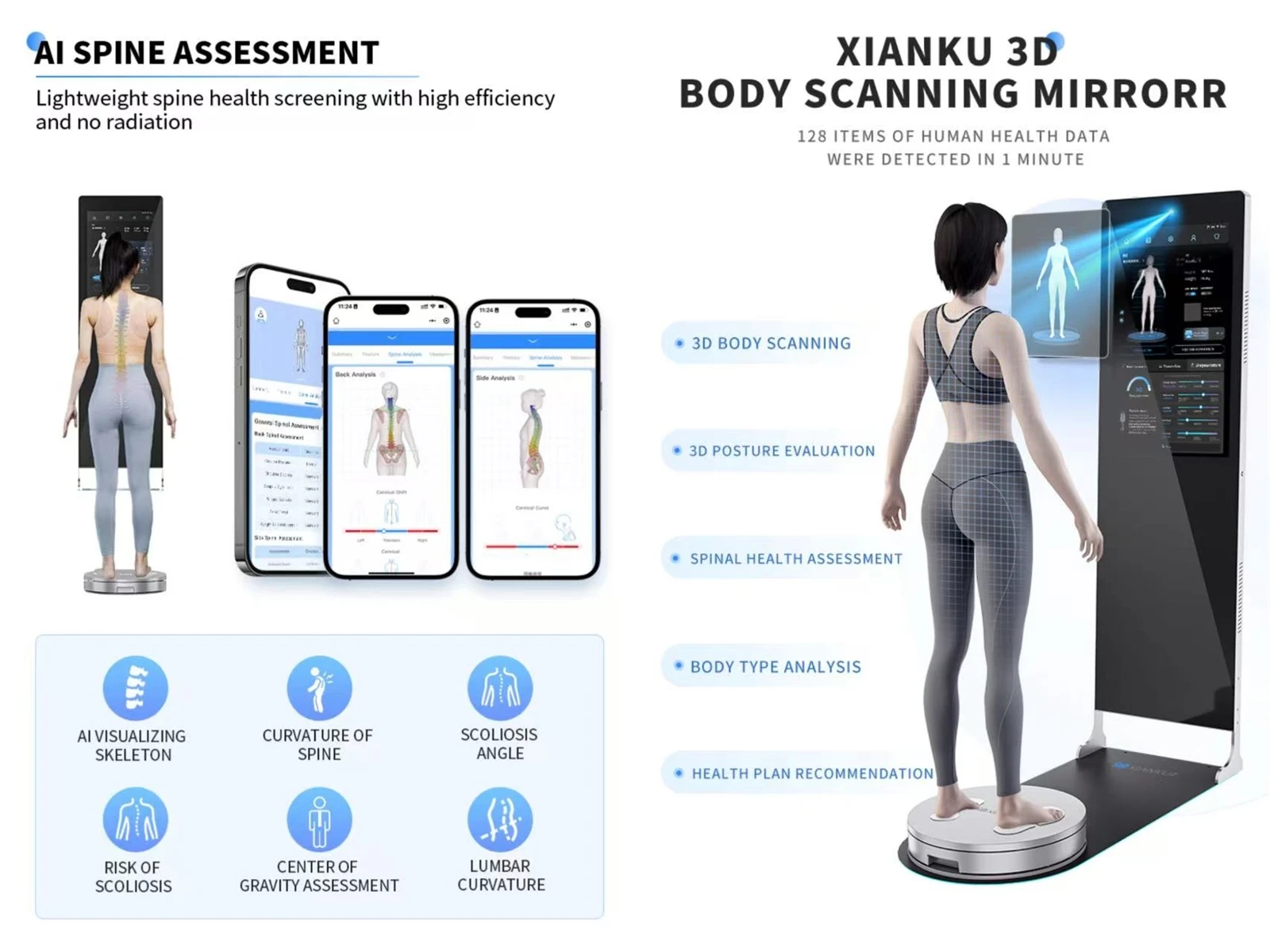
The Xianku3d Body Scanner is a technological solution engineered from the ground up to address these systemic challenges. It represents an intelligent assessment platform that integrates non-invasive 3D structured light scanning, high-fidelity three-dimensional body reconstruction, and sophisticated AI-driven digital modeling to establish a new global standard for preventive spinal health care in educational environments.
Core Technological Capabilities:
- Zero-Radiation Safety: Utilizing perfectly safe, advanced structured light technology, the scanner captures hundreds of thousands of data points in a mere 20 seconds. It constructs a precise, photorealistic digital twin of the student's entire posture without any exposure to harmful ionizing radiation, making it safe for repeated use.
- AI-Powered Posture Assessment: Proprietary, advanced algorithms perform a deep analysis of the 3D model to deliver a comprehensive and quantitative posture assessment. This provides objective metrics on key postural indicators, including spinal alignment in the coronal and sagittal planes, pelvic tilt and obliquity, shoulder height asymmetry, and trunk rotation.
- Comprehensive and Instantaneous Reporting: Within 60 seconds of the scan, the system generates an intuitive, visually engaging, and easy-to-understand digital report. This report features the fully rotatable 3D avatar and a detailed, color-coded analysis that pinpoints areas of concern, translating abstract medical concerns into tangible, understandable data for parents and professionals alike.
- Longitudinal Progress Tracking: The platform automatically and securely archives each scan, creating a permanent, cumulative digital health record for every student. This allows for direct, side-by-side visual comparison of 3D models from different dates (e.g., 6 or 12 months apart), providing undeniable, objective evidence of progression or stability, which is crucial for managing spinal health.
Table 1: A Comparative Analysis: Traditional Screening vs. Xianku's Advanced Posture Assessment
| Screening Component | Traditional Method | Xianku-Enhanced Method | Impact & Benefit |
|---|---|---|---|
| Safety Profile | Potential cumulative radiation exposure from confirmatory X-rays. | 100% radiation-free, using perfectly safe structured light. | Enables safe, frequent screenings and monitoring without any health risks, ideal for growing children. |
| Data Objectivity & Precision | Subjective visual and tactile evaluation; qualitative notes. | AI-driven, millimeter-precise quantitative data on spinal alignment and postural metrics. | Eliminates examiner bias; provides consistent, reliable, and objective results for confident decision-making. |
| Operational Speed & Efficiency | 5-8 minutes per student for manual examination and documentation. | 20-second scan, with fully automated report generation in under 1 minute. | Enables high-throughput screening; a single unit can assess thousands of students in a school day. |
| Result Communication & Engagement | Verbal description or basic written note; difficult to visualize. | Interactive 3D model and a visually compelling, shareable digital report. | Dramatically improves comprehension for parents and students, leading to higher engagement and follow-up compliance. |
| Longitudinal Progress Tracking | Relies on memory or disparate clinical notes; no baseline for comparison. | Automated digital archiving with visual timeline comparison and quantifiable data tracking. | Empowers data-driven, long-term management of spinal health, allowing for timely intervention if progression is detected. |
Section 3: The Multifaceted Value of Xianku in the Educational Ecosystem
Integrating the Xianku scanner transforms a standalone, often isolated screening event into a comprehensive, data-driven, and continuous student wellness initiative, creating a seamless "Scan-Assess-Manage" ecosystem for spinal health.
3.1 Empowering School Nurses with Objective Data
School nurses and health officials are equipped with irrefutable, quantifiable evidence. Moving beyond subjective judgment, they now possess a detailed report showing precise postural deviations with millimeter-level accuracy. This empowers them to make more accurate, confident, and defensible triage and referral decisions, thereby optimizing limited healthcare resources and reducing familial anxiety through clarity.
3.2 Transforming Parental Communication and Building Trust
The interactive 3D model serves as a powerful communication tool that transcends language and medical literacy barriers. When a school official can show a parent a rotating digital avatar of their child's back, with clear visual evidence and color-coded highlighting of asymmetries, it creates an immediate and profound understnding of the situation. This visual proof facilitates a more productive, collaborative conversation, significantly increasing parental cooperation and follow-through on specialist recommendations, thereby strengthening the home-school partnership in managing the child's spinal health.
3.3 Establishing a Digital Foundation for Lifelong Spinal Health
The Xianku system acts as the cornerstone of a modern, dynamic student health record. By establishing a secure, digital baseline of a student's posture from a young age, schools can contribute invaluable data to a lifelong spinal health profile. This aggregated, anonymized data, protected by robust privacy safeguards, can also be used by public health authorities to monitor population-level trends, assess the impact of school-based interventions (e.g., ergonomic furniture, specific physical education programs), and shape future health policies.
3.4 Streamlining Operations and Ensuring Student Dignity
The remarkable speed and full automation of the scanning process allow a limited nursing staff to efficiently screen an entire student body within a single school day. The fully clothed, non-contact, and rapid scanning procedure is both discreet and respectful, fully upholding student privacy and comfort. This approach encourages universal participation, reduces screening-related stress and stigma, and fosters a positive attitude towards proactive health monitoring. The efficiency is staggering, with the potential to screen over ten thousand students per day with a coordinated deployment, making large-scale, district-wide posture assessment programs entirely feasible.
*Table 2: The Xianku-Powered "Screen-to-Monitor" Workflow for Optimal Spinal Health**
| Stage | Process Description | Key Stakeholders | Tangible Outcome |
|---|---|---|---|
| 1. Awareness & Onboarding | Educate parents and staff on the benefits of advanced, radiation-free spinal screening. | School Administration, Parents | Increased participation rates due to enhanced trust, transparency, and understanding of spinal health importance. |
| 2. In-School Scanning | Students undergo a quick, fully-clothed, non-invasive 20-second scan in a private area. | School Nurse, Students | Highly efficient, non-intrusive data collection; positive and dignified student experience. |
| 3. AI Analysis & Triage | System generates instant reports; nurse reviews AI-flagged cases based on objective data thresholds. | Xianku AI, School Nurse | Data-driven and rapid triage (Monitor/Refer) with clear, evidence-based justification. |
| 4. Data-Driven Communication | Digital reports with 3D models are shared with parents via secure, encrypted portals. | School Nurse, Parents | Transparent, evidence-based communication facilitates informed, timely decisions and next steps. |
| 5. Specialist Referral & Intervention | The comprehensive 3D report provides the specialist with rich, pre-consultation data, reducing diagnostic time. | Parents, Orthopedic Specialist | Accelerates and informs the diagnostic process, enabling the creation of highly personalized, effective treatment or physical therapy plans. |
| 6. Long-Term Monitoring & Management | At-risk students are re-scanned periodically (e.g., annually); models are compared to track progression visually and quantitatively. | School Nurse, Specialists, Parents | Enables proactive, evidence-based management of curve progression over time without repeated radiation exposure. |
Section 4: A Global Perspective on Excellence in Student Health Technology
The commitment to advancing student health through sophisticated, safe technology is a global endeavor. The principles of safety, data-driven insight, and seamless ecosystem integration that define leaders in medical and consumer technology are perfectly embodied in the Xianku solution's design philosophy for spinal health and posture assessment.
- Siemens Healthineers: A global leader in medical imaging, Siemens has consistently pioneered low-dose radiation technologies and precision diagnostic tools. Their unwavering focus on providing clinicians with definitive, high-quality data directly mirrors Xianku's core mission to replace subjective, qualitative guesses with objective, AI-powered posture assessment metrics for school nurses, elevating the standard of care in a school setting.
- Apple: The intuitive user experience, elegant design, and unwavering commitment to data privacy and security found in Apple products set a benchmark for all consumer and professional technology. Xianku embodies this principle by ensuring the student scanning process is straightforward and non-intimidating, while all sensitive biometric data is stored and transmitted with enterprise-grade security, building essential trust with schools and families concerned about spinal health data.
- IBM (Watson Health): IBM's groundbreaking work in cognitive computing through Watson Health demonstrated the profound power of AI to analyze complex datasets and extract meaningful insights. Similarly, Xianku's AI engine does not merely collect body data points; it intelligently analyzes them to identify subtle risk patterns, generate personalized health insights, and provide actionable recommendations, moving the field from simple physical measurement to intelligent spinal health analysis and prediction.
- Philips: As a leader in health technology, Philips has long emphasized a holistic approach, creating solutions that integrate seamlessly across the entire health continuum-from prevention and diagnosis to treatment and home care. This comprehensive philosophy is deeply reflected in Xianku's system design, which aims to create a closed-loop, connected ecosystem linking schools, homes, and clinical practices for continuous, collaborative spinal health management.
- Google (Fitbit): Through its Fitbit brand, Google has successfully popularized the concept of using accessible, wearable technology for longitudinal health and fitness tracking. Xianku applies this same powerful philosophy to the critical domain of spinal health, providing a practical and scalable means to track postural changes over the critical years of adolescent development, thereby turning a single, static screening event into an ongoing, dynamic health journey.
Conclusion: Investing in a Straighter, Healthier Future Generation
The challenges inherent in traditional scoliosis screening are significant and multifaceted, but they are no longer insurmountable. The Xianku 3D Body Scanner represents a definitive paradigm shift, perfectly aligning cutting-edge technological innovation with the fundamental, non-negotiable priorities of absolute safety, diagnostic accuracy, and comprehensive, continuous care.
By providing a radiation-free, data-rich, and student-centric solution, it empowers schools, reassures parents, and protects students, enabling educational institutions to fulfill their duty of care more effectively and compassionately than ever before. It transforms the abstract concept of spinal health into a manageable, measurable, and actively monitored aspect of a student's overall well-being. Investing in such advanced posture assessment technology is not merely an administrative upgrade or a simple procurement decision; it is a profound and lasting commitment to the long-term health, confidence, and quality of life of the next generation. It ensures that every child has the opportunity to grow up strong, healthy, and straight, ready to face the future without the burden of preventable postural ailments.
(86)-181-2464-3821
alexliu@xianku.com