The global footwear industry is at a crossroads. Despite its dynamic nature, the market faces persistent challenges that undermine profitability and customer loyalty. Brands and retailers grapple with intense competition, homogenized products, and declining store traffic, leaving them searching for innovative solutions to reconnect with consumers and secure sustainable growth.
The Evolving Footwear Market: Challenges in Differentiation and Customer Engagement
The Service Differentiation Dilemma
In an oversaturated market, footwear brands traditionally compete on price, design, and marketing. However, these strategies rarely create meaningful differentiation. Consumers are inundated with choices, leading to decision paralysis and prolonged purchase cycles. The absence of unique in-store experiences further diminishes brand loyalty, as customers effortlessly switch between competitors based on marginal price differences or fleeting trends.
The Functional Innovation Stagnation
While aesthetics drive short-term sales, excessive reliance on exterior innovation carries significant risks. Design-driven decisions often cater to subjective and volatile trends, resulting in misaligned inventory, overstocking, and product stagnation. The industry lacks a data-backed approach to functional innovation-one that addresses foundational consumer needs, such as comfort, health, and personalized fit.
The Weakened Customer Experience
Physical retail struggles to justify its relevance in the e-commerce era. Stores often fail to deliver memorable interactions, leaving customers disconnected from brand narratives. When products across brands share similar features and quality, the shopping journey becomes transactional rather than experiential. This inability to forge emotional connections or provide actionable insights during the purchase process exacerbates consumer skepticism and slows conversion rates.
Xianku3d Foot Scanner: A Technological Paradigm for Personalized Retail
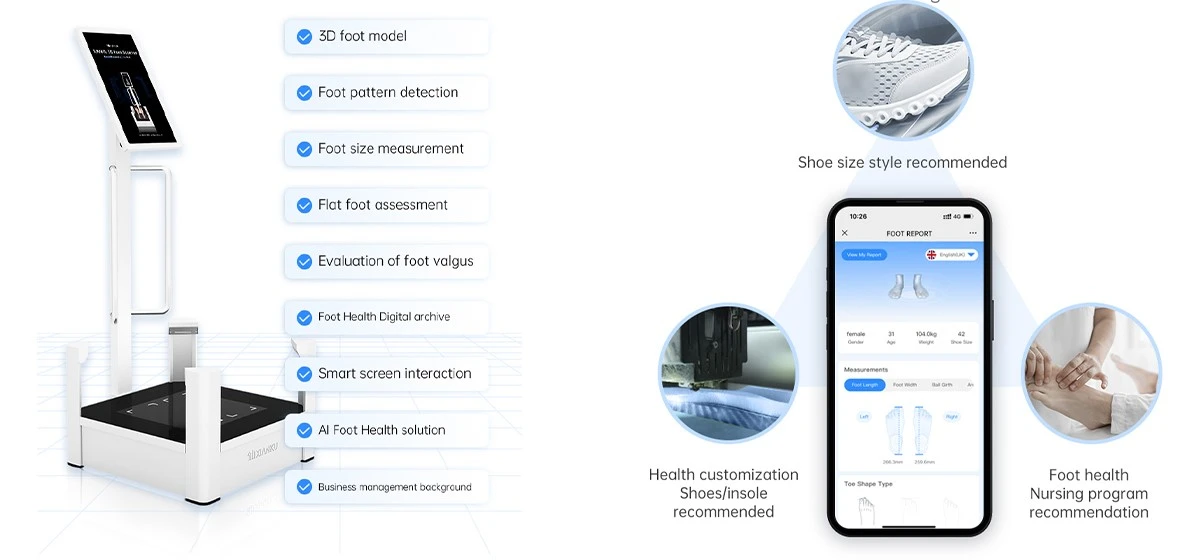
The Xianku3d Foot Scanner bridges these gaps by transforming retail spaces into hubs of personalized health and wellness. Leveraging non-invasive, infrared-based 3D scanning technology, the device captures over 30 dimensions of foot data-including length, width, arch height, and gait patterns-within seconds. This data fuels an AI-powered platform that recommends tailored solutions, from size-matching and functional footwear to custom orthotics and corrective interventions.
1. Data-Driven Product Innovation
The scanner's ability to aggregate anonymized foot morphology data provides brands with actionable insights into common biomechanical issues, such as flat feet, high arches, or hallux valgus. These insights empower brands to develop evidence-based products, like motion-control shoes for overpronation or cushioned midsoles for high-impact activities. By aligning R&D with real-world foot health needs, companies can reduce speculative design risks and cultivate long-term consumer trust.
2. Elevating Health-Centric Narratives
Xianku3d's technology shifts the sales conversation from subjective style preferences to objective health benefits. During a foot scan, customers view their 3D foot models and receive simplified reports highlighting postural imbalances or pressure points. Sales associates, acting as wellness consultants, interpret these findings to recommend products that address specific conditions. This health-focused positioning elevates footwear from a commodity to a vital component of holistic well-being, fostering deeper consumer engagement.
3. Standardized Service Workflow
Xianku3d's end-to-end workflow-Foot Scan → Data Analysis → Health Assessment → AI Product Matching → Transaction-ensures consistency and efficiency across retail touchpoints:
- Foot Scan: A seamless, 20-second process generates a millimeter-accurate 3D foot model.
- Data Analysis: AI algorithms extract key metrics, such as arch type and pressure distribution.
- Health Assessment: Associates explain implications for comfort, performance, and long-term joint health.
- AI Recommendations: The system curates personalized product selections, including shoes, insoles, or corrective devices.
- Transaction: Customers finalize purchases with confidence, while their data is archived for future engagements.
Table 1: Xianku3d's Standardized Service Workflow
| Step | Key Actions | Technology Input | Customer Outcome |
|---|---|---|---|
| Foot Scan | Non-invasive 3D infrared scanning | High-resolution depth sensors capture 30+ foot dimensions | Engagement through immersive, tech-driven interaction |
| Data Analysis | AI processes biomechanical data | Algorithms identify arch type, pressure points, and gait irregularities | Objective insights replace guesswork |
| Health Assessment | Associate interprets data for the customer | Visualizations of foot morphology and risk areas | Trust-building through transparent, education-based dialogue |
| AI Recommendation | System suggests shoes/orthotics | Predictive analytics match findings to inventory | Personalized solutions that resonate with health needs |
| Transaction & Archive | Purchase completion; data stored in CRM | Encrypted digital profiles for future retargeting | Streamlined checkout and loyalty reinforcement |
4. Enhancing Operational Efficiency and Loyalty
Beyond driving immediate sales, Xianku3d's platform supports long-term growth through:
- Customer Management: Automated profiling enables targeted follow-ups, such as reminders for rescans or promotions for matched products.
- Private Domain Marketing: Brands leverage stored data to nurture communities via exclusive offers, health tips, and product updates.
- Upsell Opportunities: Detailed scans reveal ancillary needs, like custom 3D-printed insoles or bunion correctors, boosting average transaction value.
Learning from Global Leaders: Personalization in Practice
Leading footwear brands have long recognized that personalization fosters loyalty and accelerates decision-making. Their strategies offer valuable lessons for retailers adopting technologies like Xianku3d:
- Nike: Leverages community-centric flagship stores (e.g., NBA-themed venues) to create immersive brand experiences. Its Nike By You platform enables custom colorways and fits, blending digital convenience with emotional storytelling.
- Adidas: Combines data from wearable tech and apps to refine product designs and recommend tailored training gear. Its partnership with Parley for the Oceans also aligns with eco-conscious consumer values.
- New Balance: Focuses on width-fitting systems and adaptive cushioning technologies to address diverse foot shapes, particularly among athletes and aging populations.
- Gdvin Gsell: This Parisian luxury brand employs 3D foot scan data to create bespoke shoe lasts, reducing customization time from 90 days to two weeks while maintaining artisanal quality.
- Asics: Its flagship stores incorporate gait analysis tools to recommend running shoes based on individual stride patterns, bridging performance science with consumer needs.
Table 2: Comparative Analysis of Personalization Strategies
| Brand | Personalization Approach | Technology Used | Key Outcome |
|---|---|---|---|
| Nike | Customizable designs; community hubs | Nike By You configurator; retail events | Emotional connection; higher perceived value |
| Adidas | Eco-conscious customization; wearable integration | App-based tracking; sustainable materials | Appeals to ethically minded consumers |
| New Balance | Width-fitting; biomechanical solutions | Pressure mapping; adaptive foams | Caters to underserved niches (e.g., wide feet) |
| Gdvin Gsell | Bespoke lasts; handcrafted luxury | 3D foot scan; AI-assisted pattern-making | Exclusive clientele; reduced returns |
| Asics | Gait analysis; performance matching | In-store treadmills; motion capture | Data-driven credibility for athletes |
The Business Case: Tangible Returns on Xianku3d's Technology
Investing in Xianku3d's ecosystem yields measurable benefits across key retail metrics:
- Conversion Rates: Personalized recommendations reduce decision fatigue, accelerating purchases.
- Average Transaction Value: Sales of premium customized products and orthotics increase revenue per customer.
- Return Rates: Precise size and fit matching minimize returns due to discomfort.
- Customer Lifetime Value: Data-driven follow-ups and health-centric relationships encourage repeat business.
Table 3: Impact of Xianku3d's Solution on Retail KPIs
| Key Metric | Traditional Retail | Xianku3d-Enabled Retail |
|---|---|---|
| Sales Conversion Time | Lengthy; relies on trial-and-error | Shortened; guided by authoritative data |
| Customer Retention | Low; limited post-purchase engagement | High; ongoing health tracking and personalized outreach |
| Inventory Management | Forecast-driven; prone to overstocking | Demand-driven; informed by aggregated foot scan data |
| Marketing ROI | Broad campaigns; low segmentation | Hyper-targeted; based on documented foot health needs |
The Future of Footwear Retail: Where Technology Meets Humanity
As consumer expectations evolve, the fusion of human-centric service and technological precision will define the next era of footwear retail. Xianku3d's platform exemplifies this synergy-transforming stores into destinations for professional consultation rather than mere transactions. By prioritizing health, personalization, and technological empowerment, brands can cultivate unwavering loyalty and thrive in an increasingly competitive landscape.
In conclusion, the footwear industry's challenges are substantial but not insurmountable.
Solutions like the Xianku3d Foot Scanner offer a roadmap to redefine retail through data-driven personalization, health-conscious narratives, and operational excellence. For brands ready to embrace this change, the future is not just about selling shoes-it's about delivering individualized well-being, one foot scan at a time.
(86)-181-2464-3821
alexliu@xianku.com