

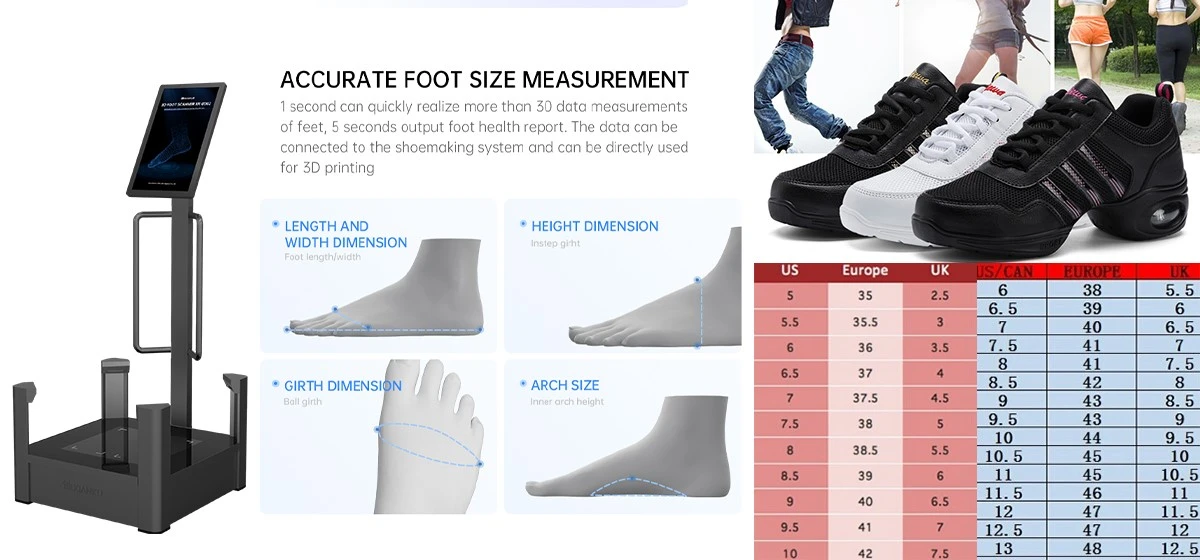
The global footwear market faces a persistent challenge: online return rates that undermine profitability and consumer trust. Industry data reveals that the median return rate for online footwear sales stands at 19%, nearly four times higher than the 5% median for in-store purchases . This discrepancy stems from three core issues plaguing the industry.
The Footwear Industry's Sizing Crisis
Proliferation of Sizing Standards
The absence of a universal sizing system creates confusion. Consumers navigate European, American, and international standards, while premium and performance footwear brands often deviate from these benchmarks by 1-2 sizes. This inconsistency forces customers to gamble when ordering online, resulting in frequent returns due to poor fit.
Inaccurate Consumer Self-Assessment
Most consumers possess only a vague understanding of their true size. Compounding this, they often apply subjective adjustments-such as sizing up for athletic shoes or down for casual wear-introducing further error. These misguided adaptations, based on incomplete self-knowledge, directly lead to dissatisfaction and returns when the shoes fail to fit as anticipated.
The Multidimensional Fit Problem
A comfortable fit depends on multiple dimensions: length, width, and height. However, most brands base their sizing on a single primary dimension, neglecting the holistic shape of the foot. This oversimplification fails to address the "all-around" embrace a shoe should provide, leaving customers with improperly fitting products .
Xianku3d Foot Scanner: A Data-Driven Solution for Reducing Returns
The Xianku3d Foot Scanner addresses these challenges head-on by replacing guesswork with precise, data-driven fit technology. Using non-invasive infrared light, the scanner captures 32 distinct foot dimensions-including length, width, and arch height-in seconds . This data forms the foundation of a comprehensive strategy to slash return rates for online footwear sales.
1. Data-Backed Sizing Optimization
For brands, the aggregated and anonymized data collected through foot scan assessments is transformative. It enables them to:
- Establish Cross-Brand Sizing Benchmarks: Understand how their sizing compares to competitors, allowing for accurate fit guidance.
- Develop Proprietary Sizing Standards: Create brand-specific sizing that is both consistent and reliable.
- Optimize Shoe Lasts: Use real-world foot morphology data to refine product designs for better universal fit .
*Table 1: Impact of 3D Foot Scanning on Key E-commerce Metrics*
| Key Performance Indicator (KPI) | Traditional Online Model | With Xianku3D Foot Scanner |
|---|---|---|
| Online Return Rate | Median of 19% | Target: Significant reduction based on precise fit data |
| Customer Conversion Rate | Lower due to purchase hesitation | Increased confidence in correct sizing |
| Customer Lifetime Value (LTV) | Potentially lower due to negative returns experience | Enhanced through positive experience and accurate repeat purchases |
| Product Development Insight | Relies on sales and return data alone | Informed by granular, anatomical foot data |
2. Enhancing the Consumer Experience and Building Trust
The foot scan process itself is a powerful tool for building consumer confidence.
- Health-Centric Narrative: The scanner provides a detailed 3D model of the customer's foot, allowing sales associates or online platforms to shift the conversation from style to health and perfect fit. This educates the consumer and elevates the perceived value of the purchase.
- Digitized Experience: The high-tech scanning process engages customers, and the immediate, visual results-a precise 3D avatar of their feet-builds trust in the technology's recommendations .
3. Operational Efficiency and Closed-Loop Marketing
Xianku3d's system integrates seamlessly into a brand's operations, creating a standardized service flow: Foot Scan -> Data Analysis -> Health Assessment -> AI Product Matching -> Transaction.
- Automated Customer Profiling: The management backend allows for subscription-based login, automatically linking customer profiles with their foot scan data.
- Private Domain Marketing: This database enables targeted re-engagement campaigns, such as notifying customers when new styles matching their foot shape are released.
- Additional Revenue Streams: The detailed analysis can identify needs for complementary products like custom orthotic insoles, increasing average order value .
Table 2: Xianku3d's Standardized Service Flow for Fit and Conversion
| Step | Process | Technology & Data Input | Business Outcome |
|---|---|---|---|
| 1. Foot Scan | Customer completes a non-invasive 3D infrared scan. | 32 dimensions of foot data are captured, including length, width, arch height . | Establishes a precise digital footprint; engages the customer. |
| 2. Data Analysis | System algorithms process the 3D model. | AI analyzes foot morphology, pressure points, and gait implications . | Generates objective, data-driven fit insights. |
| 3. Health Assessment | Platform provides a simplified report. | Visualizations highlight postural alignment and fit recommendations . | Builds trust and transitions the conversation to health and performance. |
| 4. AI Product Matching | System recommends shoes from inventory. | Predictive analytics match foot dimensions to product database. | Delivers a personalized product shortlist, eliminating choice paralysis. |
| 5. Transaction & Archiving | Purchase is completed; data is saved. | Encrypted digital profile is created for future purchases. | Secures the sale and enables personalized retargeting, reducing future returns. |
Learning from Global Leaders: Strategies to Minimize Online Returns
Leading footwear brands have pioneered various approaches to tackle the online fit and return challenge, setting a benchmark for the industry.
- New Balance: The brand has partnered with Volumental, a leader in 3D foot scanning technology. This collaboration allows New Balance to offer precise fit recommendations both in-store and online. The data gathered helps refine their size charts and product designs, directly addressing fit issues that lead to returns .
- Nike: Introduced Nike Fit, a smartphone-based foot scan solution. Using a phone's camera, it creates a precise model of a customer's foot to recommend the perfect size. Nike reported that this technology contributed to an average 20% reduction in size-related returns for participating shoe models .
- Adidas: The brand has invested in virtual try-on platforms, leveraging augmented reality and body scanning technology. This allows customers to visualize how shoes will fit and look, addressing both aesthetic and sizing concerns before purchase and reducing the incentive to buy multiple sizes .
- Birkenstock: While renowned for its footbed comfort, the brand has also focused on a robust digital sizing guide and educational content. By helping consumers understand their unique foot shape and the corresponding Birkenstock model, they have cultivated a loyal customer base that makes confident, low-return purchases .
- Volumental's Partners (e.g., ECCO, Red Wing Shoes): Brands utilizing the Volumental platform have reported impressive results, including an average 18% reduction in product returns and a 20% increase in sales . The technology provides a seamless link between in-store scanning and online purchase confidence.
Table 3: Comparison of Brand Strategies to Reduce Online Returns
| Brand | Core Strategy | Key Technology/Tactic | Impact on Returns & Business |
|---|---|---|---|
| New Balance | In-store & data-driven fitting | Partnership with Volumental's 3D foot scanning | Leverages anatomical data to improve product fit and size recommendations. |
| Nike | At-home foot scanning | Nike Fit mobile app using computer vision | 20% reduction in size-related returns for scanned styles . |
| Adidas | Virtual try-on and visualization | AR platforms and body scanning technology | Reduces purchase hesitation and size-related returns through improved visualization . |
| Birkenstock | Educational sizing guidance | Detailed digital fit guides and community trust | Builds confidence in model selection, leading to more accurate first-time purchases . |
| Volumental's Ecosystem | In-store scanning for online confidence | FitTech™ platform linking scan data to e-commerce | Average 18% reduction in returns and 20% sales increase across partner brands . |
Conclusion: The Future of Footwear Retail is Precise, Personalized, and Data-Informed
The crisis of online returns in the footwear industry is solvable. The key lies in shifting from subjective sizing to objective, precise measurement. Technologies like the Xianku3d Foot Scanner provide the crucial link, offering brands deep insights into the feet of their customers and empowering consumers with knowledge about their own anatomy.
By adopting this data-driven approach, brands can not only dramatically reduce the costs and resource waste associated with returns but also build a foundation of trust and loyalty with their customers. In an era where online shopping is dominant, providing a confident, first-time-fit experience is no longer a luxury-it is a strategic imperative for growth and sustainability in the competitive global footwear market.
(86)-181-2464-3821
alexliu@xianku.com
