

The Silent Epidemic:
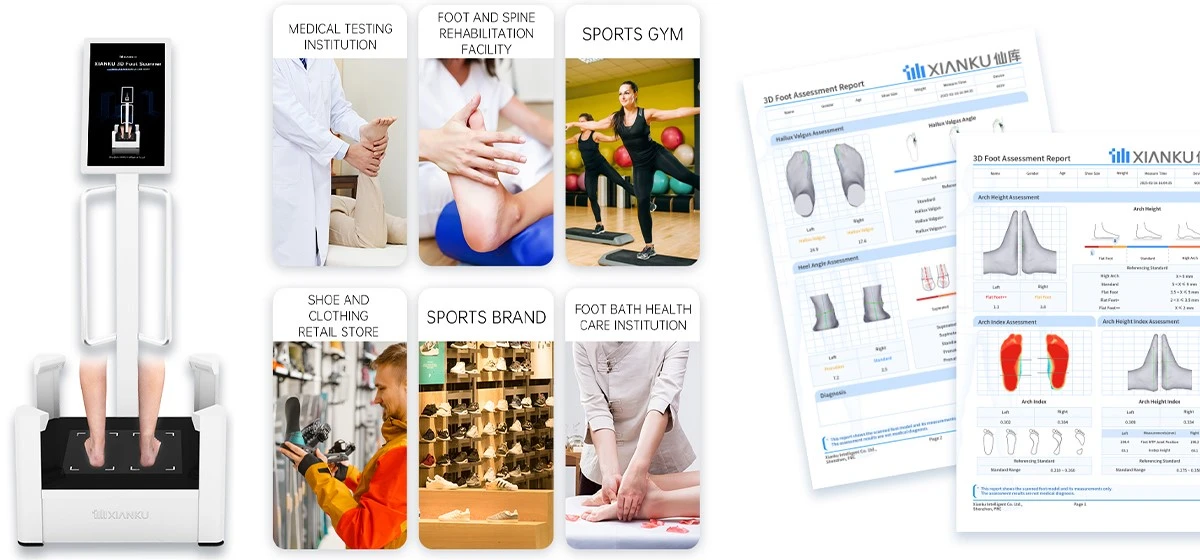
Globally, 1 in 2 adults suffers from foot disorders like plantar fasciitis, flat feet, or hallux valgus. For children, 30% experience developmental foot issues, rising to 50% in the elderly. Traditional solutions often rely on manual measurements (error-prone) or 2D scanners (incomplete data), leading to ill-fitting foot orthotics that exacerbate pain. The Xianku 3D Foot Scanner solves this with millimeter-accurate 3D modeling, scanning both feet in 1 second and generating a comprehensive report in 5 seconds.
Global Foot Health Statistics
| Demographic | Prevalence of Foot Issues | Common Conditions |
|---|---|---|
| Adults | 50% | Plantar fasciitis, heel spurs |
| Children (0–14) | 30% | Flat feet, gait abnormalities |
| Elderly | 50%+ | Balance loss, metatarsal pain |
Core Innovation: Xianku's 3D Scanning Technology
Infrared Structured Light vs. Legacy Systems
Unlike laser scanners (20+ seconds, soles-only data), Xianku uses infrared structured light to capture 2 million data points per foot, creating a 1:1 digital twin. Key advantages:
- 30+ Metrics: Arch height, heel inclination, MTP joint angles, pressure distribution.
- AI-Driven Analysis: Flags risks like overpronation (≥4° heel tilt) or hallux valgus (>10°).
- Non-Invasive Safety: Zero radiation; ideal for diabetics.
Scanner Performance Comparison
| Parameter | Traditional Laser Scanner | Xianku 3D Foot Scanner |
|---|---|---|
| Scanning Time | 20+ seconds | 1 second |
| Model Completeness | Soles only | Full 3D foot topology |
| Accuracy | ±5 mm | ±1 mm (millimeter-grade) |
| Data Output | Basic dimensions | 30+ biomechanical metrics |
| AI Recommendations | None | Custom orthotic designs |
From Scan to Custom 3D Printed Orthotics: A Seamless Workflow
Step 1: Digital Foot Health Archiving
The scanner creates a digital foot health archive, tracking changes over time. For example, a 45-year-old female (Case: Miss Zhao) showed:
- Left foot hallux valgus: 14.0° (moderate risk)
- Arch index: 0.241 (normal range: 0.21–0.26)
- Heel pronation: 4.0° (requires support)
Step 2: AI-Powered Orthotic Insole Supply Chain
Xianku's algorithm converts scans into 3D-printable insoles. Partners like Dr. Kong Health Shoes use this for:
- Personalized Pressure Mapping: Correcting imbalances (e.g., high-pressure zones in flat feet).
- Dynamic Gait Correction: Adjusting for supination/pronation.
Commercial Impact: Foot Orthotics as a Profit Engine
Monetizing Precision in Retail & Healthcare
- Shoe Stores: 3D scans boost conversions by 40% (e.g., matching shoes to orthotics).
- Clinics: Charge $50–$150 for scans bundled with custom orthotics ($200–$500 value).
- Gyms: Prevent injuries via member foot assessments (retention ↑30%).
Solving Industry Pain Points:
Problem: Inaccurate Foot Orthotics Due to Poor Data
Traditional methods fail to capture dynamic weight-bearing states or 3D contours, causing:
- 68% of users to abandon orthotics within 6 months (Journal of Foot & Ankle Research).
- $3.2B wasted annually on ineffective devices (APMA).
Xianku's Solution: Biomechanics-Driven Design
- Multi-Angle Capture: Infrared cameras scan feet at 28 points/cm².
- Algorithmic Modeling: AI correlates data with 5M+ global foot scans.
- 3D Printing Integration: Export files to printers (e.g., Creality) for same-day orthotics.
"Our scanner reduces orthotic refits by 90% by addressing root causes, not symptoms."
-Xianku Engineering Team
FAQs: Foot Orthotics & Digital Scanning
Q: Can scans replace podiatrist consultations?
A: No. Scans provide data; diagnoses require clinical expertise. Xianku reports include disclaimers (e.g., "Not for medical diagnosis").
Q: How durable are 3D-printed orthotics?
A: Medical-grade polymers last 12–18 months. Xianku's scans enable remodels as feet change.
Q: Does insurance cover digital scans?
A: Growing coverage in the EU/US; CPT code 97750 often applies.
Technical References
- Arch Index (AI): Ratio of midfoot area to total footprint (excluding toes). Normal: 0.21–0.26 (Cavanagh PR, 1987).
- Hallux Valgus: Lateral deviation >10° of the first metatarsophalangeal joint.
- Heel Inclination: >4° indicates overpronation; linked to knee/back pain (McPoil TG, 2008).
Citations
- American Podiatric Medical Association (APMA). Economic Impact of Foot Disorders. 2023. apma.org/reports
- Journal of Foot & Ankle Research. Orthotic Compliance Study. 2022. jfootankleres.biomedcentral.com
- WHO Posture Guidelines. The Biomechanics of Gait. 2021. who.int/gait-analysis
Why Xianku Dominates: With 50+ patents, 3 exclusive algorithms, and partnerships (Tsinghua University, CEC), it's redefining foot orthotics. Its B002 scanner fuels a $12B custom orthotics market-proving that precision isn't just clinical; it's commercial.
Unlock your sole's potential. Scan smarter, step stronger.
To inquire more about product solutions and purchase 3D Body Scanner, please contact us through the following contact information.
(86)-181-2464-3821
alexliu@xianku.com
