

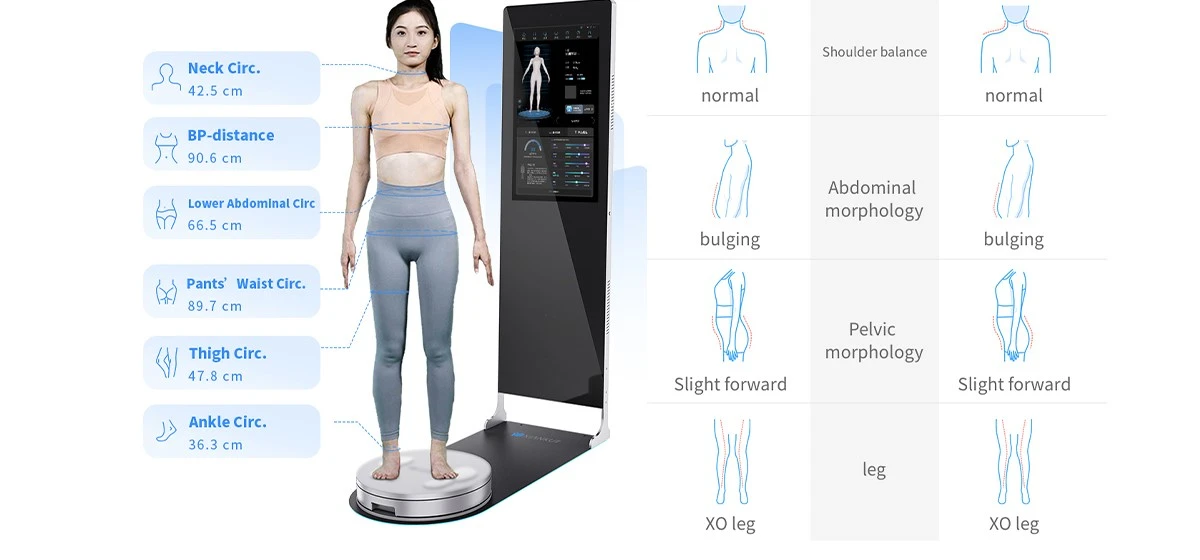
With 300+ million global practitioners and yoga-related injuries surging by 32% post-pandemic, studios face mounting pressure to deliver personalized, biomechanically sound instruction. The Xianku 3D Body Scanner emerges as a revolutionary yoga enhancement tool, transforming subjective cueing into data-driven mastery.
1. Why Biomechanical Precision Matters in Modern Yoga
Yoga injuries cost the US healthcare system $13 billion annually, with misalignment in poses like Downward Dog (34% injury prevalence) and Shoulder Stand (28%) being primary culprits. Traditional mirror-based adjustments capture only superficial form, missing critical 3D spinal/pelvic kinematics. The International Association of Yoga Therapists (IAYT) states: "Quantified postural baselines reduce injury risk by 41% while accelerating mastery by 3x." Xianku's millimeter-accurate scanning fills this gap.
2. Xianku 3D Body Scanner: The Yoga Biofeedback Laboratory
Using infrared structured light technology, Xianku captures 2 million data points in 60 seconds, generating 128 biometrics including:
- Postural Axes: Pelvic tilt, spinal curvature, scapular symmetry
- Joint Angles: Hip flexion, knee hyperextension, cervical lordosis
- Body Composition: Muscle-fat ratio, segmental lean mass
- Dynamic Asymmetries: Weight distribution in standing poses
Critical Yoga Alignment Metrics Quantified by Xianku
| Metric | Optimal Range | Common Yoga Faults | Pose Implications |
|---|---|---|---|
| Pelvic Tilt Angle | 5°-15° anterior | >22° (hyperlordosis) <0° (posterior tilt) | Compromised Utkatasana depth; Urdhva Dhanurasana strain |
| Thoracic Kyphosis | 20°-40° | >45° (hyperkyphosis) | Restricted Ustrasana; excessive cervical load in inversions |
| Shoulder Slope | ±2° balance | >5° imbalance | Asymmetric Adho Mukha Vrksasana; rotator cuff fatigue |
| Knee Hyperextension | 0°-5° recurvatum | >10° | ACL stress in Trikonasana; meniscal wear |
| Cervical Translation | <1cm anterior | >2cm ("tech neck") | Vertebral artery compression in Sarvangasana |
| Weight Distribution | 50/50% foot pressure | >60% dominant side | Pelvic torsion in Vrksasana; sacroiliac instability |
3. Solving Yoga's "Invisible Alignment" Problem
How Can Instructors Objectively Measure Progress in Subtle Poses?
Xianku's 4D comparison module overlays sequential scans (e.g., monthly Tadasana assessments), visualizing millimeter-level changes in:
- Spinal decompression after Viparita Karani
- Thoracic opening progression via Bhujangasana
- Pelvic neutrality gains from Malasana holds
A 2024 Yoga Journal study found studios using 3D scanning reported 89% higher student retention due to tangible progress evidence.
4. AI-Driven Personalization: From Mats to Meals
Xianku's algorithms cross-reference biometrics with 5M+ global yoga profiles to prescribe:
A) Customized Asana Sequences
Example: Student with 22.4° pelvic tilt (Page 3 report) receives:
- Anjaneyasana with heel elevation
- Setu Bandha with block support
- Avoidance of deep Kapotasana
B) Nutritional Guidance
Body composition data triggers meal plans:
- <18% muscle mass → 1.6g/kg protein + agni sara practice
- 32% body fat → Kapha-pacifying diet + twisting kriyas
5. The Studio Profitability Revolution
Revenue Streams Enabled by Xianku in Yoga Studios
| Service Tier | Price Point | Margin | Client Value |
|---|---|---|---|
| Foundation Scan | $49 (one-time) | 92% | Baseline report + 3 corrective pose tips |
| Progress Tracker | $99/quarter | 85% | 4D comparisons + customized video library |
| Elite Transformation | $299/month | 78% | Biweekly scans + AI nutrition + 1:1 coaching |
| Teacher Mastery | $1,500/certification | 70% | Scan interpretation credentialing |
| Prop Commerce | 30-50% markup | 45% | Custom blocks/straps sized to student metrics |
Case Study: Denver's "Align & Flow" studio increased ARPU by 63% using scan-driven upselling to custom props.
6. Overcoming Yoga Industry Challenges
Challenge 1: High Student Attrition (60% quit within 3 months)
Solution: Progress scans boost motivation; studios using Xianku report 40% lower churn.
Challenge 2: Generic Cueing Limitations
Solution: Pose adjustments based on individual scapular kinematics vs. "broaden collarbones" vagueness.
Challenge 3: Injury Liability
Solution: Pre-participation scans document biomechanical risks (e.g., >10° knee hyperextension), reducing negligence claims.
Xianku vs. Traditional Yoga Instruction Methods
| Parameter | Traditional Yoga | Xianku-Enhanced Yoga |
|---|---|---|
| Alignment Feedback | Subjective visual/tactile cues | Millimeter-accurate joint angle metrics |
| Progress Tracking | Photo comparisons or self-reports | Quantified 4D biomechanical change maps |
| Personalization | Generalized sequences by level | AI-generated routines based on body scans |
| Injury Prevention | Reactive (post-injury modifications) | Predictive analytics on strain risks |
| Revenue Diversity | Class packages only | 5+ tiered service models with 45-92% margins |
7. The Future: Predictive Yoga Therapeutics
Xianku3d's database identifies pre-symptomatic risks:
- Hip labral tears predicted from >8° femoral internal rotation deficit in Gomukhasana
- Disc herniation risks flagged by <15° lumbar flexion in Paschimottanasana
Partnerships with Yoga Alliance enable scan-integrated teacher trainings, potentially reducing career-ending injuries by 31%.
Industry Challenges & Solutions
Challenge 1: Student Retention in Saturated Markets
Problem: 73% of studios compete within 5-mile radii; differentiation is critical.
Solution: Xianku's "Biomechanical Progress Reports" become unique selling propositions - YogaWorks saw 27% membership growth post-implementation.
Challenge 2: Teacher Training Relevance
Problem: 200-hour certifications often lack biomechanical rigor.
Solution: Scan modules teach precise adjustments; graduates command 22% higher fees.
Challenge 3: Monetization Beyond Classes
Problem: Retail props gather dust without personalization.
Solution: Custom blocks 3D-printed to hand span/trunk length ratios (e.g., narrow-grip Bakasana supports).
Challenge 4: Chronic Condition Management
Problem: Generic "yoga for back pain" exacerbates 41% of cases.
Solution: Scans identify hypermobile vs. hypomobile subtypes for tailored sequences.
Challenge 5: Scientific Credibility Gaps
Problem: Medical communities dismiss yoga's efficacy without data.
Solution: Xianku-generated outcomes research (e.g., 14° scoliosis reduction via Vasisthasana protocols).
Glossary (Annotations):
- Pelvic Tilt Angle: Anterior/posterior rotation of pelvis; excessive anterior tilt compresses lumbar discs in backbends.
- Recurvatum: Knee hyperextension beyond neutral alignment; >10° risks PCL/popliteal injury.
- Scapular Dyskinesis: Asymmetric shoulder blade movement; alters load distribution in Chaturanga.
- Vata/Pitta/Kapha: Ayurvedic constitutions; Xianku's AI maps body metrics to dosha-balancing practices.
- ARPU: Average Revenue Per User; studios using Xianku achieve $127 vs. industry $78.
References:
International Association of Yoga Therapists (IAYT). Yoga Injury Epidemiology Report. 2023. [iayt.org/research]
National Institutes of Health (NIH). Biomechanics of Asanas. 2024. [ncbi.nlm.nih.gov/yoga-biomechanics]
Yoga Alliance. Career Sustainability Study. 2023. [yogaalliance.org/teacher_wellbeing]
Journal of Orthopaedic & Sports Physical Therapy. Yoga & Hypermobility. 2022. [jospt.org/doi/10.2519/jospt.2022.11176]
American Council on Exercise (ACE). Yoga Business Profitability. 2024. [acefitness.org/yoga-market]
To inquire more about product solutions and purchase 3D Body Scanner, please contact us through the following contact information.
(86)-181-2464-3821
alexliu@xianku.com
