
The global hiking and mountaineering footwear market continues to grow alongside outdoor participation. Yet behind steady demand lies a set of structural challenges that brands and retailers increasingly struggle to overcome. Competition is intense, product differentiation is limited, and fit-related dissatisfaction remains one of the leading causes of customer churn, inventory pressure, and high return rates.
Unlike casual footwear, hiking boots are expected to perform under load, over distance, and across uneven terrain. When fit fails, the consequences extend beyond discomfort to blisters, joint stress, fatigue, and injury risk. However, despite these realities, most hiking footwear is still sold using generalized size charts and subjective in-store fitting methods. This disconnect between technical performance expectations and actual fit accuracy has become a critical bottleneck for the category.

The Core Challenges Facing the Hiking Footwear Market
1. Fit Is Critical-but Poorly Solved
Hiking footwear demands precise compatibility across foot length, width, instep height, arch structure, and heel alignment. Yet traditional sizing systems were never designed to address this complexity. Consumers often size up or down blindly, resulting in unstable heel lock, toe impact on descents, or pressure hotspots during long hikes.
2. Size Compatibility Remains Inconsistent
A "US 10" hiking boot can vary significantly between brands-and even between models within the same brand. For retailers, this inconsistency increases fitting time and reliance on staff experience. For consumers, it undermines trust and leads to repeated trial-and-error purchases.
3. Market Homogenization and Innovation Fatigue
While materials and outsole technologies continue to evolve, fit innovation has stagnated. Many products differ cosmetically but offer similar internal geometry, limiting meaningful differentiation. New brands, in particular, struggle to break through without a clear functional advantage.
4. High Inventory Pressure and Return Rates
Fit uncertainty directly contributes to inventory imbalance. Sizes accumulate unevenly, slow-moving stock ties up capital, and online return rates remain high-especially in premium hiking footwear, where customers are unwilling to compromise on comfort.
5. Lack of Data-Driven R&D
Most hiking footwear development still relies on limited last libraries and historical assumptions rather than real-world foot data. Without accurate foot morphology data, brands cannot systematically improve fit or confidently target specific foot profiles.
Why Fit Matters More in Hiking Footwear Than Any Other Category
In hiking scenarios, footwear acts as a load-bearing interface between the body and terrain. Poor fit amplifies biomechanical stress, affecting not only the foot but also knees, hips, and lower back. Flat feet, high arches, heel valgus or varus, and forefoot deformities such as hallux valgus all influence how a hiking boot should be selected.
Yet most consumers are unaware of their own foot structure. Without objective assessment, even premium hiking boots may fail to deliver their intended performance.
This is where foot scan technology begins to redefine how hiking footwear is selected, sold, and developed.
Foot Scan as a Foundation for Precise Hiking Shoe Matching
A modern foot scan moves beyond basic length measurement. It captures the full three-dimensional geometry of the foot, creating a data foundation for accurate size matching and fit recommendation.
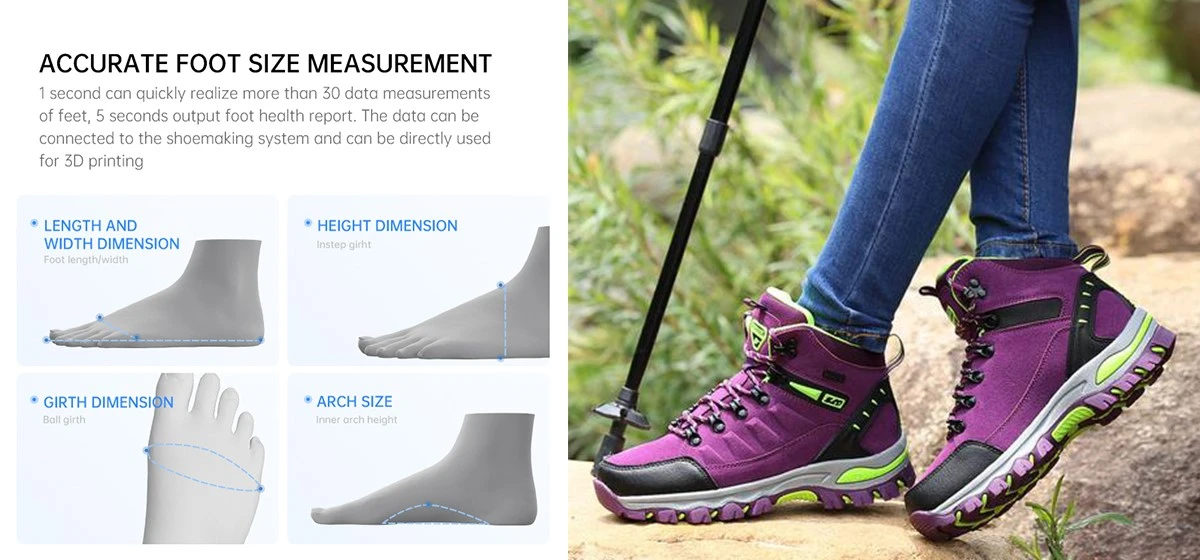
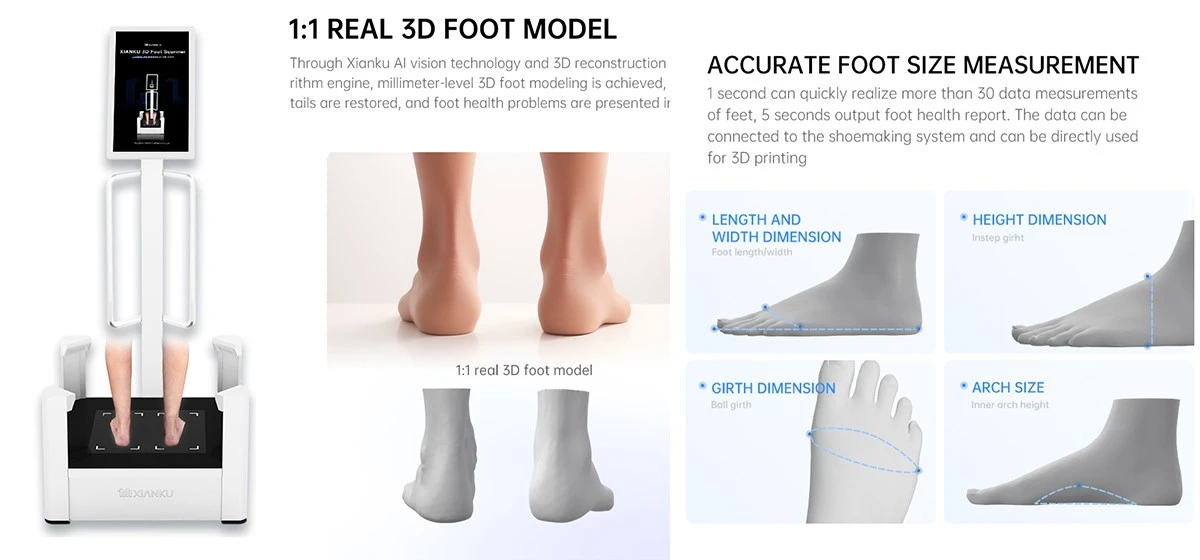
Xianku 3D Foot Scanner applies high-precision 3D scanning to measure more than 32 foot parameters, including:
- Foot length and width
- Arch height and arch type
- Instep height
- Heel width and alignment
- Forefoot morphology
The entire foot scan process takes approximately one second, generating a complete 3D foot model and a structured measurement report.
Building a Fit-Focused Sales Experience Through Foot Scan
Rather than relying on subjective fitting, Xianku enables a closed-loop sales workflow designed for hiking footwear:
Foot scan → Foot data analysis → Foot health assessment → Product recommendation → Purchase
This approach shifts decision-making from guesswork to data. Customers are guided through a visual and analytical experience that explains why a specific hiking boot fits their foot structure, not just which size they wear.
Visual Interaction and Customer Understanding
The 3D foot model, displayed alongside measurement data and structural indicators, allows customers to see their own foot characteristics clearly. This visual interaction significantly improves trust and purchase confidence-especially for high-value hiking footwear.
Personalized Hiking Shoe Selection Powered by AI
Based on foot scan results, Xianku's AI recommendation system allows brands and retailers to define custom logic for hiking footwear selection, including:
- Toe box compatibility by forefoot width
- Boot volume matching by instep height
- Arch-support compatibility for flat or high-arched feet
- Heel stability matching based on heel alignment
Only hiking shoes that meet predefined compatibility thresholds are recommended. This ensures personalization at scale while maintaining consistency across locations.
Health-Oriented Fit: A Competitive Advantage in Hiking Footwear
Beyond comfort, foot scan technology introduces a health dimension to hiking shoe selection. The scanner identifies common foot conditions such as flat feet, high arches, heel misalignment, and hallux valgus, enabling more responsible product recommendations.
This health-aware approach helps customers understand that fit affects endurance, injury risk, and long-term joint health-elevating hiking footwear from a product purchase to a performance and wellness decision.
Datafication: Reducing Inventory Risk and Improving R&D
Aggregated foot scan data becomes a strategic asset:
| Application Area | Impact |
|---|---|
| Size curve optimization | Reduced overstock and size gaps |
| Last development | Improved anatomical accuracy |
| Product planning | Better alignment with real foot populations |
| Online sales | Lower return rates through data-based size guidance |
For hiking footwear brands, this data-driven approach supports sustainable growth and smarter inventory planning.
Brands Leading the Way in Fit-Focused Hiking Footwear
Several global hiking footwear brands have long emphasized fit precision and anatomical compatibility, including Salomon, Lowa, and Scarpa. These brands are recognized for multiple width options, refined lasts, and terrain-specific designs. Foot scan technology provides the data infrastructure to extend this philosophy further-making precise fit scalable and measurable.
Conclusion: Foot Scan as the New Standard for Hiking Footwear
As the hiking footwear market becomes more competitive, fit accuracy is emerging as a decisive differentiator. Foot scan technology transforms how hiking shoes are selected, sold, and developed-replacing subjective judgment with data-driven precision.
For brands and retailers, Xianku 3D Foot Scanner offers a pathway to stronger differentiation, healthier customers, optimized inventory, and lower return rates. For consumers, it delivers confidence that their hiking footwear truly fits their feet-and the terrain ahead.
In a market where performance begins at the foot, foot scan is no longer optional. It is becoming the foundation of next-generation hiking footwear.